

Agricultural Inventory
Chapter Overview
When flooding occurs in agricultural areas, damage to existing crops and interruptions to the planting, growing, and harvesting of crops result in economic impacts. LifeSim can be used to compute the economic impacts of flooding these types of areas. The computational procedure and input sources for calculating agricultural damages have been defined in the HEC-FIA Technical Reference Manual (USACE, 2026) [?]. Computations of agricultural flood damage require a number of different inputs.
Specifically, five inputs are required:
- Hydraulic data: if summary grids are used, then a duration grid and agricultural arrival grid are required.
- National Agricultural Statistics Service Data
- Crop Budgets
- Crop Values
- Crop Loss Relationships
The hydraulic data required to compute agricultural flood damages was discussed previously. The remaining four required inputs are described in the sections below.
National Agricultural Statistics Service Data
The National Agricultural Statistics Service (NASS) Cropland Data Layer is a product that represents the type of crop and the geographic location of crops throughout the entire United States. NASS provides the Cropland Data Layer in GeoTiff format, where each cell represents a crop type. LifeSim can import this data directly from the NASS API to streamline the collection of the type and distribution of crops in the study area. The Import Agriculture Data From NASS option is shown in Figure.
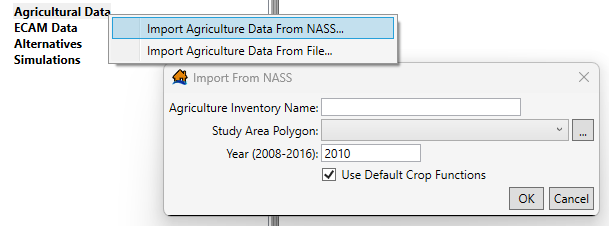
Alternatively, to Import Agriculture Data From File, the user can go to the NASS CroplandCROS website to download, research, and pre-process NASS Cropland Data.
LifeSim allows the user to import an existing crop data GeoTiff file into LifeSim. The distribution of each agricultural category in the study area is used in combination with the planting, harvesting, and crop loss relationship inputs (described below) in the calculation of agricultural flood damages.
Crop Budget Data
Costs required to produce crops are necessary for the economic loss computations for agricultural areas. The Crop Editor in LifeSim is used to define the cost of planting each crop type. Monthly crop planting costs in LifeSim can be either fixed or variable. The crop planting cost input data required for the economic loss computations is available from local Cooperative Extension System Offices, which can be found on the U.S. Department of Agriculture's website.
The final components of the crop planting data required are the dates of the first possible and last possible plantings. This data is used to create a function that represents the total value of the inputs in the field at any point in the year, which is converted to a percentage of the maximum total value of the inputs in the field to calculate the percentage damageable at any point in the year.
The maximum total value input into the field is not necessarily equivalent to the value achieved at market for the crops pulled from the field for two reasons. First, the harvest cost and shipping costs need to be added to all of the inputs to get the full cost to produce the crops. Second, the value of the crop may be less than the cost to produce it. LifeSim uses a proration of the total value input less the harvest costs as a proxy for an exposed value.
Crop Value Data
Crop characteristics are necessary for LifeSim to compute the appropriate reduction in crop value due to the costs associated with harvesting. The required input characteristics are harvest date, harvest cost, yield, unit price, and percentage of total crop value lost due to late planting. The values for each of these parameters are defined in the Crop Editor.
Crop Loss Relationships
Crop loss relationships are required for LifeSim to calculate the agricultural flood damages. Crop loss relationships in LifeSim define the percentage of crop loss based on the number of days (i.e., duration) crops are inundated each month.
Computational Procedure
This section details the computational procedures used by LifeSim to calculate agriculture flood damages at a single crop cell. The procedures assume inundation durations throughout the project area are known and have already been input to the model. Additionally, the procedures assume that crops are planted at the first available date after flooding and that crops will be planted immediately before an event (meaning that weather forecasting is not considered). The computational procedures are detailed below.
- Determine what type of crop the cell represents.
- Determine the arrival of flooding for the crop cell.
- Determine the duration of flooding for the crop cell.
- Based on the arrival time and duration, determine if planting dates are impacted or if the crop is damaged before harvest.
- If damaged during the growing season, determine if the duration is longer than the longest duration damage curve; if so, the farmer lost all value placed in the field so far. The loss is equivalent to the marketable value minus harvest costs, prorated by total value input to the field.
- If flooding limited the ability to plant and the farmer was unable to plant the preferred crop, use the secondary crop, and the loss will be the total marketable value for the secondary crop less harvest costs minus the total marketable value for the primary crop less harvest costs.
- If the flooding made the farmer plant later than the first day of the season for the primary crop but the farmer was able to plant the primary crop, the damages are based on a reduction in full yield due to late planting. This is equivalent to total marketable value less harvest cost times 1% loss due to late planting.
- Calculate the loss for each crop cell in the inundated area using the process described above and output the crop type, location, duration, and total damage for each crop cell damaged.