

Indirect Damages with ECAM
Chapter Overview
The computational procedure and input sources for calculating indirect damages have been defined in the HEC-FIA Technical Reference Manual (USACE, 2026) [?]. The Economic Consequences Assessment Model (ECAM) is a computable general equilibrium model with separate datasets for each county in the United States and is used to compute indirect economic impacts. The model computes each county’s ability to respond to external economic shocks. ECAM requires:
- Total capital (a summation of the structure and content values for all commercial, public, and industrial structure types)
- Total labor (a summation of the daytime populations for all commercial, public, and industrial structure types)
Capital losses resulting from a flood event make it more difficult (but not impossible) to produce business output. Labor losses occur when people are displaced from the impact area, preventing them from reporting to their jobs as they would under typical circumstances. Like capital losses, labor losses reduce the quantity and efficiency of production. Total capital and labor values can be either manually entered or imported.
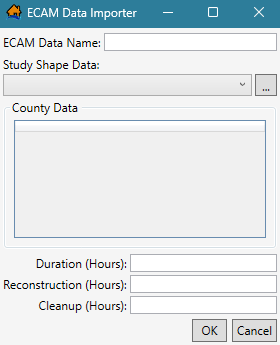
ECAM also requires users to enter the flood duration, the reconstruction period duration, and the cleanup period duration. The flood duration depends on how quickly the flood waters recede. This data can usually be obtained from a hydraulic model. Currently, the user must provide a single value for the entire flooded area, so thought and judgment must be given to the definition of this duration time. The reconstruction and cleanup period durations largely depend on the types of structures located in the flooded area. This information is entered into LifeSim in the ECAM Data Importer, as shown in Figure.
Computational Procedure
This section details how the capital and labor losses are calculated using the ECAM component within LifeSim. Within the calculations, the direct damages and life loss – computed as discussed in Computational Procedure – are utilized to evaluate the losses of capital and labor as a ratio of the overall available capital and labor by sector. After labor losses and capital losses are calculated, they are submitted to the ECAM module as inputs. ECAM then computes indirect losses. Specific details on calculating capital and labor losses can be found in Indirect Economic Damage.
To convert the capital loss ratio (CLr) and labor loss ratio (LLr) into a reduction in economic output, the ECAM system model requires information about the specific nature of the economy being analyzed. The ECAM system model determines whether the economy in question is capital or labor intensive, and what the rate of exchange is between labor and capital. Each county has a unique dataset that is used to define the specific economic characteristics assessed in the ECAM system model.
Statistics for production, employment, income, and all other economic indicators are based upon the IMPLAN (IMpact analysis for PLANning) dataset, unless otherwise indicated. Each of these datasets can distinguish up to 440 separate production activities, ten household types, and four levels of government. The dataset used for evaluating indirect economics with ECAM and LifeSim has been aggregated from the full 440 sectors to 30 sectors. Additional information on the IMPLAN dataset is available from IMPLAN Group, LLC. Additional information on the ECAM system model can be found in Lehman et al. (2013) [?].