Blanket Theory Transformation
The top stratum is usually composed of several layers of different soils instead of one uniform material. This worksheet transforms the thickness and vertical permeabilities of these layers into a blanket of uniform thickness and vertical permeability to use in the BT solutions. This worksheet is not used in any of the calculations. It may be used to inform selecting distributions for the transformed thickness and vertical permeability of the riverside and landside blankets (top strata) and effective thickness of the landside blanket (top stratum) on other calculation worksheets.
The concept of a transformed thickness of the top stratum is applicable only to semi-pervious top stratum cases and not for impervious top stratum cases. Cases 5, 6, 7, and 8 are for semi-pervious top stratum conditions. Case 5 considers the presence of a semi-pervious top stratum on only the riverside; Case 6 considers the presence of a semi-pervious top stratum on only the landside; Case 7 considers a semi-pervious top stratum on both the riverside and landside; and Case 8 is the same as in Case 7, except a partially penetrating seepage barrier is present at the levee centerline. The semi-pervious riverside blanket thickness and vertical permeability must be transformed for Cases 5, 7, and 8 (Option 1), and the semi-pervious landside blanket thickness and vertical permeability must be transformed for Cases 6, 7, and 8 (Option 2). Use the drop-down list to select the case. Cells that do not apply have a gray background.
Transformed Blanket Thickness for Length to Effective Seepage Exit
If the vertical permeability of each soil layer (kvi) is known, the top stratum can be transformed into a blanket characterized by an overall thickness and vertical permeability. The transformation procedure in EM 1110-2-1913 (2000) [?] consists of assuming a uniform vertical permeability for the generalized top stratum equal to the vertical permeability of the most impervious soil layer (kv,b) and using a transformation factor (Ft) to determine the corresponding thickness for the entire stratum (zb). This generalized top stratum is used in the seepage analysis to compute of the length to the effective seepage exit. This transformation procedure can be applied to the riverside and/or landside blankets, depending on the case. The thickness transformation factor is calculated in Equation as the ratio of the vertical permeability of the blanket, after it was transformed (kv,b) to the vertical permeability of the material being transformed (kvi).
where:
kv,b = minimum vertical permeability of the soil layers comprising the top stratum
kvi = vertical permeability of soil layer i
If the in situ thickness of each soil layer (zi) is known, the corresponding transformed thickness (zbi) of each soil layer can be expressed using Equation.
where:
zi = in situ thickness of soil layer i
The total transformed thickness of the blanket (zb) is calculated using Equation as the sum of the transformed thicknesses.
where:
n = total number of soil layers comprising the blanket (top stratum)
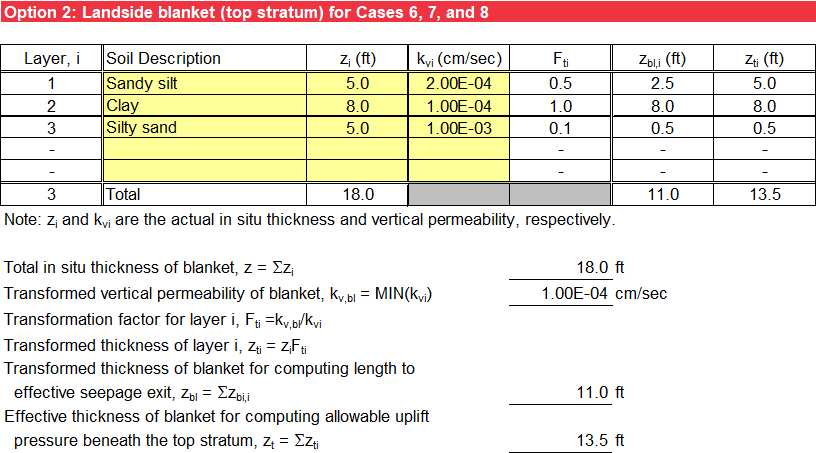
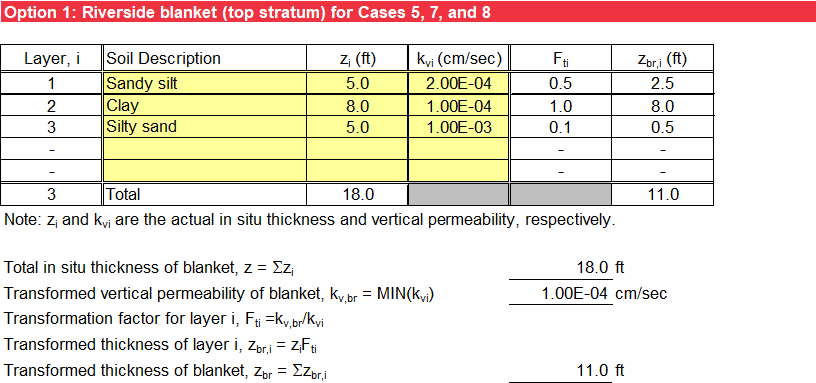
Figure illustrates the calculations for transformed riverside blanket (top stratum) thickness for length to effective seepage exit. The process is the same for the landside blanket (top stratum) as shown in Figure.
Transformed Blanket Thickness for Allowable Uplift Pressure
The transformed thickness of the landside blanket (top stratum) used to compute the length to the effective seepage exit (zbl) may or may not be the same as the effective thickness of the landside top stratum (zt) used to compute the allowable uplift pressure beneath the top stratum. The effective thickness of the landside blanket (top stratum) used to compute the allowable uplift pressure beneath the top stratum (zt) equals the in situ thicknesses of all strata above the base of the least pervious stratum plus the transformed thicknesses of the underlying more pervious top strata (as described in the previous section). Therefore, zb equals zt only when the least pervious stratum is at the ground surface. Figure illustrates the additional calculation for transformed thickness of the landside blanket (top stratum) used to compute the length to the effective seepage exit.