

Background
Backward erosion piping (BEP) is the detachment of soil particles that occurs at a free, unfiltered surface in which the process gradually works its way toward the upstream or riverside of the embankment or its foundation until a continuous pipe is formed. Erosion initiates at the landside of a levee or the downstream side of a dam through unfiltered seepage exits that may exist due to penetrations or weaknesses in the overlying blanket, such as ditches, animal burrows (such as rodent or crawfish holes), root holes, former sand boils, cracks, or other thin or weak spots. Once erosion initiates, the pipe may progress horizontally through the foundation toward the impounded water if hydraulic gradients in the foundation are sufficiently high. The hydraulic gradients and flow must remain high near the upstream or riverside tip of the progressing pipe for particles to continue eroding. (Note: Floodside, waterside, and riverside are used interchangeably for levees.)
Initiation of BEP involves heave or blowout of the foundation materials at the landside toe of a levee or the downstream toe of a dam. Fluidization or liquefaction occurs near the seepage exit (that is, a zero effective stress condition) in which the sand expands and turns into a fluid state. Underseepage analysis methods are used to inform the likelihood of heave/blowout and include Blanket Theory (BT) and finite-element seepage analysis.
This toolbox deterministically and probabilistically assesses the likelihood of initiation of BEP (heave/blowout) using BT and the first-order, second-moment (FOSM) method of reliability analysis. Factors leading to initiation of BEP may not be addressed by traditional seepage analysis. This is particularly true when dealing with the movement of fine-grained material through the embankment or foundation of a dam or levee. This toolbox also assesses the quantity of flow or seepage using BT. These quantities from BT or finite-element analysis can be used to inform judgment for other nodes in the BEP event tree, such as whether the flow in a pipe is sufficiently high to keep the pipe open for progression, the ability to flood-fight for unsuccessful intervention, and the likelihood of breach.
Blanket Theory
Engineer Manual (EM) 1110-2-1913 (USACE 2000) [?] provides closed-form BT solutions for seepage pressures and flows beneath levees. The solutions were developed for the geology along the Mississippi River, where a pervious stratum is overlaid by a less pervious top stratum or blanket. If the top stratum is composed of different soil layers of less pervious materials, the thickness and vertical permeabilities of these layers must be transformed into a uniform thickness and vertical permeability.
These solutions were originally developed in Technical Manual (TM) 3-424 (USACE 1956) [?] and have been used by USACE since then in various forms. The solutions use a compilation of existing theories and methods, such as the method of fragments (Forchheimer 1917 [?], Muskat 1937 [?], Pavlovsky 1956 [?], and Harr 1962 [?]), investigation of Mississippi River levee underseepage (Turnbull and Mansur 1959 [?]), and the effects of semi-pervious blankets (Bennett 1946 [?] and Barron 1948 [?]). Engineer Research and Development Center (ERDC)/Geotechnical Structures Laboratory (GSL) Technical Report (TR)-18-24 (Brandon et al. 2018 [?]) highlighted errors in the BT equations in EM 1110-2-1913 (USACE 2000) [?].
The fundamental assumption of this method is that equipotential lines at various critical parts of the flow region can be approximated by vertical lines that divide the region into sections or fragments. Equipotential lines produced from a finite-element analysis (FEA) are nearly vertical when the base width of the impervious levee (L2) is greater than the thickness of the pervious substratum (d). Figure illustrates the method of fragments, and BT solutions are limited to the case where L2/d = 1 (Batool 2013) [?]. BT includes closed-form solutions for various blanket conditions to determine an equivalent upstream entrance distance (x1) and/or equivalent downstream exit distance (x3). Where the blanket is impervious, these distances are equal to the length of the blanket (_x1 _= L1 and/or x3 = L3, discussed in the following cases). Where there is no blanket, as in Figure, x1 and/or x3 for a homogeneous, isotropic pervious foundation is equal to 0.43d from the method of fragments.
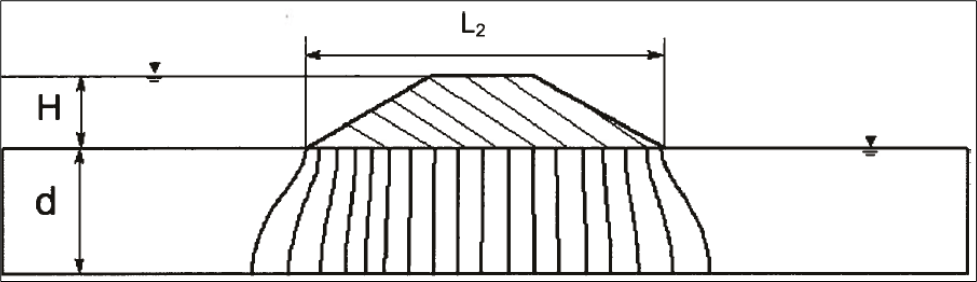
EM 1110-2-1913 (USACE 2000) [?] includes seven standard BT cases. Case 1 is for no top stratum. Cases 2, 3, and 4 are for impervious top stratum conditions. Case 2 considers an impervious top stratum on both the riverside and landside of the levee; Case 3 considers an impervious top stratum on only the riverside; and Case 4 considers an impervious top stratum on only the landside. Cases 5, 6, and 7 are for semi-pervious top stratum conditions. Case 5 considers the presence of a semi-pervious top stratum on only the riverside; Case 6 considers the presence of a semi-pervious top stratum on only the landside; and Case 7 considers a semi-pervious top stratum on both the riverside and landside. Case 8 was reintroduced by ERDC/GSL TR-18-24 (Brandon et al. 2018 [?]), which adds a partially penetrating seepage barrier to Case 7. ERDC/GSL TR-18-24 (Brandon et al. 2018 [?]) provides derivations of the BT equations. Some key findings about the applicability of the BT solutions follow:
-
The width of the impermeable boundary, which depends on the BT case and boundary condition, must be greater than or equal to the depth or thickness of the pervious substratum to ensure horizontal flow in the confined aquifer.
-
The ratio of horizontal permeability of the pervious substratum to the vertical permeability of the blanket must be greater than or equal to 10 to maintain confined horizontal flow in the pervious substratum and vertical seepage or leakage through the blanket.
-
The transition between semi-pervious and impervious blanket behavior occurs at a ratio of horizontal permeability of the pervious stratum to vertical permeability of the blanket between 1,000 and 4,000. At permeability ratios in the range of these values, the semi-pervious solutions (Cases 5, 6, and 7) produce the same values of heads and flows as the impervious solutions (Cases 3, 4, and 2, respectively), and the results of BT agree closely with FEA.
-
The transformation from a fully pervious to a semi-pervious blanket occurs at a ratio of horizontal permeability of the pervious stratum to vertical permeability of the blanket of about 2. In other words, using the semi-pervious equations produces a more accurate determination of the flow and the excess hydraulic head for permeability ratios equal to or greater than 2 as compared to solutions considering the blanket as fully pervious (nonexistent). For permeability ratios less than 2, the presence of the blanket may be ignored, and the solutions for cases having no blanket provide more accurate results than the solutions for the semi-pervious cases.
To simplify the calculations, the semi-pervious top stratum is replaced by an equivalent impervious top stratum, such that the seepage beneath the levee is the same. For Cases 5, 7, and 8, this is accomplished by calculating an equivalent length (x1) of an impervious top stratum for a semi-pervious stratum of length (L1) on the riverside. For Cases 6, 7, and 8, this is accomplished by calculating an equivalent length (x3) of an impervious top stratum for a semi-pervious stratum of length (L3) on the landside. The semi-pervious stratum lengths are included with L2 for the appropriate cases when evaluating the fundamental assumption of this method (Batool et al. 2015 [?]). ERDC/GSL TR-18-24 (Brandon et al. 2018 [?]) provides additional details.
For Cases 1 through 7, there are three zones for the pervious substratum corresponding to the riverside of the riverside levee toe, base width of the levee, and landside of the landside levee toe. Due to the presence of the partially penetrating seepage barrier, Case 8 subdivides the middle zone (base width of the levee) into two zones: riverside and landside of the seepage barrier. Figure illustrates these zones and the parameters used in BT for Case 8.
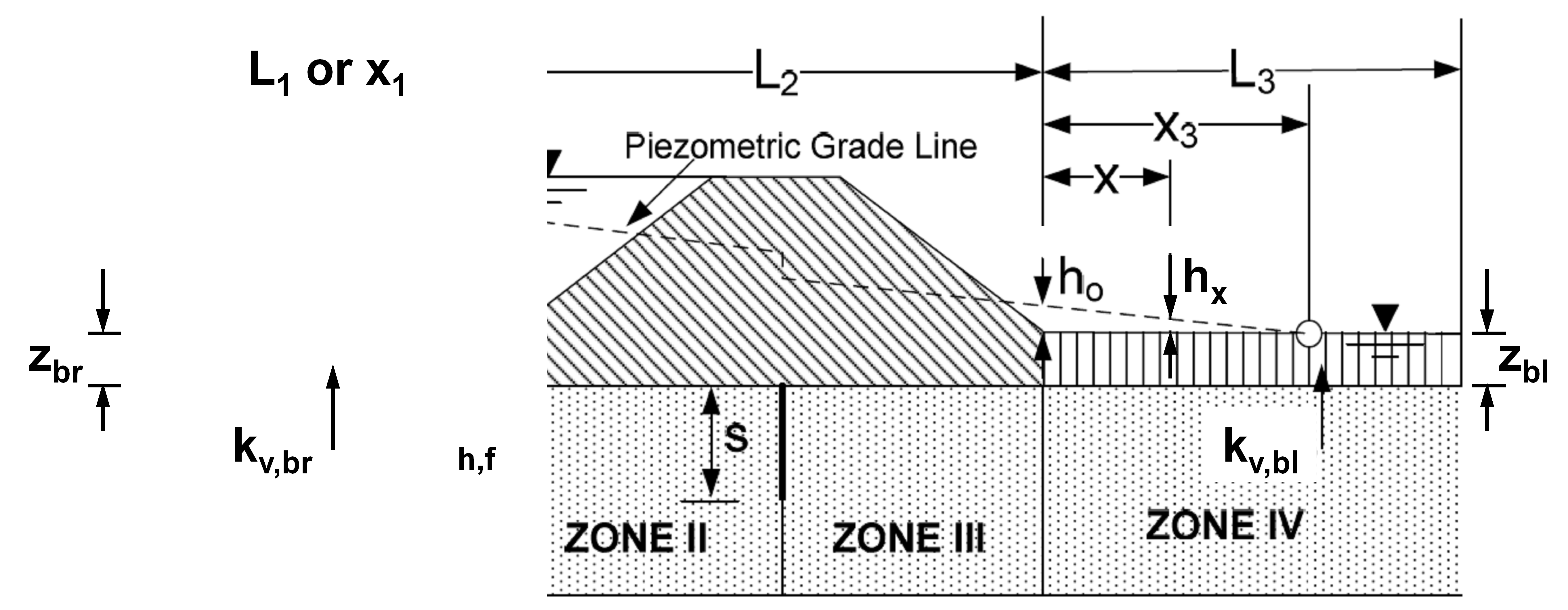
Since the flow in the pervious substratum is assumed to be horizontal, the hydraulic head loss is linear with horizontal distance, and the excess hydraulic head at the landside levee toe (ho) and at a distance x from the landside levee toe (hx) are obtained by solving similar triangles. The distances used on the riverside (L1 or x1) and landside (L3 or x3) of the levee depend on the BT case and boundary condition and are discussed for each relevant case in subsequent chapters of this document.
Mississippi Valley Division Design Guidance
The USACE Mississippi Valley Division (MVD) developed design guidance for levee underseepage protection for the Mississippi River and major tributary levees. Table, Table, and Table, from Change 2 of MVD’s Division Regulation (DIVR) 1110-1-400 (USACE 1998) [?], are guides for assessing the riverside and landside blanket vertical permeabilities if site-specific permeability data is not available. However, these are suggested design values developed for the Mississippi River alluvial valley. Use care when applying design values to risk assessments or in different geologic conditions.
In these tables, the landside blanket vertical permeabilities are less than the riverside blanket vertical permeabilities for the same soil type primarily due to cracking in the riverside blanket being repeatedly filled with silt from flood inundation and, to a lesser extent, the impounded water pressure on the riverside and cracking in the landside blanket due to seepage uplift.
| Soil Type | Riverside Blanket Thickness, (feet) | Vertical Permeability of Riverside Blanket, (centimeters/second) |
|---|---|---|
| Silty sand | <5 | 7.0E-04 |
| 5 to 10 | 2.5E-04 | |
| Silt and sandy silt | <5 | 2.0E-04 |
| 5 to 10 | 1.5E-04 | |
| >10 | 1.0E-04 | |
| Clay and silty clay | <5 | 0.8E-04 |
| 5 to 10 | 0.5E-04 | |
| 10 to 15 | 0.2E-04 | |
| >15 | 0.05E-04 |
| Soil Type | Landside Blanket Thickness, (feet) | Vertical Permeability of Landside Blanket, (centimeters/second) | Permeability Ratio, |
|---|---|---|---|
| Silty sand | <5 | 10.0E-0 | 125 |
| 5 to 10 | 8.0E-04 | 150 | |
| >10 | 6.0E-04 | 200 | |
| Silt and sandy silt | <5 | 5.0E-04 | 250 |
| 5 to 10 | 4.0E-04 | 300 | |
| 10 to 15 | 3.0E-04 | 400 | |
| >15 | 2.0E-04 | 600 | |
| Clay and silty clay | <5 | 4.0E-04 | 250 |
| 5 to 10 | 3.0E-04 | 400 | |
| 10 to 15 | 1.5E-04 | 800 | |
| 15 to 20 | 0.5E-04 | 2,500 | |
| >20 | 0.08E-04 | 15,000 |
| Landside Blanket Thickness, (feet) | Vertical Permeability of Clay Landside Blanket, (centimeter/second) | Vertical Permeability of Silt Landside Blanket, (centimeter/second) | Vertical Permeability of Silty Sand Landside Blanket, (centimeter/second) |
|---|---|---|---|
| 1 | 4.56E-04 | 5.70E-04 | 10.50E-04 |
| 2 | 4.30E-04 | 5.40E-04 | 10.10E-04 |
| 3 | 4.06E-04 | 5.10E-04 | 9.80E-04 |
| 4 | 3.80E-04 | 4.80E-04 | 9.40E-04 |
| 5 | 3.57E-04 | 4.50E-04 | 9.00E-04 |
| 6 | 3.30E-04 | 4.25E-04 | 8.60E-04 |
| 7 | 3.10E-04 | 4.00E-04 | 8.30E-04 |
| 8 | 2.88E-04 | 3.80E-04 | 8.00E-04 |
| 9 | 2.66E-04 | 3.60E-04 | 7.80E-04 |
| 10 | 2.45E-04 | 3.40E-04 | 7.55E-04 |
| 11 | 2.25E-04 | 3.23E-04 | 7.30E-04 |
| 12 | 2.08E-04 | 3.10E-04 | 7.10E-04 |
| 13 | 1.89E-04 | 2.95E-04 | 6.95E-04 |
| 14 | 1.72E-04 | 2.81E-04 | 6.80E-04 |
| 15 | 1.57E-04 | 2.70E-04 | 6.60E-04 |
| 16 | 1.41E-04 | 2.60E-04 | 6.50E-04 |
| 17 | 1.28E-04 | 2.50E-04 | 6.40E-04 |
| 18 | 1.14E-04 | 2.40E-04 | 6.2E-04 |
| 19 | 1.01E-04 | 2.30E-04 | 6.10E-04 |
| 20 | 0.90E-04 | 2.22E-04 | 6.00E-04 |
| 21 | 0.78E-04 | 2.14E-04 | 5.85E-04 |
| 22 | 0.69E-04 | 2.05E-04 | 5.80E-04 |
| 23 | 0.60E-04 | 1.98E-04 | 5.65E-04 |
| 24 | 0.52E-04 | 1.90E-04 | 5.60E-04 |
| 25 | 0.45E-04 | 1.83E-04 | 5.45E-04 |
| 26 | 0.38E-04 | 1.78E-04 | 5.40E-04 |
| 27 | 0.31E-04 | 1.71E-04 | 5.30E-04 |
| 28 | 0.25E-04 | 1.66E-04 | 5.20E-04 |
| 29 | 0.20E-04 | 1.60E-04 | 5.15E-04 |
| 30 | 0.15E-04 | 1.56E-04 | 5.10E-04 |
Finite Element Analysis
FEA is commonly used to perform seepage analysis using commercial off-the-shelf software like Geostudio’s SEEP/W, provided the model and boundary conditions are properly defined. FEA estimates seepage or flows and excess hydraulic heads (and thus, factors of safety against heave/blowout) for complex foundation profiles and levee geometries.
Unlike slope stability analysis, there is currently no probabilistic analysis method for finite-element seepage analysis. Any deterministic two-dimensional (2D) analytical model can be evaluated probabilistically using first-order, second-moment method of reliability analysis as described in Engineer Technical Letter (ETL) 1110-2-561 (2006) [?]. USACE has performed probabilistic analysis using this method for many years.
The Taylor series method evaluates the coefficient of variation of the factor of safety (FS) against heave/blow out and computes the lognormal reliability index. The reliability index is directly and uniquely related to the probability of unsatisfactory performance. The probability of unsatisfactory performance merely indicates the likelihood that an adverse event or condition; in this case, a factor of safety against heave/blowout less than 1 occurs. The outcome of these reliability analyses is the probability of the factor of safety against heave/blowout being less than 1. This is undesirable, but it does not automatically result in breach of the dam or levee.