

Johnstown
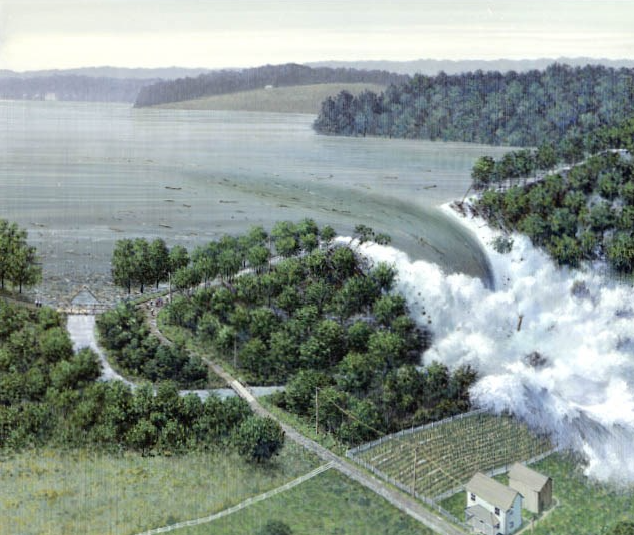
South Fork Dam in Johnstown, Pennsylvania, United States.
🡇 Download ModelOverview
South Fork Dam, 15 miles upstream of Johnstown, PA, was originally constructed in 1852 for Portage Canal water supply. The dam breached in 1862. However, the reservoir elevation was not at full capacity, and downstream damage was minimal (McCullough, 1968) [?]. By 1881, the dam had been repaired to maintain a permanent lake for recreation. The rebuilt dam did not have adequate spillway capacity.
On Friday, May 31, 1889, overnight heavy rain led to flooding that exceeded record levels by 12:00 PM. Between 2:45 PM and 3:00 PM, the dam breached due to overtopping, releasing the entire reservoir in a short amount of time (HDR, 2022) [?]. The breach inundation arrived at Johnstown about an hour later. The flooding was catastrophic, resulting in the destruction of most Johnstown structures and the loss of an estimated 2,209 lives (McCullough, 1968) [?].
Data
The following provides a short description of the data sources used for validation.
Data were collected for both hydraulic and consequence modeling efforts from many sources including books, articles, and maps archived at the Library of Congress.
Hydraulics
HDR, Inc. (HDR) was tasked with developing the 1889 South Fork Dam breach inundation model within the Hydrologic Engineering Center's River Analysis System (HEC-RAS). A 2-dimensional (2D) unsteady hydraulic model of the South Fork Dam and subsequent Viaduct Bridge breaches were developed based on the best available topography data, collected historic data, and previous studies. Breach parameters were developed based on analysis of photos, drawings, and previous studies (Kaktins et al., 2013; Coleman et al., 2016) [?] [?]. The model was used to simulate the South Fork Dam breach, the subsequent Viaduct breach, and the flood inundation along Conemaugh River from South Fork Dam to five miles downstream of Johnstown Stone Bridge. The 2D modeling results were then provided as input for consequence analysis using LifeSim.
For a detailed account of HDR’s hydraulic data collection effort, see the South Fork Dam Failure Case Study inundation modeling report (HDR, 2022) [?].
Structure Inventory
The primary source for the structure inventory was a set of Sanborn Fire Insurance Maps from 1886 [?]. The 1886 Sanborn map consists of an index page and 13 detailed grid maps. These were georeferenced in Esri ArcGIS Pro based on the street intersections. The detailed maps contain building footprints, number of stories, and construction type (brick, stone, or wood). They also contain a building use description (dwelling, tenement, or business type/name). In areas where detailed maps were not available, structure points were created based on counts from the index map and an estimated layout assuming stables are in the middle alley. An 1895 map [?] with a larger footprint was also used as a resource for areas not covered by the 1886 map, particularly for South Fork and the northwest area of Cambria. The primary source for population was an 1889 canvas for the Johnstown directory. All occupants were assumed to be under the age of 65 in the structure inventory.
The final inventory was comprised of 2,261 structures with total mean population-at-risk (PAR) in the inundation area around 10,800.
Road Network
Traffic evacuations were not simulated. Therefore, a road network was not configured.
Destinations
Traffic evacuations were not simulated. Therefore, destinations were not configured.
Emergency Planning Zones
As most of the PAR had no warning of the dam breach prior to when breach flow arrived, zero Warning Issuance Delay time and immediate First Alert diffusion were inputted for the LifeSim model’s Emergency Planning Zone.
The best estimate scenario parameters were chosen to reflect as best as possible what happened in the historical event. Since there was no specific warning that was distributed to the Johnstown area, the primary driver of life loss from a LifeSim parameter standpoint was the amount of mobilization that occurred prior to the breach flood arrival. Mobilization also has the greatest uncertainty, as sources are unspecific as to how many people evacuated due to pre-breach flooding (hundreds of families or hundreds of people). Given this uncertainty, the mobilization (Protective Action Initiation) was set to a uniform distribution between 20% and 50%.
Alternative
To understand how the LifeSim parameters influence the results, multiple sensitivity simulations were initially run. The parameters tested were the mobilization rates, the warning times, and the structure stability curves.
To facilitate reaching the mobilization caps within each iteration, warning was set at the beginning of the simulation for the area flooded prior to the breach, and the area flooded only in the event of breach had a warning set at +1 hour relative to breach, which roughly represents the initial arrival of the breach flooding at Johnstown.
The best estimate structure stability selected was the Wood Buoyant - Heavy curve, with a Triangular uncertainty distribution.
Modeling Conclusion
-
The South Fork Dam failure that caused the devastating flooding of Johnstown, PA in 1889 was the deadliest dam failure in the history of the United States. This validation study has shown that HEC-RAS and LifeSim can produce a life loss estimate very similar to what happened in 1889.
-
The structure data based on the Sanborn Fire Insurance maps and the population per structure estimates are similar resolution to what the U.S. Army Corps of Engineers (USACE) currently uses to estimate life loss consequences due to potential dam breaches.
-
Model results further validated methods used by USACE to estimate the consequences component of dam and levee safety infrastructure risk.
Model Version
The original LifeSim model was developed in 2022 using LifeSim version 2.0. The public model was updated in 2025 to LifeSim version 2.1.5 and produced negligible changes from the original documented results.