Screening
This worksheet provides general characteristics to initially screen a soil's susceptibility to internal instability based on the shape of the gradation curve.
Coarse, Broadly Graded Soils Typically of Glacial Origin
In self-filtering soils, the coarse particles prevent the internal erosion of the medium particles, and the medium particles prevent internal erosion of the fine particles. Soils which potentially do not self-filter are also susceptible to internal instability.
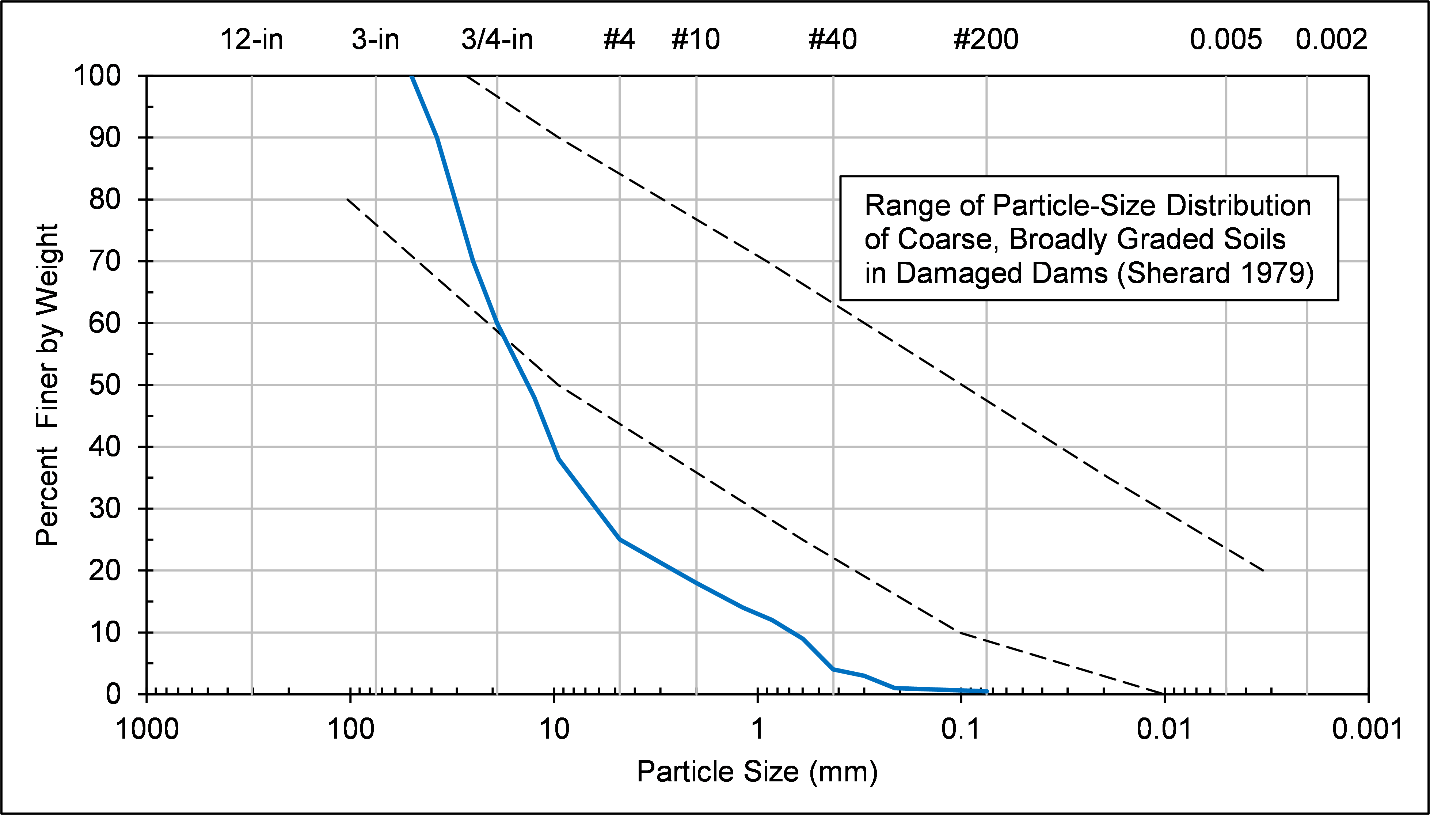
According to Sherard (1979) [?], soils are generally considered internally unstable if the coarser fraction of the material does not filter the finer fraction. Sherard obtained data from a number of embankment dams where sinkholes appeared on the crest and slopes of widely graded embankments of glacial origin and plotted a band around these gradations. The internally unstable soil gradations usually plotted as nearly straight lines or slight curves. The soils have a volume of fine particles greater than the volume of voids between the coarse sand and gravel fraction, and the coarser particles float in the finer particles.
As the example in Figure illustrates, the user-specified gradation from the Gradation worksheet is plotted against Sherard’s unstable band for screening these characteristics.
Broadly Graded Soils with a Flat Tail of Fines and Gap-Graded Soils
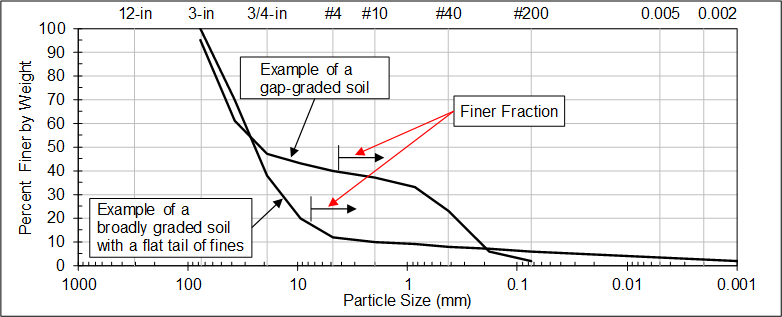
Figure illustrates the two examples from Fell et al. (2008) [?] of gradations susceptible to internal instability: a broadly graded soil with a flat tail of fines and a gap-graded soil. Broadly graded soil has a wide range of particle sizes (e.g., cobbles and gravels with sands, clays, and silts) with excessive fines that plot as a flat tail on the gradation curve. Gap-graded soil has a broad gradation in which a distinct portion (range of particle sizes) is significantly under-represented or completely absent. As illustrated, the finer fraction is the point of inflection for broadly graded soils and the fine limit of the gap for gap-graded soils.