

Background
Internal instability describes the susceptibility of a soil to seepage-induced movement and loss of fine particles in the soil matrix. Various terms have been used in technical literature and research to describe the internal erosion mechanism associated with internally unstable soils, often inconsistently.
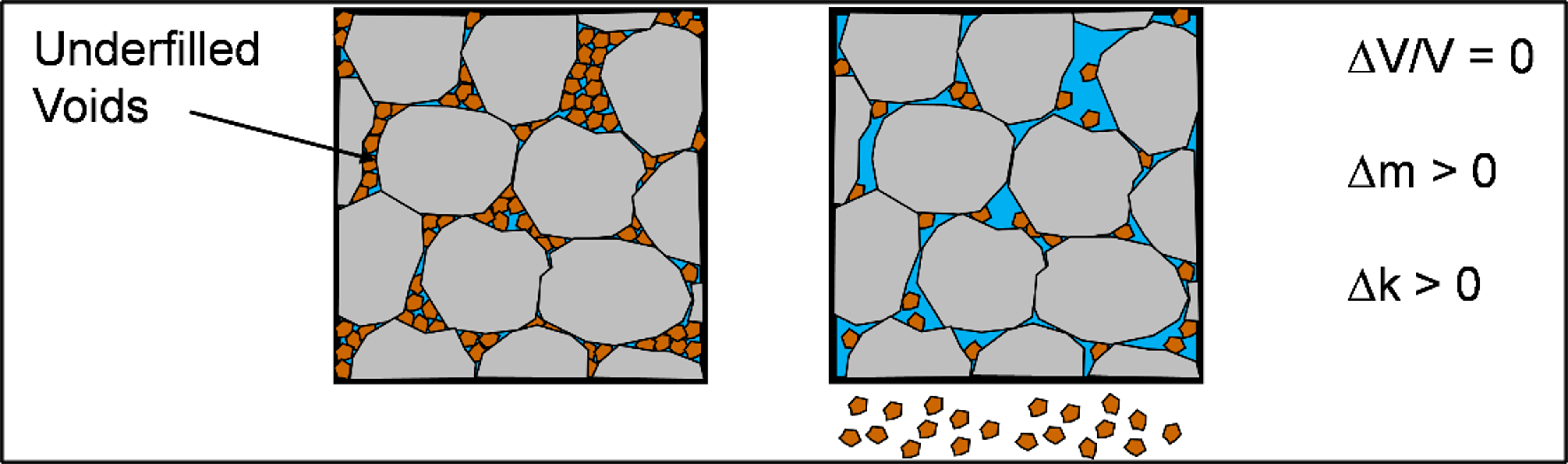
Suffusion is defined as selective erosion of finer particles from the matrix of coarser particles (that are in point-to-point contact) of an internally unstable soil such that the finer particles are removed through the voids between the coarser particles by seepage flow, leaving behind a soil skeleton formed by the coarser particles. The voids are underfilled such that the volume of finer particles fits within the voids formed by the coarser particles. Therefore, effective stresses do not load the finer particles. The seepage-induced mass loss results in little or no change in volume and an increase in hydraulic conductivity particles as illustrated in Figure Fannin and Slangen (2014) [?].
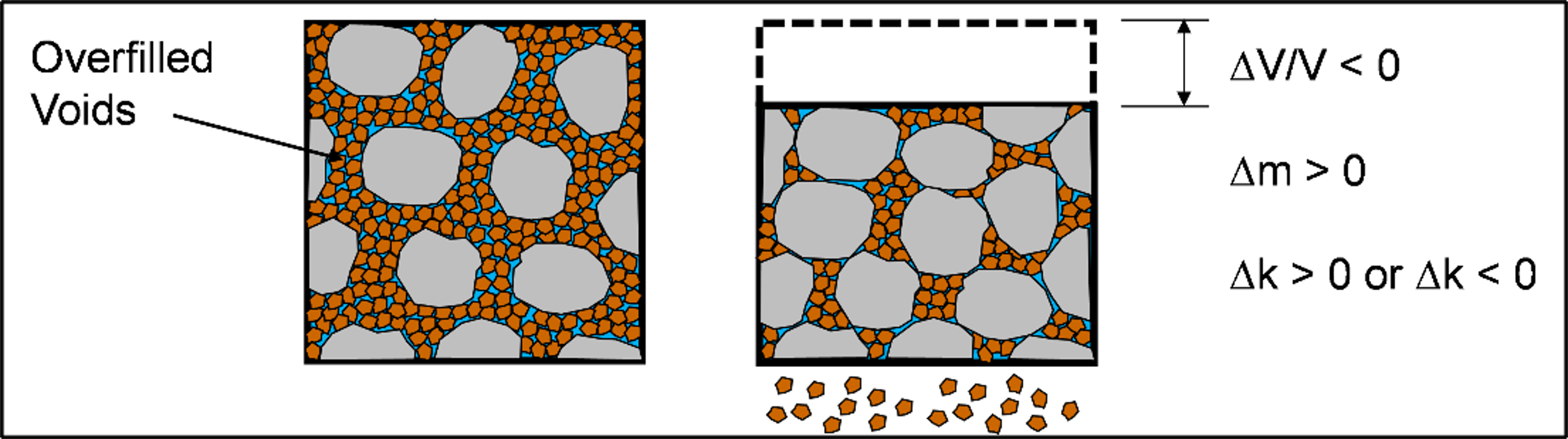
Suffosion is a similar process. However, the voids are overfilled such that the coarser particles float within the finer particles, and effective stresses load the finer particles. The seepage-induced mass loss results in a reduction in volume and a change in hydraulic conductivity particles as illustrated in Figure. Suffosion is less likely under the stress conditions and gradients typically found in embankment dams.
Both processes associated with internally unstable soils are secondary or contributing mechanisms that can lead to one of the primary mechanisms of internal erosion.
Several methods have been proposed to assess susceptibility to internal instability based on particle-size analysis. This toolbox assesses the geometric condition for initiation (susceptibility to internal instability) for the following methods:
-
Burenkova (1993) method [?]
-
Modified Burenkova method of Wan and Fell (2004) [?]
-
Alternative method of Wan and Fell (2008) [?]
-
Modified Kenney and Lau method of Li and Fannin (2008) [?]
-
It also includes the suggested method for mechanism and amount of erosion of Douglas et al. (2019) [?]
Correctly applying these methods requires understanding the context from which each method was developed as described in the following sections. These methods, along with sensitivity analysis, can be used as the first step to estimate the susceptibility to internal instability. If, by using such methods, the soil is clearly not susceptible to internal instability and erosion of fine particles, it is unlikely that further effort is necessary. However, if such methods lead to uncertainty, laboratory tests should be conducted on actual soil gradations that carefully simulate the field conditions.