Mechanism and Amount of Erosion
Douglas et al. (2019) [?] developed a suggested method for the mechanism and amount of internal erosion for non-plastic silt-sand-gravel soils within the envelope of the gradation of the broadly graded soils tested and with similar shaped gradations. Douglas [?] uses the terminology of International Commission on Large Dams (ICOLD) Bulletin 164 (2017) [?] for suffusion and global backward erosion (GBE).
Suffusion is as defined in the Background section. GBE is defined as seepage-induced, gravity-assisted particle detachment at unfiltered filtered exits. The voids between the coarser particles are overfilled such that the coarser particles float within the finer particles. The seepage-induced mass loss does not reduce volume or change hydraulic conductivity. Some organizations outside of the U.S. use GBE (United States Society on Dams (2021) [?]), but USACE considers this internal migration (stoping). Voids develop at the interface with the unfiltered exit that grow (or stope) upward and backward sub-vertically as erosion continues and the temporary roof progressively collapses. Stoping can occur in narrow central core dams constructed with broadly graded cohesionless soils (glacial till) susceptible to internal instability at unfiltered exits. It also occurs at interfaces with open defects in the foundation (e.g., karst bedrock or open-work gravel) or structures embedded in the embankment.
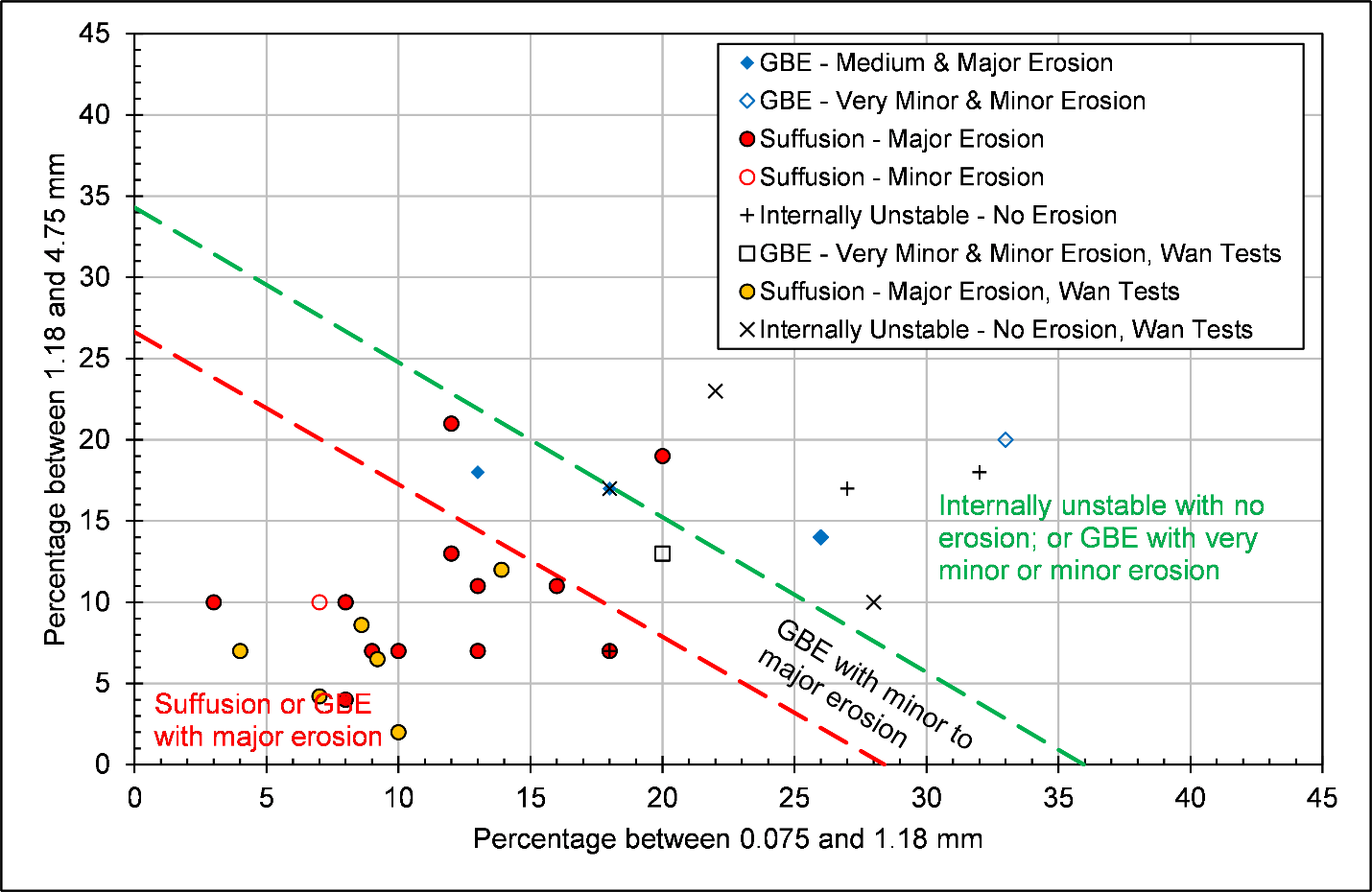
The methodology is based on the ability of the soil to self-filter such that the coarse particles prevent erosion of the medium particles and the medium particles prevent erosion of the fine particles. As shown in Table, Douglas et al. (2019) [?] indicated that most of the eroded soil in laboratory tests using a continuing erosion condition was finer than 1.18 millimeter (mm), and the particles between 1.18 and 4.75 mm appeared to self-filter the finer particles. The self-filtering was characterized based on the percentage of the soil between 1.18 and 4.75 mm and the percentage between 0.075 and 1.18 mm. Therefore, the suggested method is based on a gradation split on the No. 16 sieve (1.18 mm).
| Erosion Class | Erosion Amount |
|---|---|
| No erosion | No erosion or only a few grams falling from the mesh when first wetted |
| Very minor erosion | ≤0.2% of total sample dry weight |
| Minor erosion | >0.2% and <1% of total sample dry weight |
| Medium erosion | 1% to 5% of total sample dry weight |
| Major erosion | >5% of total sample dry weight; or 1% to 5% of total sample dry weight but ≥10% of the dry weight of the finer fraction |
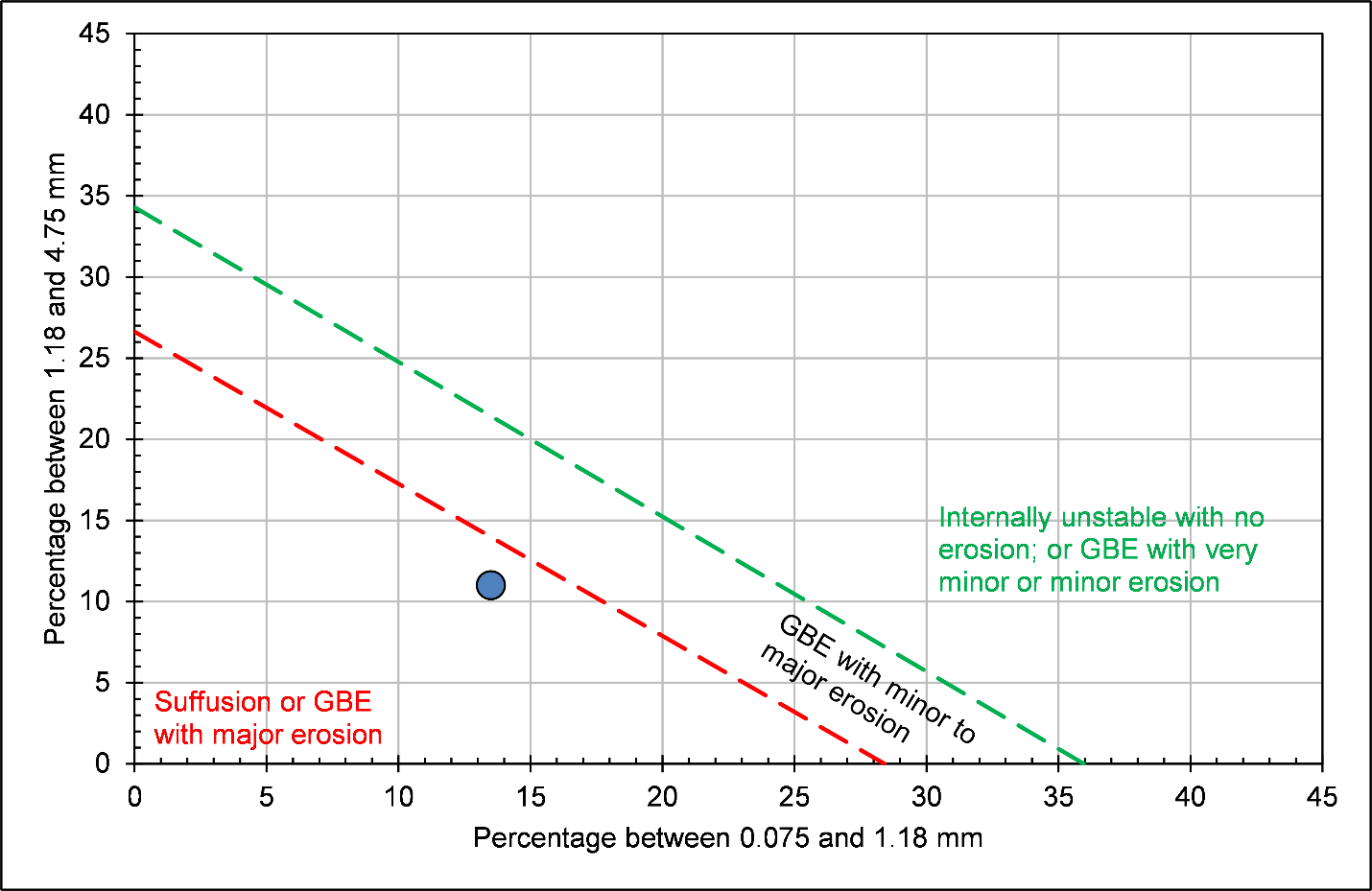
Figure shows the test data along with the approximate boundaries separating the data into three categories:
-
Internally unstable but self-filtering soils with no erosion or GBE with very minor or minor erosion
-
GBE with minor to major erosion
-
Suffusion or GBE with major erosion.
Applicability
This worksheet classifies the mechanism and amount of internal erosion of broadly graded soils using the suggested method of Douglas [?]. The method applies to non-plastic silt-sand-gravel soils within the envelope of the gradation of the broadly graded soils tested and with similar shaped gradations. The method does not apply to gap-graded soils.
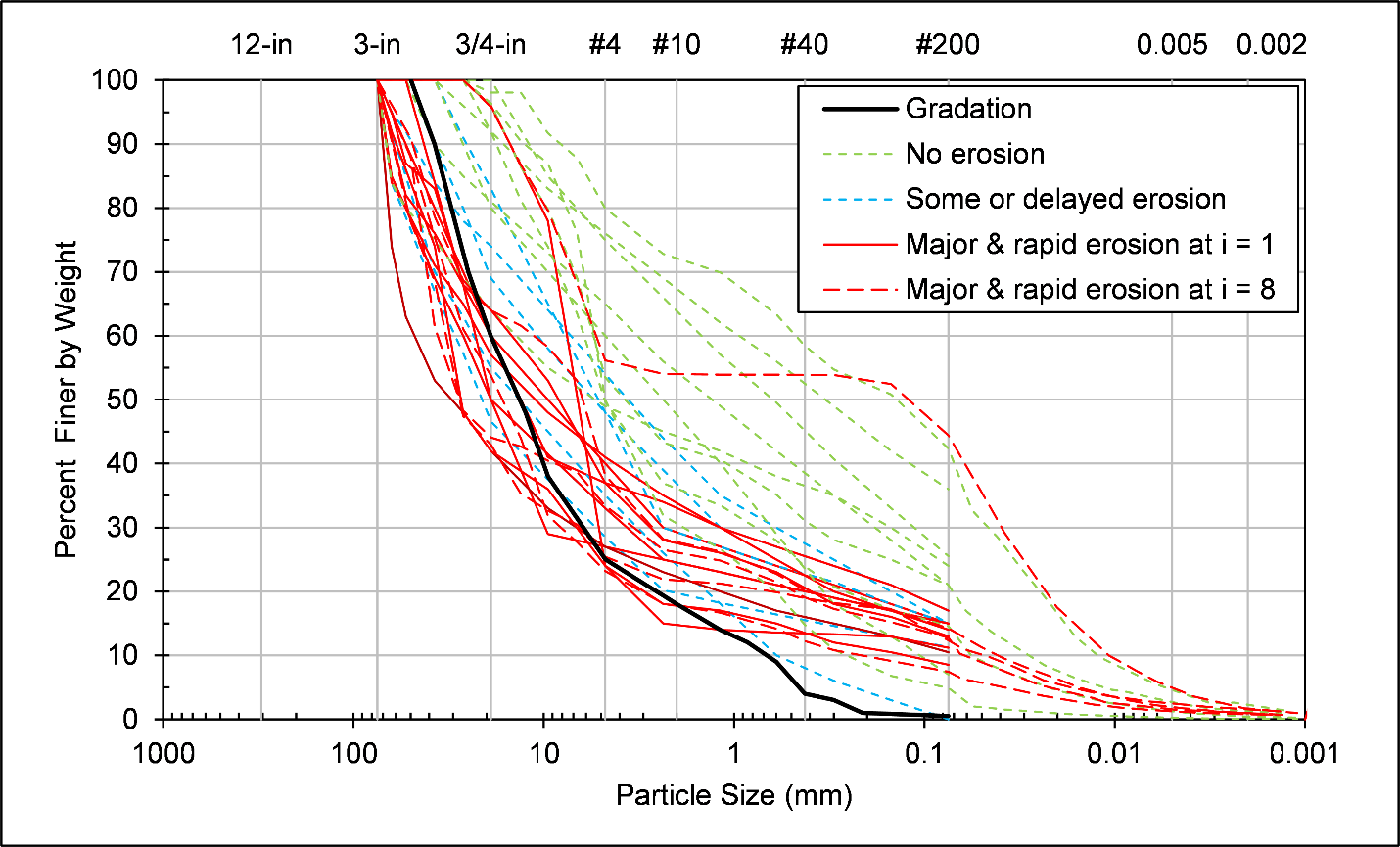
In step 1, the user-specified gradation from the Gradation worksheet is plotted as a black line against the gradations of samples exhibiting major and rapid erosion at an average hydraulic gradient of 1 from Douglas et al. (2019) [?] tests (solid red line) and at an average hydraulic gradient of 8 from Wan and Fell (2004) [?] tests (dashed red line), along with the gradations of samples with some or delayed erosion (dashed light blue line) and no or very minor erosion (dashed light green line) from Douglas et al. (2019) [?] tests. This informs whether the user-specified gradation is within the envelope of the gradation of the soils tested and has a similar gradation shape.
Methodology
In step 2, based on the particle-size analysis on the Gradation worksheet, the percentage of the soil between 1.18 and 4.75 mm (passing the No. 4 sieve and retained on the No. 16 sieve) and the percentage between 0.075 and 1.18 mm (passing the No. 16 sieve and retained on the No. 200 sieve) are calculated. If these particle sizes are not available for the specified gradation, these calculations cannot be performed.
The approximate boundary for no erosion of internally unstable but self-filtering soils with no erosion, or GBE with very minor or minor erosion, is plotted as a green dashed line, and the approximate boundary for suffusion or GBE with major erosion is plotted as a red dashed line, as illustrated in Figure. Between these two boundaries is a zone where GBE with minor to major erosion occurs. The mechanisms of internal erosion and erosion class (amount of internal erosion) are provided below the plot.