

Plastic Pipe
Plastic pipes through or beneath a levee embankment or floodwall usually consist of a thermoplastic material. The most commonly used thermoplastic pipes are high-density polyethylene (HDPE), polypropylene (PP), and polyvinyl chloride (PVC). Other plastic pipe materials may exist, but for the purposes of this toolbox, they are all considered generically as plastic pipe.
Pipe Condition
Plastic pipe has performed well in many environments that are corrosive to metal and concrete pipes. Plastic pipes are also more abrasion resistant compared to metal pipes (Potter 1988) [?]. The exception to this is very abrasive conditions, where long-term performance of plastic pipes is not well defined.
The greatest concern with plastic pipe is deformation leading to damage at the joints or other sections of the pipe. This was verified by at least two field studies of HDPE pipe by Gassman et al. (2005) [?] and Nelson and Krauss (2002) [?]. Both studies showed evidence of major problems with the joints from excessive deflection and/or differential movement of the pipe.
In step 1, the condition of the plastic pipe is verified using a drop-down list, as illustrated in Figure. Select Yes if a recent inspection (within 5 years) confirms no excessive deflections (more than 5 percent of the pipe diameter) or offsets or bulges along the pipe. Select No if it is positively identified that those conditions do not exist.

Remaining Service Life
Since less is known about the long-term performance of plastic pipes in levee and floodwall applications compared to other materials (steel, aluminum, concrete, etc.), a default service life is assumed to be 50 years based on work done by Potter 1988 [?].
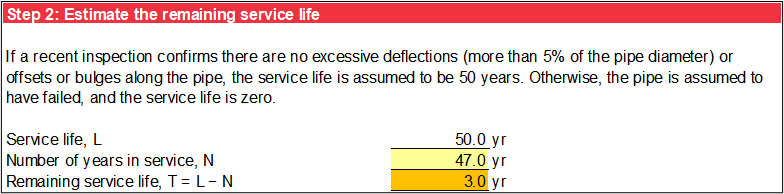
The selection in step 1 affects the service life in step 2. If Yes was selected in step 1, the service life (L) of the plastic pipe is assumed to be 50 years. If No was selected in step 1, L is 0 years (the pipe has failed). Specify the number of years in service (N).
The remaining service life (T) is calculated by subtracting the number of years of service (N) from the service life (L). If the remaining service life is less than or equal to 5 years, the cell has an orange background. A negative remaining service life service life is the number of years exceeding the service life. The calculation is illustrated in Figure.
The remaining service life characterization is the same as steel and aluminum pipe.