

Clay Pipe
Clay pipes have been used in sanitary sewer systems for thousands of years. There are two types of clay pipes. Older clay pipes (placed in service prior to the late 1970s to early 1980s) are likely terracotta (literally meaning “baked earth”). Terracotta is a dried clay fired to 1,200°F. Any clay pipe placed in service since the early 1980s is likely vitrified clay pipe (VCP). Vitrified clay is a ceramic fired to over 2,000°F. Vitrification significantly increased the density and mechanical bonding properties of the pipe’s particles when compared to terracotta, making it more durable and less susceptible to breakage.
Pipe Condition
Clay pipes are highly resistant to very abrasive and corrosive environments (Gabriel and Moran 1998) [?] and Potter 1988 [?]. The greatest concerns with clay pipes are deformation, deflection, or misalignment. This is especially true for older terracotta clay pipes. Differential movement and/or settlement can cause a separation of the joints or breakage of the brittle pipe. Clay pipes are typically provided in very short lengths (2 to 4 feet) due to their weight. Therefore, clay pipes usually have more joints relative to other pipe materials, making them potentially more susceptible to joint performance issues. Another concern with clay pipes is the potential for tree roots to penetrate the body of the pipe or open the joints.
Step 1 assesses the condition of the pipe, as illustrated in Figure. Using the drop-down list, select Yes if a recent inspection (within 5 years) confirms no deformations, signs of deflection, or joint openings along the pipe. Select No if the condition is unknown or those conditions are known to exist.

Remaining Service Life
Because clay pipes are highly resistant to very abrasive and corrosive environments, many municipal sewer inspections reveal clay pipes in very good condition and functioning as designed, despite being over 100 years old. Therefore, service life by itself is not necessarily the best indicator of performance.
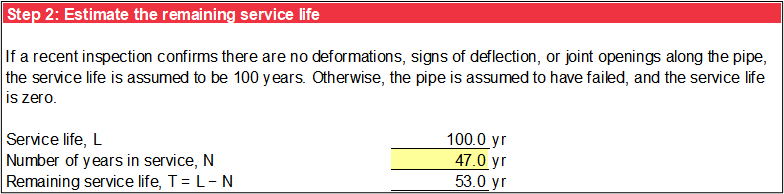
The selection in step 1 affects the service life in step 2. If Yes was selected in step 1, the service life (L) of the clay pipe is assumed to be 100 years (Potter 1988) [?]. If No was selected in step 1, L is 0 years (the pipe has failed). Specify the number of years in service (N).
The remaining service life (T) is calculated by subtracting the number of years of service (N) from the service life (L). If the remaining service life is less than or equal to 5 years, the cells have an orange background. A negative remaining service life is the number of years exceeding the service life. The calculation is illustrated in Figure.
The remaining service life characterization is the same as steel and aluminum pipe.