

Concrete Pipe
Reinforced concrete pipes (RCP) are commonly used to convey interior drainage through levee embankments and floodwalls. This worksheet applies to traditional gravity drainage structures made from either precast or cast-in-place concrete. This worksheet does not apply to large conduits that convey water from a reservoir through, under, or around an embankment dam in a controlled manner.
Pipe Shape Characterization
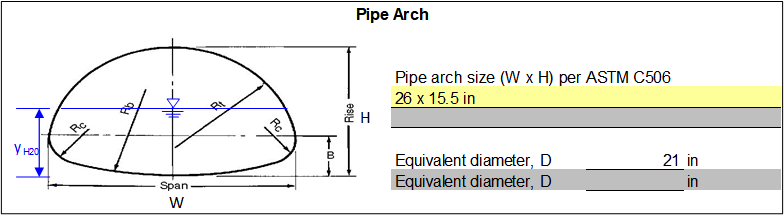
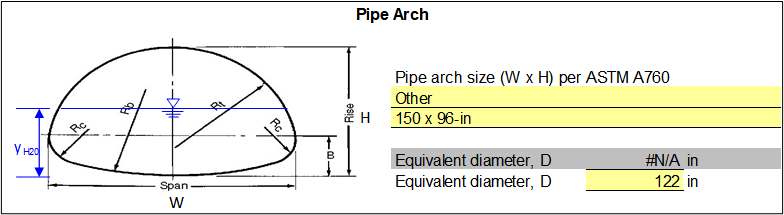
The pipe shape characterization is the same as steel and aluminum pipe. For Arch, choose the pipe arch size based on ASTM C506 using the drop-down list, and the equivalent diameter displays as illustrated in Figure. For Other, specify the description of the pipe arch size and equivalent diameter as illustrated in Figure. Cells that do not apply have a gray background.
Flow Velocity Characterization
The pipe shape characterization is the same as steel and aluminum pipe. A Manning’s roughness coefficient (n) of 0.012 is suggested for smooth concrete as an interior flow surface (USACE 2020) [?].
Flow Frequency Characterization
The flow frequency characterization is the same as steel and aluminum pipe.
Bedload Characterization
The bedload characterization is the same as steel and aluminum pipe.
Flow Abrasiveness Characterization
The flow abrasiveness characterization is the same as steel and aluminum pipe.
Deterioration Environment Characterization
Step 6 characterizes the aggressive deterioration environment. Aggressive deterioration environments for concrete include extremely acidic conditions, microbiological (anaerobic) corrosion, and chloride corrosion (Potter 1988) [?]. These environments are the same as steel and aluminum pipe. Additional aggressive deterioration environments for RCP include the following:
-
Freeze/thaw damage: Two concerns when assessing the potential for this type of damage are air entrainment and temperature environment. If the concrete pipe was constructed before 1945, it likely did not include air entrainment in the concrete mix design. If the pipe is likely not air-entrained and is located in a region that has considerable freeze/thaw cycles, freeze/thaw damage is considered likely unless other information is available. Climatic data, such as the map of annual freeze/thaw cycles ( https://doi.org/10.1175/1520-0450(1974)013%3C0348:TFOFTC%3E2.0.CO;2 ) published by Hershfield (1974) [?], can help assess the potential for damaging freeze/thaw cycles. Over 120 annual freeze/thaw cycles represent an aggressive deterioration environment without air entrainment and no known existing signs of cracking or distress. If there is any historic evidence of even minor cracking or distress in the pipe, over 80 annual freeze/thaw cycles are considered aggressive for a non-air-entrained RCP.
-
Chemical attack: Two types of chemical attack concerns are sulfate attack and alkali-silica reaction. Sulfate attack can occur when the soil, water, or effluent has a sulfate level that exceeds 1,000 ppm (Potter 1988) [?]. This generally occurs in arid regions when the soil is very alkaline (pH greater than or equal to 9). Damage is more likely on structures that are partially buried, as opposed to those fully buried, due to capillary action and surface evaporation. If Type II or Type V Portland cement is not used, sulfate damage is likely. Sulfate levels are generally high in areas with expansive clays and/or gypsum. Highly alkaline soils are primarily present in arid, western portions of the U.S. The second type of chemical attack is alkali-silica reaction (ASR). ASR occurs when there is a chemical reaction between the aggregate and cement used in the concrete mix. This causes the concrete to expand, eventually suffer cracking/distortion, and structurally weaken. While rare for pipes, it has been known to cause RCP failures (Haavik and Mielenz 1991) [?].
Select the number of aggressive deterioration environments that are applicable or likely applicable using the drop-down list. The options include None, One, or Multiple. Based on the pipe material and number of aggressive deterioration environments, the characterization of the deterioration environment for the pipe is the same as for steel and aluminum pipe.
Remaining Service Life
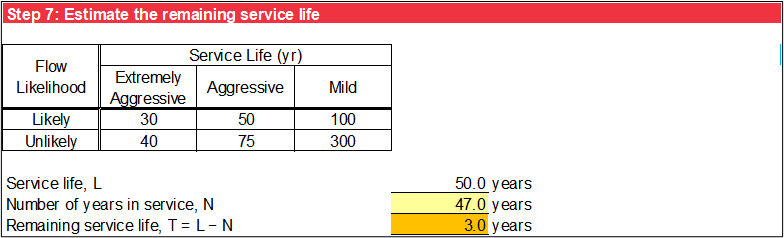
Step 7 calculates the remaining service life for the pipe. The service life is obtained from a table as a function of flow likelihood and deterioration environment as illustrated in Figure.
Specify the number of years in service (N). The remaining service life (T) is calculated by subtracting the number of years of service (N) from the service life (L). If the remaining service life is less than or equal to 5 years, the cell has an orange background. A negative remaining service life is the number of years exceeding the service life.
The remaining service life characterization is the same as steel and aluminum pipe.