US Army Corps of EngineersInstitute for Water Resources, Risk Management Center

Appendix A - Derivation of Hydraulic Shear Stress Equations

Each of the following four derivations of hydraulic shear stress on the surface of a continuous flaw (crack, gap, or pipe) from flow of water in the flaw is based on these simplifying assumptions:

  • Cross-section of the flaw is uniform from upstream to downstream (waterside to landside).

  • Steady uniform flow occurs through the flaw.

  • Head loss is linear from upstream to downstream (waterside to landside).

  • Frictional resistance is uniform along the surface of the flaw.

  • Frictional resistance is equal to the driving force.

Hydraulic Shear Stress on the Surface of a Cylindrical Pipe

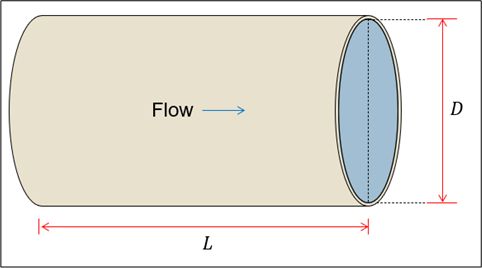
Flow through a cylindrical pipe.
Figure: Flow through a cylindrical pipe.

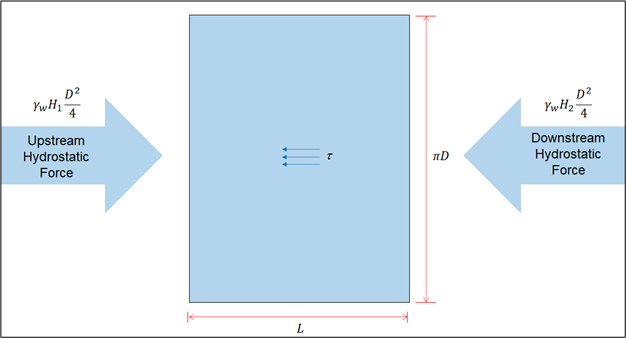
Equation approximates the average hydraulic shear stress acting on the pipe by assuming static equilibrium.

F=γWH1πD24τ(πD)LγWH2πD24=0\sum F = \gamma_{W}H_{1}\frac{\pi D^2}{4}-\tau(\pi D)L-\gamma_{W}H_{2}\frac{\pi D^2}{4} = 0

where:

F = force
D = diameter of the pipe
L = length of the pipe
H1 = hydraulic head at upstream end of pipe (headwater elevation minus base of pipe elevation)
H2 = hydraulic head at downstream end of pipe (tailwater elevation minus base of pipe elevation)
γw = unit weight of water
τ = average hydraulic shear stress

Free-body diagram for flow through a cylindrical pipe.
Figure: Free-body diagram for flow through a cylindrical pipe.

Solving for the average hydraulic shear stress results in Equation and Equation.

τ(πD)L=γW(H1H2)πD24\tau(\pi D)L = \gamma_{W}(H_{1}-H_{2})\frac{\pi D^2}{4}
τ=γW(H1H2)D4L\tau = \frac{\gamma_{W}(H_{1}-H_{2})D}{4L}

Equation calculates the average hydraulic gradient across the flow path.

i=H1H2Li=\frac{H_{1}-H_2}{L}

Therefore, Equation can be rewritten as Equation.

τ=γWiD4\tau = \frac{\gamma_{W}iD}{4}

Alternatively, the average hydraulic shear stress acting on the walls of the pipe can be approximated by a more general formula for the hydraulic shear stress along a pipe as shown in Equation.

τ=γWiAPw\tau = \gamma_{W}i\frac{A}{P_w}

where:

A = average cross-sectional area of the flow

A=πD24A=\frac{\pi D^2}{4}

where:

Pw = average wetted perimeter

Pw=πDP_{w} = \pi D

Substituting Equation, Equation, and Equation into Equation results in Equation, Equation, and Equation.

τ=γW(H1H2L)((πD24)πD)\tau = \gamma_{W}\left(\frac{H_{1}-H_{2}}{L}\right)\left(\frac{\left(\frac{\pi D^2}{4}\right)}{\pi D}\right)
τ=γW(H1H2)D4L\tau = \frac{\gamma_{W}(H_{1}-H_{2})D}{4L}
τ=γWiD4\tau = \frac{\gamma_{W}iD}{4}

Solving Equation for the pipe diameter and setting τ = τc (critical shear stress) results in the critical pipe diameter for initiation of concentrated leak erosion (Dcr) as shown in Equation, Equation, and Equation.

γW(H1H2)D=4Lτc\gamma_{W}(H_{1}-H_{2})D = 4L\tau_{c}
Dcr=4LτcγW(H1H2)D_{cr} = \frac{4L\tau_c}{\gamma_{W}(H_{1}-H_2)}

Hydraulic Shear Stress on the Surface of a Horizontal Crack

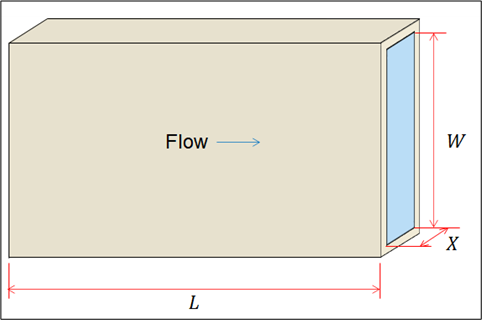
Flow through a horizontal crack.
Figure: Flow through a horizontal crack.

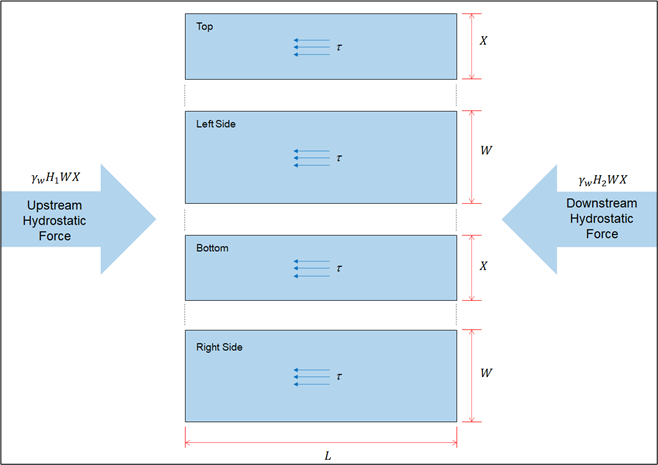
Equation approximates the average hydraulic shear stress acting on the crack by assuming static equilibrium.

F=γWH1WXτ(2WL+2XL)γWH2WX=0\sum F = \gamma_{W}H_{1}WX-\tau(2WL+2XL)-\gamma_{W}H_{2}WX = 0

where:

F = force
W = vertical crack dimension (crack width)
X = horizontal crack dimension (crack width parallel to the embankment centerline)
L = length of the crack
H1 = hydraulic head at upstream end of crack (headwater elevation minus base of crack elevation)
H2 = hydraulic head at downstream end of crack (tailwater elevation minus base of crack elevation)
γw = unit weight of water
τ = average hydraulic shear stress

Free-body diagram for flow through a horizontal crack.
Figure: Free-body diagram for flow through a horizontal crack.

Solving for the average hydraulic shear stress results in Equation and Equation.

τ(2WL+2XL)=γW(H1H2)WX\tau(2WL+2XL) = \gamma_{W}(H_{1}-H_{2})WX
τ=γW(H1H2)WXL(2W+2X)\tau = \frac{\gamma_{W}(H_{1}-H_2)WX}{L(2W+2X)}

Equation calculates the average hydraulic gradient across the flow path.

i=H1H2Li=\frac{H_{1}-H_2}{L}

Therefore, Equation can be rewritten as Equation.

τ=γWiWX2W+2X\tau=\frac{\gamma_{W}iWX}{2W+2X}

Alternatively, the average hydraulic shear stress acting on the walls of the crack can be approximated by a more general formula for the hydraulic shear stress along a crack as shown in Equation.

τ=γWiAPw\tau =\gamma_{W}i\frac{A}{P_w}

where:

A = average cross-sectional area of the flow

A=WXA=WX

Pw = average wetted perimeter

Pw=2W+2XP_{w} = 2W+2X

Substituting Equation, Equation, and Equation into Equation results in Equation, Equation, and Equation.

τ=γW(H1H2L)(WX2W+2X)\tau = \gamma_{W}\left(\frac{H_{1}-H_2}{L}\right)\left(\frac{WX}{2W+2X}\right)
τ=γW(H1H2)WXL(2W+2X)\tau = \frac{\gamma_{W}(H_{1}-H_{2})WX}{L(2W+2X)}
τ=γWiWX2W+2X\tau = \frac{\gamma_{W}iWX}{2W+2X}

Solving Equation for the crack width (vertical crack dimension) and setting τ = τc (critical shear stress) results in the critical crack width for initiation of concentrated leak erosion (Wcr) as shown in Equation to Equation.

Lτc(2W+2X)=γW(H1H2)WXL\tau_c(2W+2X) = \gamma_{W}(H_{1}-H_{2})WX
Lτc(2W+2X)γW(H1H2)WX=0L\tau_c(2W+2X) - \gamma_{W}(H_{1}-H_{2})WX = 0
2LτcW+2LτcXγW(H1H2)WX=02L\tau_{c}W+2L\tau_{c}X- \gamma_{W}(H_{1}-H_{2})WX = 0
W[2LτcγW(H1H2)X]=2LτcXW[2L\tau_{c}-\gamma_{W}(H_{1}-H_2)X] = -2L\tau_{c}X
Wcr=2LτcX2LτcγW(H1H2)XW_{cr} = \frac{-2L\tau_{c}X}{2L\tau_{c}-\gamma_{W}(H_{1}-H_2)X}
Wcr=2τcX2LτcγWiXW_{cr} = \frac{-2\tau_{c}X}{2L\tau_{c}-\gamma_{W}iX}

Because W << X, the average hydraulic shear stress in Equation can be approximated as shown in Equation and Equation.

τ=γWiWX2(0)+2X\tau = \frac{\gamma_{W}iWX}{2(0)+2X}
τγWiW2\tau \approx \frac{\gamma_{W}iW}{2}

Solving Equation for the crack width and setting τ = τc (critical shear stress) results in the critical crack width for initiation of concentrated leak erosion as shown in Equation.


Wcr2τcγWiW_{cr} \approx \frac{2\tau_c}{\gamma_{W}i}

Hydraulic Shear Stress on the Surface of a Vertical Rectangular Crack

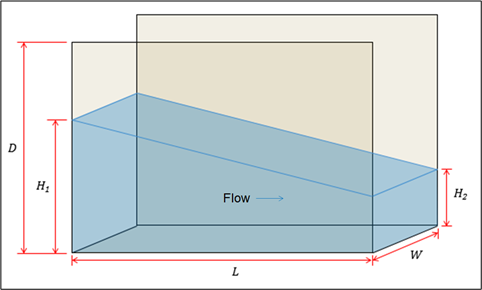
Flow through a vertical rectangular crack.
Figure: Flow through a vertical rectangular crack.

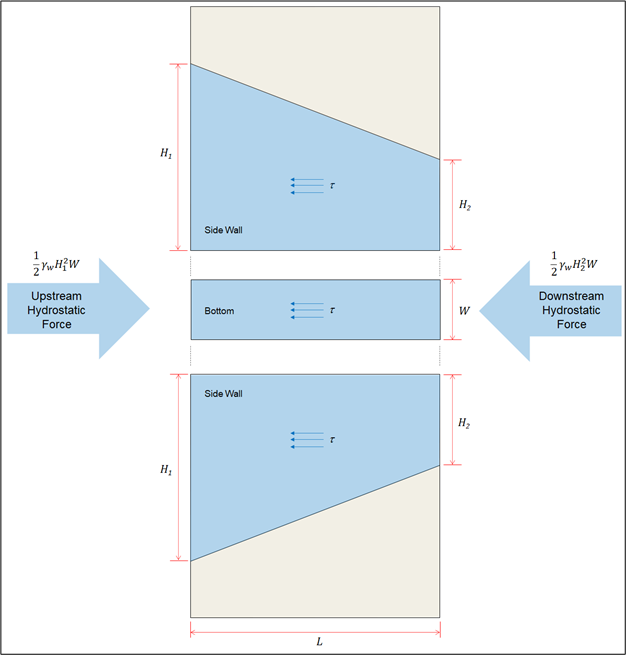
Equation approximates the average hydraulic shear stress acting on the crack by assuming static equilibrium.

F=12γWH12Wτ(2L(H1+H22)+WL)12γWH22W=0\sum F = \frac{1}{2}\gamma_{W}H_{1}^{2}W-\tau(2L\left(\frac{H_{1}+H_2}{2}\right)+WL)-\frac{1}{2}\gamma_{W}H_{2}^{2}W=0

where:

F = force
D = depth of crack from top of core
H1 = hydraulic head at upstream end of crack (headwater elevation minus base of crack elevation)
H2 = hydraulic head at downstream end of crack (tailwater elevation minus base of crack elevation)
L = equivalent length of crack for net hydraulic head
W = width of crack at top of core
γw = unit weight of water
τ = average hydraulic shear stress

Free-body diagram for flow through a vertical rectangular crack.
Figure: Free-body diagram for flow through a vertical rectangular crack.

Solving for the average hydraulic shear stress results in Equation and Equation.

τL(H1+H2+W)=12γWW(H12H22)\tau L(H_{1}+H_{2}+W) = \frac{1}{2}\gamma_{W}W(H_{1}^{2}-H_{2}^2)
τ=γWW(H12H22)2L(H1+H2+W)\tau = \frac{\gamma_{W}W(H_{1}^{2}-H_{2}^2)}{2L(H_{1}+H_{2}+W)}

Alternatively, the average hydraulic shear stress acting on the walls of the crack can be approximated by a more general formula for the hydraulic shear stress along a crack as shown in Equation.

τ=γWiAPw\tau=\gamma_{W}i\frac{A}{P_w}

where:

i = average hydraulic gradient across the flow path

i=H1H2Li = \frac{H_{1}-H_{2}}{L}

A = average cross-sectional area of the flow

A=12(WH1+WH2)A=\frac{1}{2}(WH_{1}+WH_{2})
A=W2(H1+H2)A=\frac{W}{2}(H_{1}+H_2)

Pw = average wetted perimeter

Pw=12((2H1+W)+(2H2+W))P_{w} = \frac{1}{2}((2H_{1}+W)+(2H_{2}+W))
Pw=H1+H2+WP_{w}=H_{1}+H_{2}+W

Substituting Equation, Equation, and Equation into Equation results in Equation and Equation.

τ=γW(H1H2L)W2(H1+H2)H1+H2+W\tau = \gamma_{W}\left(\frac{H_{1}-H_2}{L}\right)\frac{\frac{W}{2}(H_{1}+H_2)}{H_{1}+H_{2}+W}
τ=γWW(H12H22)2L(H1+H2+W)\tau = \frac{\gamma_{W}W(H_{1}^{2}-H_{2}^2)}{2L(H_{1}+H_{2}+W)}

Solving Equation for the crack width at the top of the core and setting τ = τc (critical shear stress) results in the critical crack width for initiation of concentrated leak erosion (Wcr) as shown in Equation to Equation.

2Lτc(H1+H2+W)=γWW(H12H22)2L\tau_{c}(H_{1}+H_{2}+W)=\gamma_{W}W(H_{1}^{2}-H_{2}^2)
2Lτc(H1+H2)+2LτcW=γWW(H12H22)2L\tau_{c}(H_{1}+H_{2})+2L\tau_{c}W = \gamma_{W}W(H_{1}^{2}-H_{2}^2)
γWW(H12H22)2LτcW=2Lτc(H1+H2)\gamma_{W}W(H_{1}^{2}-H_{2}^2)-2L\tau_{c}W=2L\tau_{c}(H_{1}+H_2)
W(γW(H12H22)2Lτc)=2Lτc(H1+H2)W(\gamma_{W}(H_{1}^{2}-H_{2}^2)-2L\tau_c) = 2L\tau_{c}(H_{1}+H_2)
Wcr=2Lτc(H1+H2)γW(H12H22)2LτcW_{cr} = \frac{2L\tau_{c}(H_{1}+H_2)}{\gamma_{W}(H_{1}^{2}-H_{2}^2)-2L\tau_c}

Because H2 is often zero (i.e., no tailwater) and W << H1, the average hydraulic shear stress in Equation can be approximated as shown in Equation, Equation, and Equation.

τγWW(H120)2L(H1+0+0)\tau \approx \frac{\gamma_{W}W(H_{1}^{2}-0)}{2L(H_{1}+0+0)}
τγWWH12L\tau \approx \frac{\gamma_{W}WH_1}{2L}
τγWiW2\tau \approx \frac{\gamma_{W}iW}{2}

Solving Equation for the crack width and setting τ = τc (critical shear stress) results in the critical crack width for initiation of concentrated leak erosion as shown in Equation.
Wcr2τcγWiW_{cr} \approx \frac{2\tau_{c}}{\gamma_{W}i}

Hydraulic Shear Stress on the Surface of a Vertical Triangular Crack

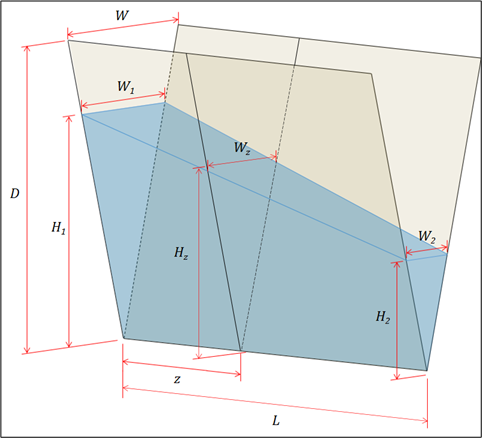
Flow through a vertical triangular crack.
Figure: Flow through a vertical triangular crack.

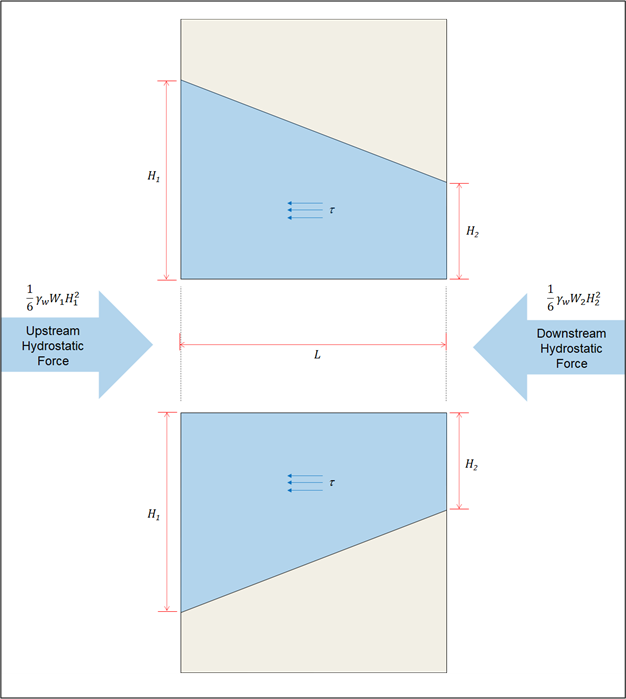
Equation approximates the average hydraulic shear stress acting on the crack by assuming static equilibrium.

F=16γWH12W1τL(H12+(W12)2+H22+(W22)2)16γWH22W2=0\sum F = \frac{1}{6}\gamma_{W}H_{1}^{2}W_{1}-\tau L \left(\sqrt{H_{1}^{2}+\left(\frac{W_1}{2}\right)^2} + \sqrt{H_{2}^{2}+\left(\frac{W_2}{2}\right)^2}\right) - \frac{1}{6}\gamma_{W}H_{2}^{2}W_{2} = 0

where:

F = force
D = depth of crack from top of core
H1 = hydraulic head at upstream end of crack (headwater elevation minus base of crack elevation)
H2 = hydraulic head at downstream end of crack (tailwater elevation minus base of crack elevation)
Hz = height of water in crack at a distance z from upstream end of crack
L = equivalent length of crack for net hydraulic head
W = width of crack at top of core
W1 = width of crack at upstream end of crack
W2 = width of crack at downstream end of crack
Wz = width of crack at a distance z from upstream end of crack
Z = distance measured along base of crack from upstream end of crack
γW = unit weight of water
τ = average hydraulic shear stress

Free-body diagram for flow through a vertical triangular crack.
Figure: Free-body diagram for flow through a vertical triangular crack.

Solving for the average hydraulic shear stress results in Equation and Equation.

τL(H12+(W12)2+H22+(W22)2)=16γW(H12W1H22W2)\tau L \left(\sqrt{H_{1}^{2}+\left(\frac{W_1}{2}\right)^2} + \sqrt{H_{2}^{2}+\left(\frac{W_2}{2}\right)^2}\right) = \frac{1}{6}\gamma_{W}(H_{1}^{2}W_{1}-H_{2}^{2}W_2)
τ=γW6L(H12W1H22W2)H12+(W12)2+H22+(W22)2\tau = \frac{\gamma_{W}}{6L}\frac{(H_{1}^{2}W_{1}-H_{2}^{2}W_2)}{\sqrt{H_{1}^{2} + \left(\frac{W_1}{2}\right)^{2}} + \sqrt{H_{2}^{2} + \left(\frac{W_2}{2}\right)^{2}}}

Solving for crack width at H1 and H2 using similar triangles results in Equation, Equation, and Equation.

WD=W1H1=W2H2\frac{W}{D} = \frac{W_1}{H_1} = \frac{W_2}{H_2}
W1=WH1DW_{1} = \frac{WH_1}{D}
W2=WH2DW_{2} = \frac{WH_2}{D}

Substituting these crack widths into Equation results in Equation, Equation, and Equation.

τ=γW6L(H12(WH1D)H22(WH2D))H12+(WH12D)2+H22+(WH22D)2\tau = \frac{\gamma_{W}}{6L}\frac{\left(H_{1}^{2}\left(\frac{WH_{1}}{D}\right) - H_{2}^{2}\left(\frac{WH_{2}}{D}\right)\right)}{\sqrt{H_{1}^{2}+\left(\frac{WH_1}{2D}\right)^{2}}+ \sqrt{H_{2}^{2}+\left(\frac{WH_2}{2D}\right)^{2}} }
τ=γWW6DL(H13H23)H11+W24D2+H21+W24D2\tau = \frac{\gamma_{W}W}{6DL}\frac{(H_{1}^{3}-H_{2}^3)}{H_{1}\sqrt{1+\frac{W^2}{4D^2}} + H_{2}\sqrt{1+\frac{W^2}{4D^2}}}
τ=γWW6DL(H13H23)(H1+H2)1+W24D2\tau = \frac{\gamma_{W}W}{6DL}\frac{(H_{1}^{3}-H_{2}^3)}{(H_{1}+H_{2})\sqrt{1+\frac{W^2}{4D^2}}}

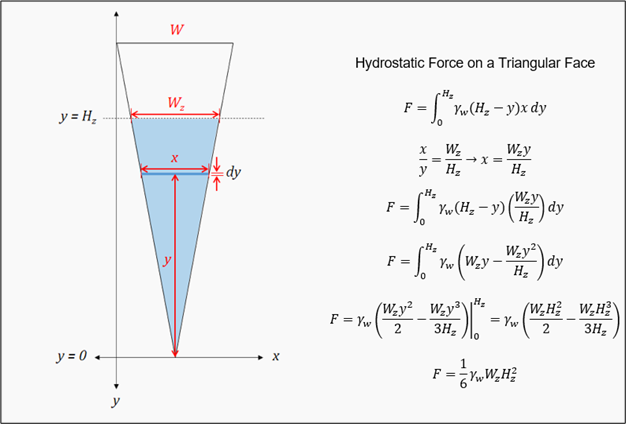
The derivation of the equation used to calculate the hydrostatic forces is shown in Figure A-9.

Hydrostatic force on a triangular face.
Figure: Hydrostatic force on a triangular face.

Alternatively, the average hydraulic shear stress acting on the walls of the crack can be approximated by a more general formula for the hydraulic shear stress along a crack as shown in Equation.

τ=γWiAPw\tau = \gamma_{W}i\frac{A}{P_w}

where:

i = average hydraulic gradient across the flow path

i=H1H2Li = \frac{H_{1}-H_{2}}{L}

A = average cross-sectional area of the flow

A=1L0L12HzWzdzA = \frac{1}{L}\int_0^L\frac{1}{2}H_{z}W_zdz

where:

Hz = height of water in crack at a distance z from upstream end of crack
Wz = width of crack at a distance z from upstream end of crack

Hz=H1(H1H2)zLH_{z} = H_{1}- \frac{(H_{1}-H_2)z}{L}
Wz=WHzD=[H1(H1H2)zL](WD)W_{z} = \frac{WH_{z}}{D} = \left[H_{1} - \frac{(H_{1}-H_{2})z}{L}\right]\left(\frac{W}{D}\right)
A=0L12[H1(H1H2)zL][H1(H1H2)zL](WD)dzA = \int_0^L\frac{1}{2}\left[H_{1}-\frac{(H_{1}-H_2)z}{L}\right]\left[H_{1}-\frac{(H_{1}-H_2)z}{L}\right]\left(\frac{W}{D}\right)dz
A=W2DL0L(H1H1zL+H2zL)(H1H1zL+H2zL)dzA=\frac{W}{2DL}\int_0^L\left(H_{1}-\frac{H_{1}z}{L}+\frac{H_{2}z}{L}\right)\left(H_{1}-\frac{H_{1}z}{L}+\frac{H_{2}z}{L}\right)dz
A=W2DL0L(H12H12zL+H1H2zLH12zL+H12z2L2H1H2z2L2+H1H2zLH1H2z2L2+H22z2L2)dzA = \frac{W}{2DL}\int_0^L\left(H_{1}^{2}-\frac{H_{1}^{2}z}{L}+\frac{H_{1}H_{2}z}{L}-\frac{H_{1}^{2}z}{L}+\frac{H_{1}^{2}z^{2}}{L^2}-\frac{H_{1}H_{2}z^2}{L^2}+\frac{H_{1}H_{2}z}{L}-\frac{H_{1}H_{2}z^2}{L^2}+\frac{H_{2}^{2}z^2}{L^2}\right)dz
A=W2DL(H12zH12z22L+H1H2z22LH12z22L+H12z33L2H1H2z33L2+H1H2z22LH1H2z33L2+H22z33L2)0LA = \frac{W}{2DL}\left(H_{1}^{2}z - \frac{H_{1}^{2}z^2}{2L}+\frac{H_{1}H_{2}z^2}{2L}-\frac{H_{1}^{2}z^2}{2L}+\frac{H_{1}^{2}z^3}{3L^2}-\frac{H_{1}H_{2}z^3}{3L^2}+\frac{H_{1}H_{2}z^2}{2L}-\frac{H_{1}H_{2}z^3}{3L^2}+\frac{H_{2}^{2}z^3}{3L^2}\right)\bigg|_0^L
A=W2DL(H12LH12L22L+H1H2L22LH12L22L+H12L33L2H1H2L33L2+H1H2L22LH1H2L33L2+H22L33L2)A = \frac{W}{2DL}\left(H_{1}^{2}L-\frac{H_{1}^{2}L^2}{2L}+\frac{H_{1}H_{2}L^2}{2L}-\frac{H_{1}^{2}L^{2}}{2L}+\frac{H_{1}^{2}L^{3}}{3L^2}-\frac{H_{1}H_{2}L^3}{3L^2}+\frac{H_{1}H_{2}L^2}{2L}-\frac{H_{1}H_{2}L^3}{3L^2}+\frac{H_{2}^{2}L^3}{3L^2}\right)
A=W12DL(6H12L3H12L+3H1H2L3H12L+2H12L2H1H2L+3H1H2L2H1H2L+2H22L)A=\frac{W}{12DL}\left(6H_{1}^{2}L-3H_{1}^{2}L + 3H_{1}H_{2}L-3H_{1}^{2}L + 2H_{1}^{2}L - 2H_{1}H_{2}L + 3H_{1}H_{2}L - 2H_{1}H_{2}L + 2H_{2}^{2}L\right)
A=W12D(2H12+2H1H2+2H22)A = \frac{W}{12D}(2H_{1}^2+2H_{1}H_{2}+2H_{2}^2)
A=W6D(H12+H1H2+H22)A = \frac{W}{6D}(H_{1}^{2}+H_{1}H_{2}+H_{2}^2)

where:

Pw = average wetted perimeter

Pw=12(2H12+(W12)2+2H22+(W22)2)P_{w} = \frac{1}{2}\left(2\sqrt{H_{1}^{2}+\left(\frac{W_1}{2}\right)^2} + 2\sqrt{H_{2}^{2}+\left(\frac{W_2}{2}\right)^2}\right)
Pw=12(2H12+(WH12D)2+2H22+(WH22D)2)P_{w} = \frac{1}{2}\left(2\sqrt{H_{1}^{2}+\left(\frac{WH_{1}}{2D}\right)^2} + 2\sqrt{H_{2}^{2}+\left(\frac{WH_2}{2D}\right)^2}\right)
Pw=H12+(WH12D)2+H22+(WH22D)2P_{w} = \sqrt{H_{1}^{2}+\left(\frac{WH_{1}}{2D}\right)^2} + \sqrt{H_{2}^{2}+\left(\frac{WH_2}{2D}\right)^2}
Pw=H11+W24D2+H21+W24D2P_{w} = H_{1}\sqrt{1+\frac{W^2}{4D^2}} + H_{2}\sqrt{1+\frac{W^2}{4D^2}}
Pw=(H1+H2)1+W24D2P_{w}= (H_{1}+H_{2})\sqrt{1+\frac{W^2}{4D^2}}

Substituting Equation, Equation, and Equation into Equation results in Equation, Equation, and Equation.

τ=γw(H1H2L)W6D(H12+H1H2+H22)(H1+H2)1+W24D2\tau = \gamma_{w}\left(\frac{H_{1}-H_2}{L}\right)\frac{\frac{W}{6D}(H_{1}^{2}+H_{1}H_{2}+H_{2}^2)}{(H_{1}+H_2)\sqrt{1+\frac{W^2}{4D^2}}}
τ=γwW6DL(H13+H12H2+H1H22H12H2H1H22H23)(H1+H2)1+W24D2\tau = \frac{\gamma_{w}W}{6DL}\frac{(H_{1}^{3}+H_{1}^{2}H_{2}+H_{1}H_{2}^{2}-H_{1}^{2}H_{2}-H_{1}H_{2}^{2}-H_{2}^{3})}{(H_{1}+H_{2})\sqrt{1+\frac{W^2}{4D^2}}}
τ=γwW6DL(H13H23)(H1+H2)1+W24D2\tau = \frac{\gamma_{w}W}{6DL}\frac{(H_{1}^{3}-H_{2}^3)}{(H_{1}+H_{2})\sqrt{1+\frac{W^2}{4D^2}}}

Solving Equation for the crack width and setting τ = τc (critical shear stress) results in the critical crack width for initiation of concentrated leak erosion (Wcr) as shown in Equation to Equation.

τc(H1+H2)1+W24D2=γwW(H13H23)6DL\tau_{c}(H_{1}+H_{2})\sqrt{1+\frac{W^2}{4D^2}}=\frac{\gamma_{w}W(H_{1}^{3}-H_{2}^{3})}{6DL}
τc2(H1+H2)2(1+W24D2)=γw2W2(H13H23)236D2L2\tau_{c}^{2}(H_{1}+H_{2})^{2}\left(1+\frac{W^2}{4D^2}\right) = \frac{\gamma_{w}^{2}W^{2}(H_{1}^{3}-H_{2}^{3})^2}{36D^{2}L^2}
τc2(H1+H2)2+τc2(H1+H2)2W24D2=γw2W2(H13H23)236D2L2\tau_{c}^{2}(H_{1}+H_{2})^{2}+\frac{\tau_{c}^{2}(H_{1}+H_2)^{2}W^2}{4D^2} = \frac{\gamma_{w}^{2}W^{2}(H_{1}^{3}-H_{2}^{3})^2}{36D^{2}L^2}
γw2W2(H13H23)236D2L2τc2(H1+H2)2W24D2=τc2(H1+H2)2\frac{\gamma_{w}^{2}W^{2}(H_{1}^{3}-H_{2}^3)^2}{36D^{2}L^2} - \frac{\tau_{c}^{2}(H_{1}+H_2)^{2}W^2}{4D^2} = \tau_{c}^{2}(H_{1}+H_{2})^{2}
W2(γw2(H13H23)236D2L2τc2(H1+H2)24D2)=τc2(H1+H2)2W^{2}\left(\frac{\gamma_{w}^{2}(H_{1}^{3}-H_{2}^3)^2}{36D^{2}L^2} - \frac{\tau_{c}^{2}(H_{1}+H_2)^{2}}{4D^2}\right) = \tau_{c}^{2}(H_{1}+H_{2})^{2}
W2=τc2(H1+H2)2(γw2(H13H23)236D2L2τc2(H1+H2)24D2)W^{2} = \frac{\tau_{c}^{2}(H_{1}+H_{2})^{2}}{\left(\frac{\gamma_{w}^{2}(H_{1}^{3}-H_{2}^3)^2}{36D^{2}L^2} - \frac{\tau_{c}^{2}(H_{1}+H_2)^{2}}{4D^2}\right)}
Wcr=τc(H1+H2)γw2(H13H23)236D2L2τc2(H1+H2)24D2W_{cr} = \frac{\tau_{c}(H_{1}+H_{2})}{\sqrt{\frac{\gamma_{w}^{2}(H_{1}^{3}-H_{2}^3)^2}{36D^{2}L^2} - \frac{\tau_{c}^{2}(H_{1}+H_2)^{2}}{4D^2}}}

Because H2 is often zero (i.e., no tailwater) and W << D, the average hydraulic shear stress in Equation can be approximated as shown in Equation, Equation, and Equation.

τγwW6DL(H130)(H1+0)1+0\tau \approx \frac{\gamma_{w}W}{6DL}\frac{(H_{1}^{3}-0)}{(H_{1}+0)\sqrt{1+0}}
τγwWH126DL\tau \approx \frac{\gamma_{w}WH_{1}^2}{6DL}
τγwiWH16D\tau \approx \frac{\gamma_{w}iWH_1}{6D}

Solving Equation for the crack width and setting τ = τc (critical shear stress) results in the critical crack width for initiation of concentrated leak erosion as shown in Equation.
Wcr6DτcγwiH1W_{cr} \approx \frac{6D\tau_{c}}{\gamma_{w}iH_{1}}