Background
Concentrated leak erosion is a form of scour, and the process involves leakage flow through a continuous, transverse flaw (crack, gap, or pipe). Leakage flow through the flaw applies hydraulic shear stresses or tractive forces onto the surface of the flaw, leading to particle detachment from the surface. To assess the likelihood of initiation of concentrated leak erosion in a flaw, the hydraulic shear stress on the surface of a flaw from flow of water in the flaw can be compared to the critical shear stress of the embankment core material.
The hydraulic shear stress in a flaw for a given headwater (HW) level is based on the geometry of the embankment core, the estimated flaw dimensions, and the average hydraulic gradient through the flaw. According to Wan (2006) [?], the hydraulic shear stress can be estimated using Equation.
where:
= density of water
= acceleration due to gravity
= net hydraulic head
= length of the flaw over which the hydraulic head difference occurs
= average cross-sectional area of the flaw
= average wetted perimeter of the flaw
Substituting for the unit weight of water and for the average hydraulic gradient into Equation, Equation can be simplified to Equation.
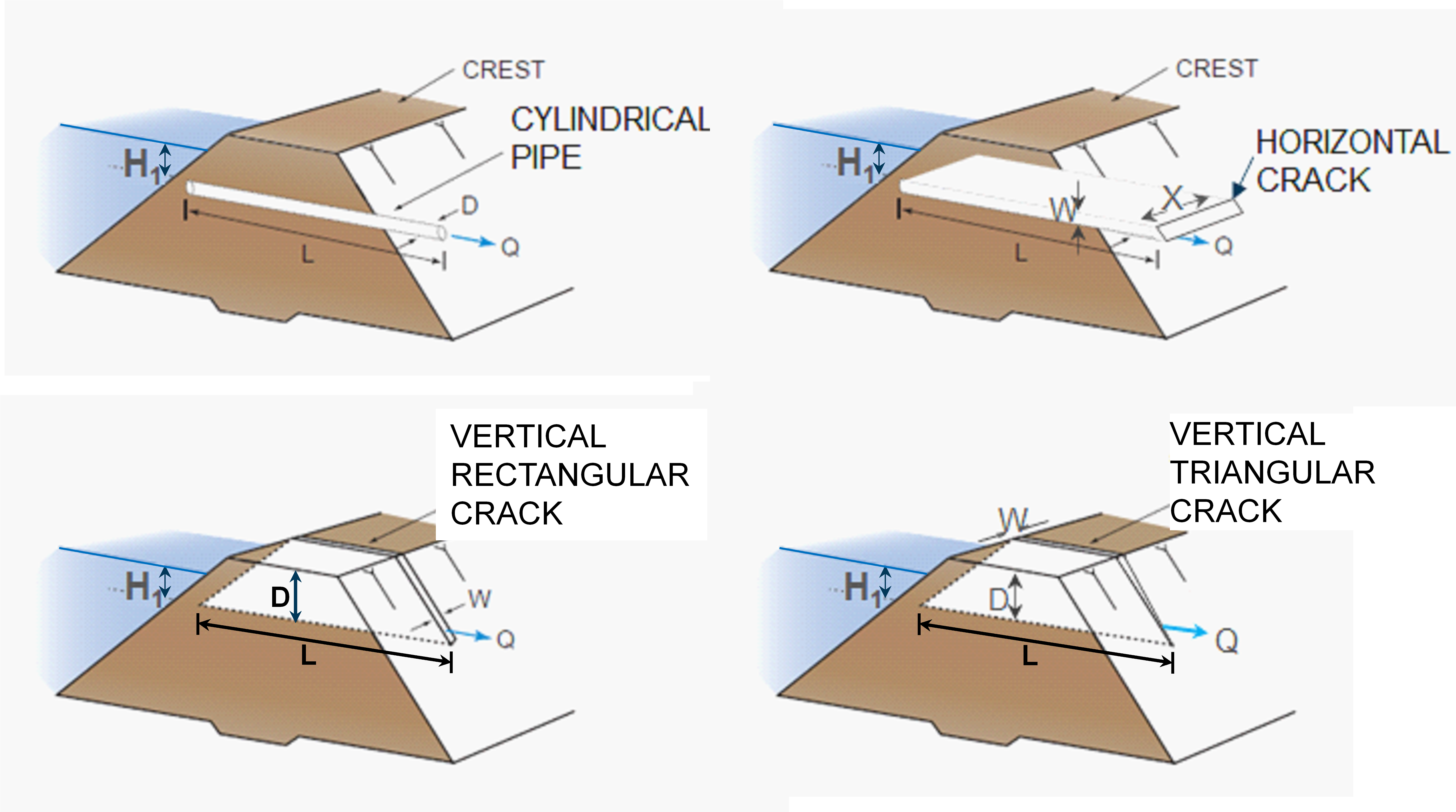
Equations to approximate the hydraulic shear stress for flow through a cylindrical pipe, horizontal crack, vertical rectangular crack (or gap), and a vertical triangular crack (or gap) were derived using this basic equation. Figure, adapted from Fell et al. (2015) [?], illustrates each flaw type. These derivations are based on the following simplifying assumptions:
-
Cross-section of the flaw is uniform from upstream to downstream (waterside to landside).
-
Steady uniform flow occurs through the flaw.
-
Head loss is linear from upstream to downstream (waterside to landside).
-
Frictional resistance is uniform along the surface of the flaw.
-
Frictional resistance is equal to the driving force.
This toolbox calculates the hydraulic shear stress in the flaw and compares it to the critical shear stress of the soil for the selected flaw geometry. For parameter combinations where the hydraulic shear stress exceeds the critical shear stress, the toolbox assumes initiation. The toolbox also calculates the critical crack width or pipe diameter as a function of critical shear stress and headwater level. Use the probability tables developed by Fell et al. (2008) [?] to perform screening estimates of the probability of initiation of concentrated leak erosion based on the soil properties of the embankment core, the flaw size and geometry, and the average hydraulic gradient of flow through the flaw.