Cylindrical Pipe
Method of Analysis
In step 1, use the drop-down list to select the method of analysis (probabilistic or deterministic). There are two options for probabilistic analysis. The first performs 1,000 iterations (judged adequate for most applications) without using Palisade’s @RISK software. This provides flexibility if an @RISK software license is not available. The second uses @RISK to customize the probabilistic analysis. Use the drop-down list to select Yes if @RISK is used and No if @RISK is not used. Figure through Figure illustrate the three possible scenarios.



Critical Shear Stress and Initial Pipe Diameter
In step 2, input the critical shear stress for the embankment core and initial pipe diameter. The selections in step 1 affect the input for step 2, and cells that do not apply have a gray background. These cells are not used in subsequent calculations, even if data is present.
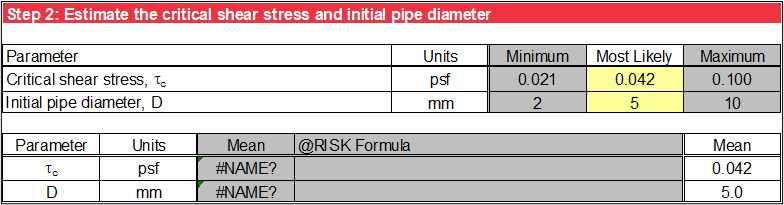
For deterministic analysis, input only the most likely values. The mean values used for subsequent calculations are the most likely (or mode) value. Figure illustrates the deterministic input.
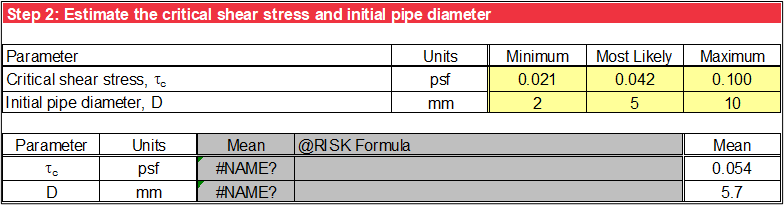
For probabilistic analysis without using @RISK, input the minimum and maximum values in addition to the most likely value, and triangular distributions represent the random variables. The mean values used in subsequent calculations are the average of the minimum, most likely, and maximum values. Figure illustrates the probabilistic input without @RISK.
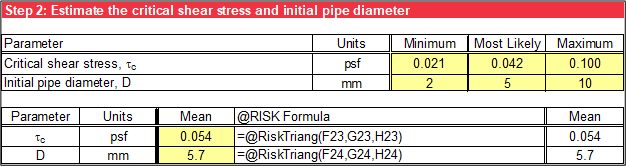
For probabilistic analysis using @RISK, input the minimum, most likely, and maximum values, and use an @RISK formula for a triangular distribution in the third column as a default. Alternatively, input a valid @RISK distribution in lieu of this default formula, and the user-specified input displays in the fourth column. The mean values used for subsequent calculations are the means for the @RISK distributions entered in the third column. Figure illustrates the probabilistic input using @RISK.
The RMC Erodibility Parameters Toolbox helps estimate the critical shear stress of the embankment core. The toolbox contains empirical relationships and published values based on field and laboratory testing. The RMC Concentrated Leak Erosion (Cracking) Toolbox helps estimate the initial pipe diameter. Because it is very difficult to predict the initial pipe diameter, sensitivity analysis is recommended.
If using @RISK to perform probabilistic analysis, delete unnecessary calculation worksheets because the simulation is performed for all worksheets in the workbook, which is time consuming. If cycling through iterations using @RISK, the displayed results are no longer mean values of the random variables; they are the selected iteration’s values.
The remaining input for step 2 is the base of pipe elevation. When setting up this worksheet, include a headwater partition for the base of pipe elevation. The probability of initiation of concentrated leak erosion is zero at and below this elevation.
Core Geometry
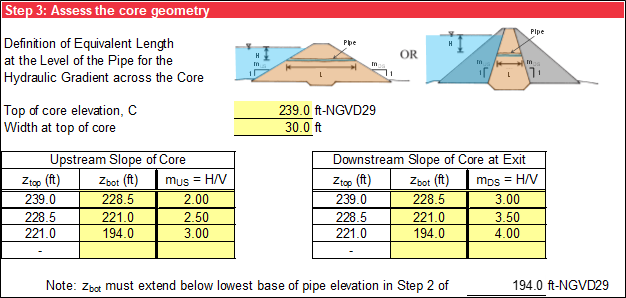
In step 3, the embankment core geometry is defined. Input includes the top of the core elevation, width at the top of the core, and slope data for the core. Slopes are defined by elevation, starting at the top of the core and ending at the base of the embankment. Figure illustrates the core geometry input. Step 4 uses the slopes of the embankment core to calculate the pipe length over which the hydraulic head difference occurs. Therefore, the lowest core elevation (minimum zbot) must be less than or equal to the base of pipe elevation to compute the length. A caution displays with an orange background if the minimum user-specified zbot for the upstream or downstream slope of the core is greater than base of pipe elevation.
Hydraulic Shear Stress
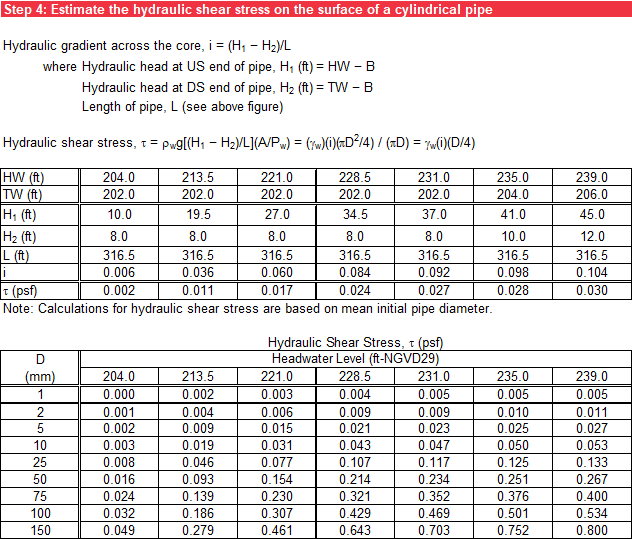
Step 4 calculates the hydraulic shear stress on the surface of the cylindrical pipe from flow of water in the pipe as shown in Equation.
where:
D = initial diameter of the pipe
The average hydraulic gradient used in Equation is calculated by dividing the net hydraulic head across the pipe by the length at the base of the pipe for each defined headwater-tailwater combination.
For a homogenous embankment, the pipe length is measured at the base elevation of the pipe as a straight line from the upstream slope of the embankment to the downstream slope. For a zoned embankment where the upstream and downstream zones are very permeable (e.g., rockfill), the pipe length is measured as a straight line at the base elevation of the pipe from the upstream slope of the impervious core to the downstream slope of the impervious core. Override the formula for pipe length with a user-specified length for embankments with sloping cores, pipe orientations that are not perpendicular to the embankment centerline, etc.
The hydraulic shear stress calculated at the bottom of the first table in Figure is for the mean initial pipe diameter. Because some uncertainty is always present regarding the input parameters for this type of analysis, the second table reports the hydraulic shear stress using the same hydraulic conditions as the first table but for pipe diameters ranging from 1 millimeter to 150 millimeters. The second table is used in step 6 to estimate the critical pipe diameter.
Likelihood of Initiation of Concentrated Leak Erosion
Step 5 compares the calculated hydraulic shear stress on the surface of the cylindrical pipe from flow of water in the pipe to the critical shear stress for initiation of concentrated leak erosion. The factor of safety (FS) against initiation of concentrated leak erosion is calculated as shown in Equation.
where:
τcr = critical shear stress for initiation of concentrated leak erosion
τ = hydraulic shear stress on the surface of the cylindrical pipe from flow of water in the pipe
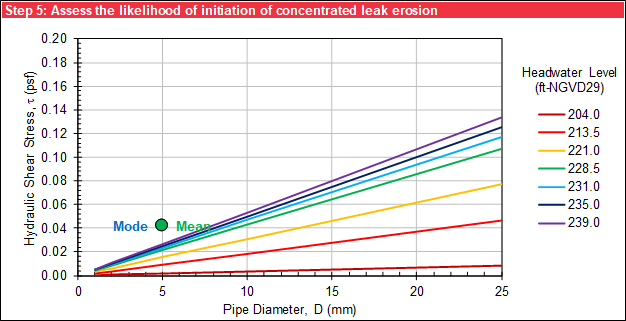
For deterministic analysis, the mean hydraulic shear stress is plotted for each headwater level as a function of pipe diameter and results in a series of straight lines. The mean and mode initial pipe diameter and critical shear stress defined in step 2 are plotted as a point on the chart. When this point plots above the line of the headwater level being considered, the FS is greater than 1, and initiation of concentrated leak erosion is not predicted. When this point plots below the line, the FS is less than 1, and initiation is predicted. Cells that do not apply have a gray background. Figure illustrates the graphical output of hydraulic shear stress for deterministic analysis.
For probabilistic analysis, a black box is also plotted showing the distribution limits for initial pipe diameter and critical shear stress. Initiation is predicted for initial pipe diameter and critical shear stress combinations that plot inside the black box and below the line corresponding to the headwater level being evaluated. If cycling through iterations using @RISK, the displayed mean pipe diameter and critical shear stress are no longer mean values; they are the selected iteration’s values. Figure provides an example of the graphical output of hydraulic shear stress for probabilistic analysis.
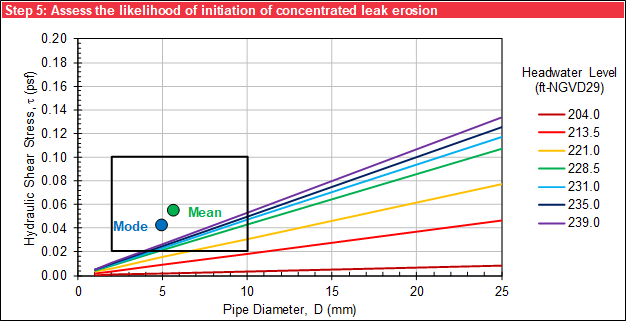
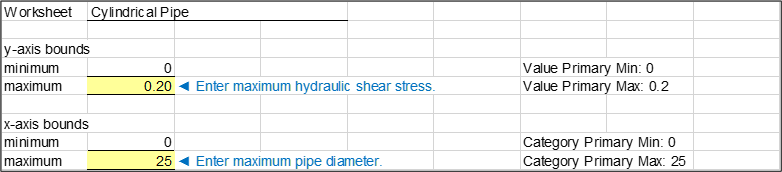
Figure illustrates the plot options for this chart. The maximum value for the y-axis (hydraulic shear stress) and maximum value for the x-axis (pipe diameter) are user-specified.
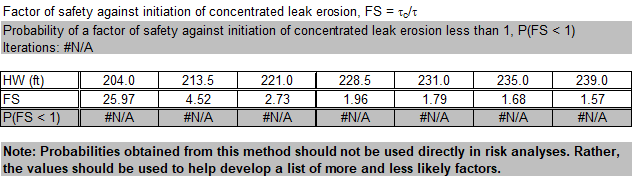
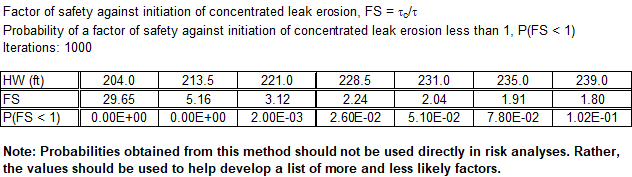
For deterministic analysis, the FS is calculated using the most likely values of the random variables and summarized in separate tables. Cells that do not apply have a gray background. For probabilistic analysis, the FS is calculated as described for the deterministic analysis but for the mean values of the random variables, and multiple iterations are performed by sampling the distributions in step 6. The probability of initiation is equal to the percentage of iterations that resulted in a FS less than 1 [(P(FS < 1)]. For probabilistic analysis performed without using @RISK, 1,000 iterations are used. For probabilistic analysis using @RISK, the number of iterations is user-specified, and “@RISK” displays in parentheses after the number of iterations for this scenario. If cycling through iterations using @RISK, the displayed results are no longer mean values; they are the selected iteration’s values. For deterministic and probabilistic analyses, cells with FS less than 1 have an orange background. Figure illustrates the deterministic tabular output, and Figure illustrates the probabilistic tabular output without using @RISK.
At the end of step 5, summary plots are generated. The first plot is the mean FS against initiation of concentrated leak erosion as a function of headwater level. A deterministic analysis uses only the mean critical shear stress and the mean initial pipe diameter. The result is plotted as a blue line, and a gray background is applied to the drop-down list above the plot signifying it does not apply. A horizontal reference line is displayed in black for a FS of 1.0. Figure illustrates graphical output for deterministic analysis.
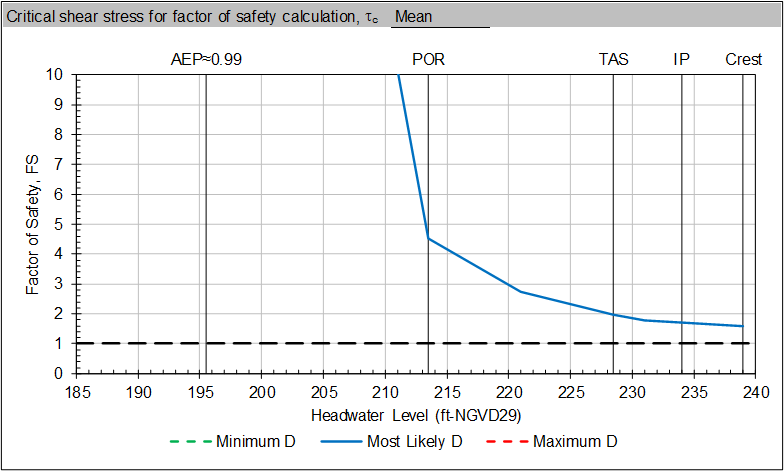
For probabilistic analysis, use the drop-down list above the plot to select a critical shear stress other than the mean for the FS calculation. Options include the minimum, most likely, and maximum critical shear stress. Additionally, along with the mean initial pipe diameter, the FS against for initiation of concentrated leak erosion is plotted for the minimum (green dashed line) and maximum (red dashed line) initial pipe diameter. If cycling through iterations using @RISK, the plotted FS is calculated using the hydraulic shear stress for the selected iteration and the critical shear stress from the drop-down list. Figure provides an example of the graphical output for probabilistic analysis.
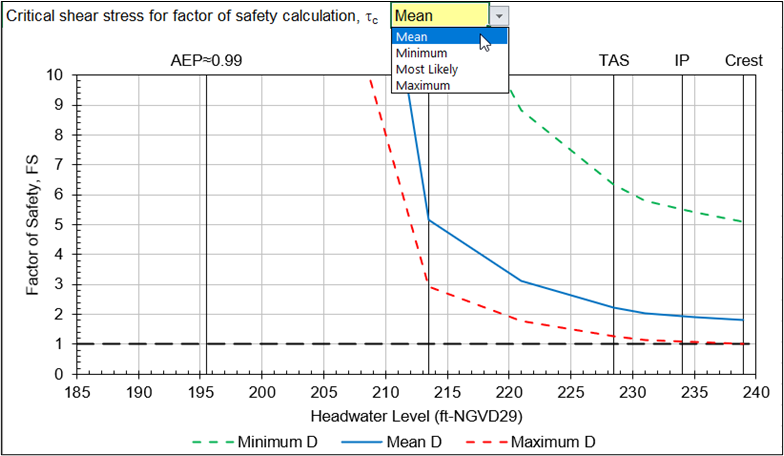
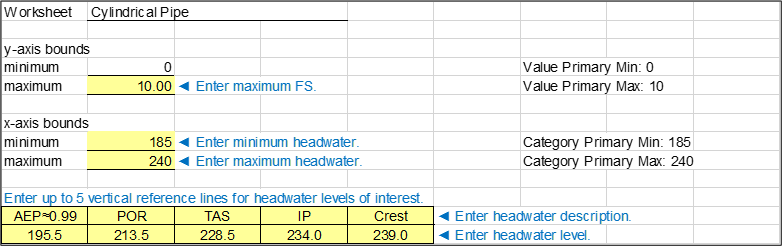
Figure illustrates the plot options for Figure. The maximum value for the y-axis (FS against initiation of concentrated leak erosion) and minimum and maximum values for the x-axis (headwater level) are user-specified. Up to five vertical reference elevations can be defined with user-specified labels displayed at the top of the chart.
The second plot is the probability of initiation of concentrated leak erosion as a function of headwater level. For deterministic analysis, a probability of initiation of concentrated leak erosion is not calculated, and this plot has a gray background. For probabilistic analysis, the mean probability of initiation of concentrated leak erosion displays. If cycling through iterations using @RISK, this plot has a gray background because the probability of initiation cannot be calculated from a single iteration. Similarly, this plot has a gray background for deterministic analysis. Figure illustrates the graphical output for probabilistic analysis.
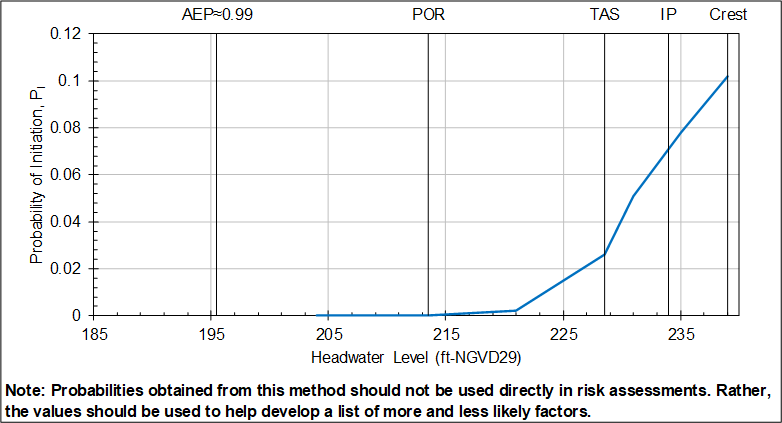
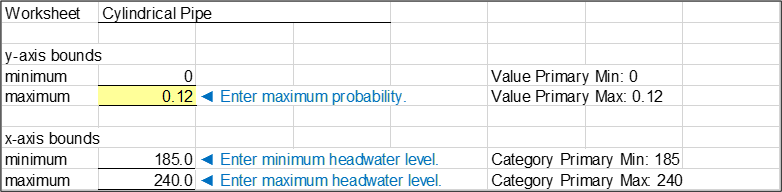
Figure illustrates the plot options for this chart. The vertical reference elevations and minimum and maximum values for the x-axis (headwater level) are the same as the previous chart. Only the maximum value for the y-axis (probability of initiation of concentrated leak erosion) is user-specified.
Headwater Level for Initiation of Concentrated Leak Erosion
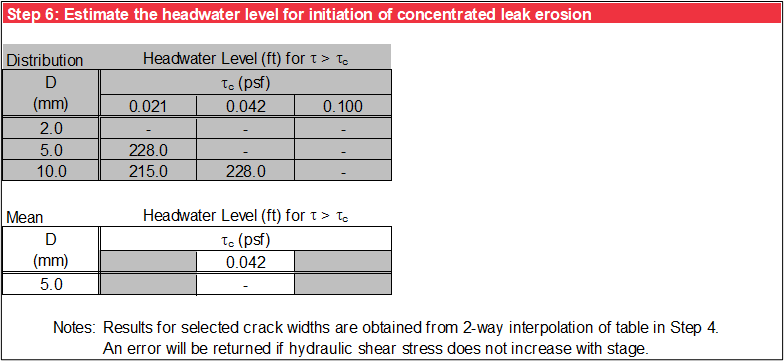
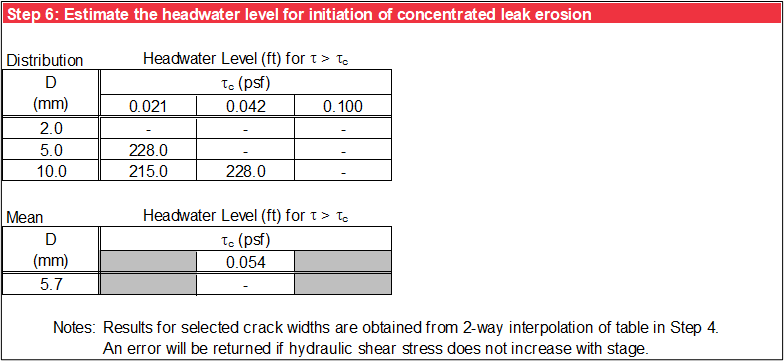
Step 6 calculates the headwater level for initiation of concentrated leak erosion. The results for different combinations of the initial pipe diameter and critical shear stress are linearly interpolated from the tables in step 4. The first table (Distribution) considers the combinations created by the distribution input in step 2 and is available only when probabilistic analysis is selected. For deterministic analysis, this table has a gray background. The second table (Mean) considers the mean initial pipe diameter and the mean critical shear stress and is available for both deterministic and probabilistic analyses. If the critical shear stress is less than the hydraulic shear stress for the minimum specified headwater level, the headwater level for initiation so indicates. If the critical shear stress is greater than the hydraulic shear stress for the maximum specified headwater level or if the hydraulic shear stress does not increase with an increase in headwater level (e.g., because of an increase in the tailwater level), the headwater level for initiation cannot be calculated, and an error displays. For deterministic analysis, the mean value in the second table is equal to the most likely (or mode) value. Figure and Figure provide examples of critical headwater levels for deterministic and probabilistic analyses, respectively.
Critical Pipe Diameter for Initiation of Concentrated Leak Erosion
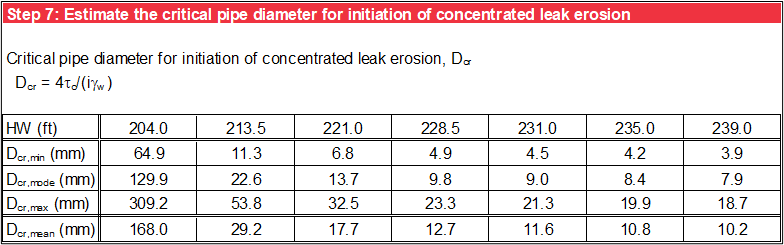
Step 7 calculates the critical pipe diameter for initiation of concentrated leak erosion (Dcr) for each headwater level using Equation.
This equation was derived by solving Equation for the pipe diameter and setting the hydraulic shear stress equal to the critical shear stress.
For deterministic analysis, the calculations for the minimum and maximum critical pipe diameters have a gray background, and the most likely (mode) and mean critical pipe diameter are equal at each headwater level evaluated because the mode and mean critical shear stress are equal. Figure provides an example for deterministic analysis.
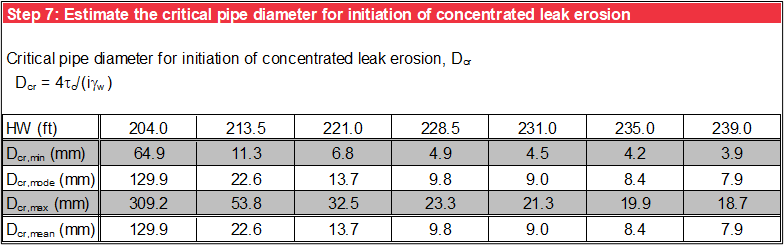
For probabilistic analysis, the critical pipe diameter for each headwater level is calculated using the minimum, most likely (mode), maximum, and mean critical shear stress, where Dcr,min is based on the minimum τc; Dcr,mode is based on the most likely (mode) τc; Dcr,max is based on the maximum τc; and Dcr,mean is based on the mean τc. Figure provides an example for probabilistic analysis.