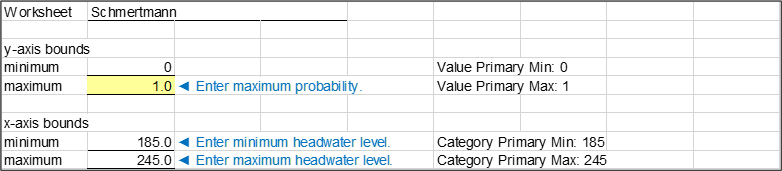
Schmertmann
Schmertmann (2000) [?] developed an approach for estimating the factor of safety (FS) regarding piping using the concept of ambient, pre-pipe, hydraulic gradients along the potential piping path based on laboratory flume tests. The FS for pipe progression is given in Equation:
where:
ipmt = maximum pre-pipe hydraulic gradient along the pipe path in the reference laboratory test (that is, laboratory horizontal critical gradient)
if = maximum pre-pipe hydraulic gradient along the pipe path in the field
CD = depth/length factor
CL = total pipe length factor
CS = grain-size factor
CK = anisotropic permeability factor
Cγ = density factor
CZ = underlayer factor
Cα = adjustment for pipe inclination
CR = embankment axis curvature factor
Schmertmann applied these correction factors to more than 100 laboratory flume tests to adjust the laboratory results to the reference values shown in Table.
| Parameter | Minimum |
|---|---|
| Seepage path length, L | 5 feet |
| Piping Layer Depth, D | 1 foot |
| Particle size with 10% passing by weight, d10 | 0.20 millimeters |
| Anisotropy, | 1.5 |
| Relative density, Dr | 60 percent |
| Pipe path inclination, α | 0 degrees |
From the corrected values, Schmertmann proposed a no-test default relationship as the default value of ipmt to use in assessments if laboratory flume tests were not conducted, shown in Equation and Figure.
where
Cu = coefficient of uniformity
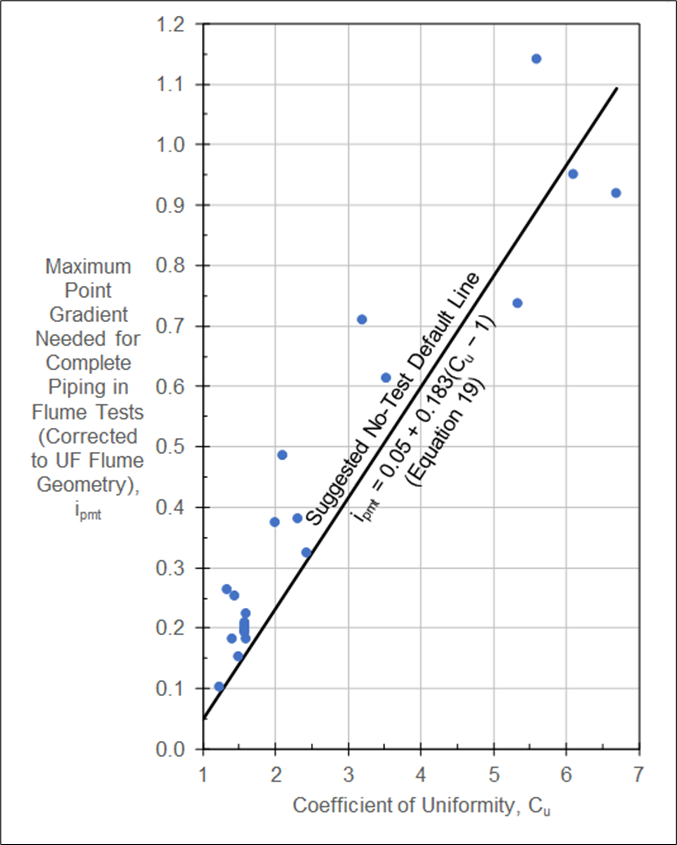
Equation and Equation can be used along with the correction factors to assess the FS for BEP progression in the field. While this figure is quite useful, it is difficult to estimate the uncertainty in the critical point gradient because study averages were presented. For example, one of the single data points is the average from 14 individual laboratory tests.
To assess the likelihood of BEP progression, Robbins and Sharp (2016) [?] compiled all the data in Schmertmann (2000) [?] and developed a probabilistic chart for determining ipmt, again relative to the reference values, as shown in Figure. Robbins and O’Leary (2020) [?] expanded this chart to include 0 percent and 100 percent probability trend lines based on linear extrapolation of the slopes and intercepts of the quantile regression lines.
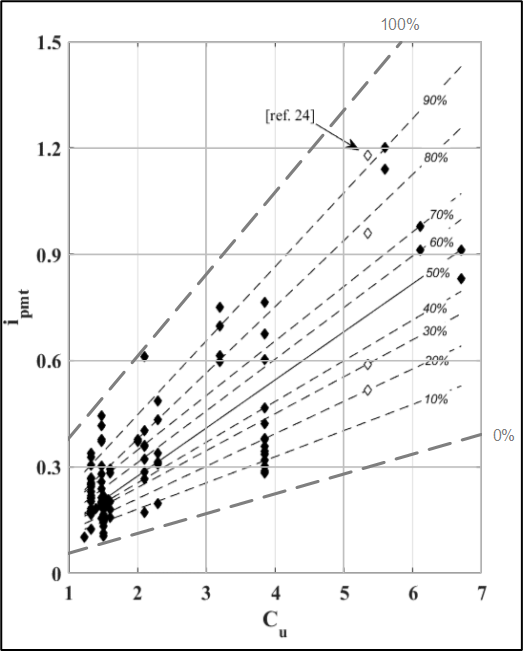
To calculate a probability of BEP progression using the lines shown on the probability chart, the value of ipmt must be calculated for a given field scenario as shown in Equation.
The probabilistic chart from Robbins and Sharp (2016) [?] shows that the uncertainty with the laboratory critical gradient increases with increasing Cu, where there is less data. In addition, at higher Cu values, soils tend to become internally unstable. Therefore, the probabilistic chart is limited to a Cu between 1.1 and about 4.
Method of Analysis
In step 1, use the drop-down list to select the method of analysis (probabilistic or deterministic). There are two options for probabilistic analysis. The first performs 1,000 iterations (judged adequate for most applications) without using Palisade's @RISK software. This provides flexibility if an @RISK software license is not available. The second uses @RISK to customize the probabilistic analysis. Use the drop-down list to select Yes if @RISK is to be used and No if @RISK is not used. The three possible scenarios are illustrated in Figure through Figure.



Piping Layer Characterization
Step 2 characterizes the piping layer. The input includes the depth (thickness) of the piping layer (D), coefficient of uniformity (Cu), grain size in the field with 10 percent finer by weight (d10f), anisotropy in the field of the piping layer (Rkf), relative density in the field (Drf), and angle of the pipe path (α). The adjusted Schmertmann method uses the probabilistic chart of Robbins and Sharp (2016) [?], expanded by Robbins and O’Leary (2020) [?], for both the deterministic and probabilistic methods and is limited to Cu between 1.1 and 4. Cu values outside of this range have an orange background. The depth (thickness of the piping layer) is in the direction perpendicular to the angle of the pipe path discussed later in this section.
The selections in Step 1 affect the input for Step 2, and cells that do not apply have a gray background. These cells are not used in subsequent calculations even if data is present.
For deterministic analysis, input only the most likely values. The mean value used for subsequent calculations is the most likely (or mode) value. Figure illustrates the deterministic input.
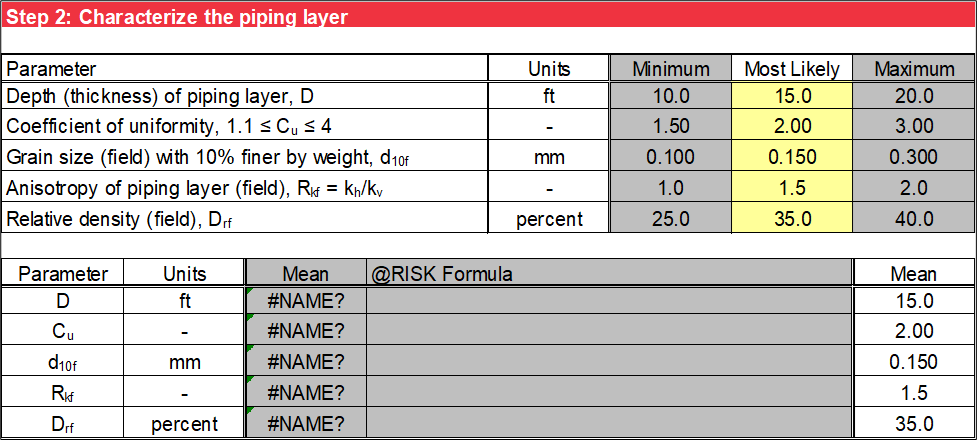
For probabilistic analysis without using @RISK, input the minimum and maximum values in addition to the most likely value, and triangular distributions represent the random variables. The mean values used in subsequent calculations are the average of the minimum, most likely, and maximum values. Figure illustrates probabilistic input without using @RISK.
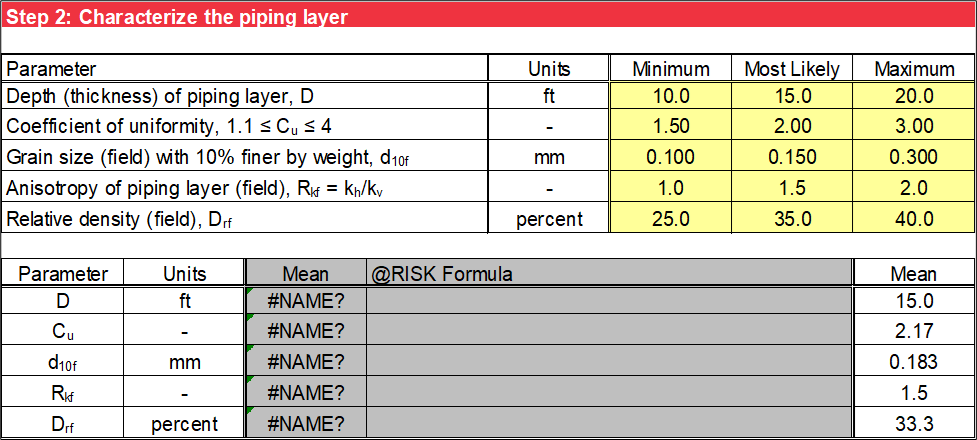
For probabilistic analysis using @RISK, input the minimum, most likely, and maximum values, and use an @RISK formula for a triangular distribution in the third column as a default. Alternatively, input a valid @RISK distribution in lieu of this default formula, and the user-specified input displays in the fourth column. The mean values used for subsequent calculations are the means for the @RISK distributions entered in the third column. Figure illustrates the probabilistic input without using @RISK.
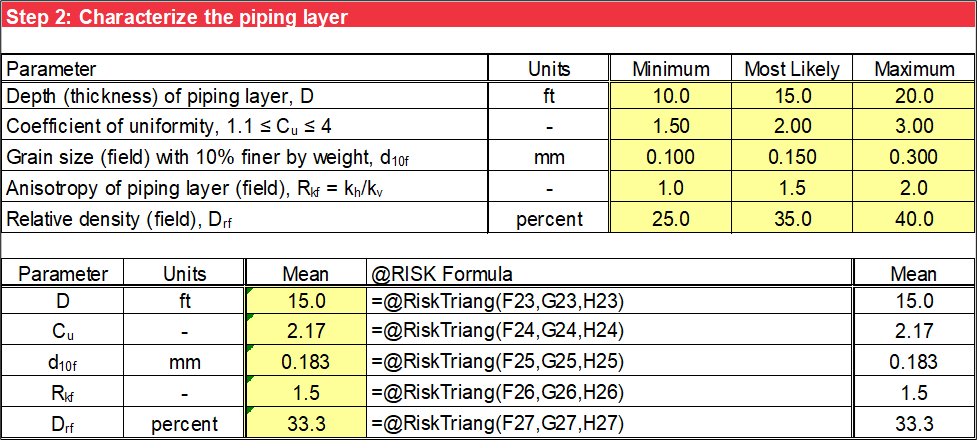
If using @RISK to perform probabilistic analysis, delete unnecessary calculation worksheets because the simulation is performed for all worksheets in the workbook, which is time consuming. If cycling through iterations using @RISK, the displayed results are no longer mean values of the random variables; they are the selected iteration’s values.
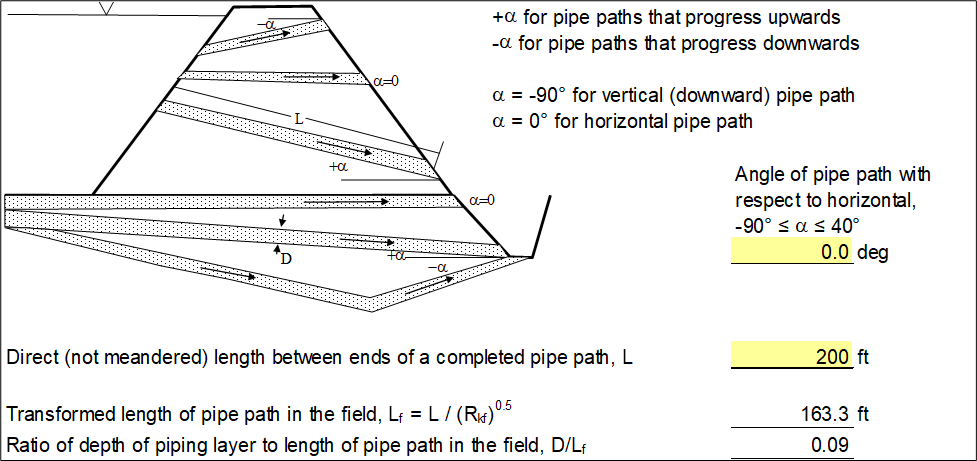
The remaining input for step 2 addresses pipe path geometry as illustrated in Figure and includes the angle of the pipe path (α) with respect to horizontal and the direct (not meandered) length between ends of a completed pipe path (L). A figure is included in this step as a guide.
In most cases, the pipe path is horizontal, and α = 0 degrees. The angle is positive for pipe paths that progress upwards and negative for pipe paths that progress downwards. Based on Schmertmann (2000) [?], the range for α is between -90 degrees and 40 degrees. Cells where the input parameter is outside these limits have an orange background.
Based on the user-specified anisotropy, the ratio of the depth of the piping layer to the length of the pipe path in the field is calculated, and the transformed length of the piping path in the field (Lf) is calculated using Equation.
where:
Rkf = anisotropy in the field of the piping layer (kh/kv)
Laboratory Horizontal Critical gradient
Step 3 estimates the laboratory horizontal critical gradient. Use the drop-down list to indicate if a laboratory flume test was performed. Cells that do not apply have a gray background. For a laboratory flume test, input the measured laboratory horizontal critical gradient as illustrated in Figure. In practice, laboratory flume tests are rarely conducted to measure the critical horizontal gradient, and the linear relationship proposed by Schmertmann (2000) [?] is the primary means for estimating critical gradient values as a function of coefficient of uniformity (Cu). In this toolbox, the 50 percent quantile line from Robbins and Sharp (2016) [?] is used in lieu of Schmertmann’s no-test default line using Equation as illustrated in Figure.
Robbins and Sharp found that the best fit, median line of all test results indicates Schmertmann's no-test default line is conservative for Cu < 3 and unconservative for Cu > 3.


Field Horizontal Critical Gradient
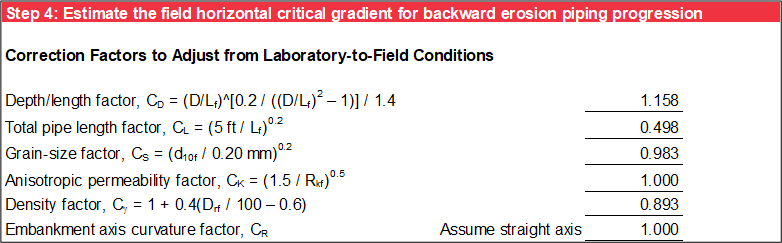
Step 4 calculates the field horizontal critical gradient by applying the various correction factors to the estimated or measured laboratory horizontal critical gradient as illustrated in Figure. The correction factors for foundation depth, seepage path length, grain size, anisotropy, and soil density are estimated using Equation, Equation, Equation, Equation, and Equation. Since a straight axis is assumed for the embankment, there is no correction factor for curvature in the embankment axis, and CR = 1.
where:
= ratio of depth of piping layer to length of pipe path in the field
Lf = transformed length (feet) of the pipe path in the field
= anisotropy in the field (Rkf)
Drf = relative density in the field
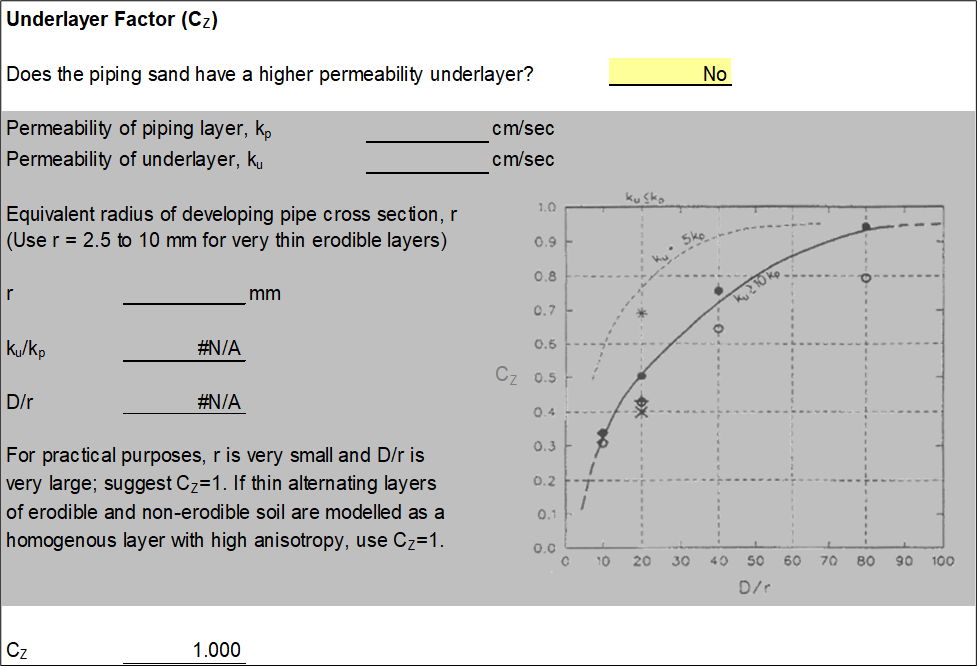
A higher permeability layer beneath the piping layer increases the flow toward the pipe and decreases the critical gradient. Use the drop-down list to indicate the presence of a higher permeability underlayer (for example, fine sand layer over coarse sand layer). If there is no higher permeability underlayer, CZ = 1 as illustrated in Figure. Cells that do not apply have a gray background. If a higher permeability underlayer exists, input the permeability of the piping layer (kp), permeability of the underlayer (ku), and equivalent radius of the developing pipe cross section (r) to estimate the underlayer correction factor (CZ).
Schmertmann (2000) [?] provided CZ as a function of for , , and based on very limited data derived from flow nets of the University of Florida flume. CZ is obtained from two-way linear interpolation using these three curves as illustrated in Figure. Fell et al. (2008) [?] suggests using CZ = 1 since r is very small and is typically very large in practice; CZ is approximately 1 when is greater than about 80. For very thin erodible layers (less than a couple of feet), Fell et al. (2008) [?] suggested using r = 2.5 to 10 mm, where the horizontal critical gradient decreases as r increases. If thin alternating layers of erodible and non-erodible soil are modeled as a homogenous layer with high anisotropy, use CZ = 1.
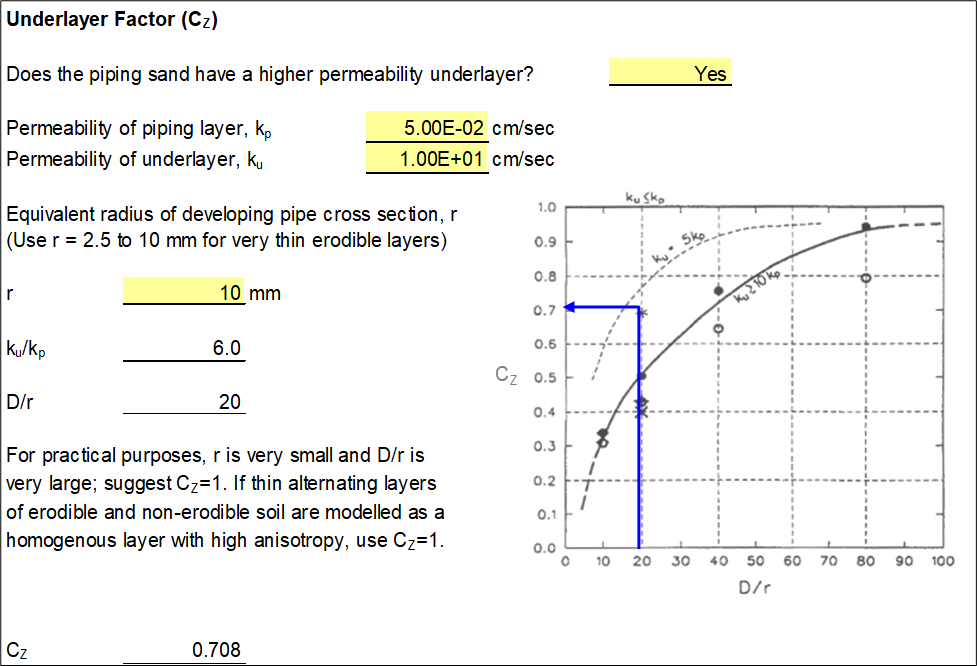
The field horizontal critical gradient is calculated using the above correction factors and Equation as illustrated in Figure.

Pipe Path Inclination
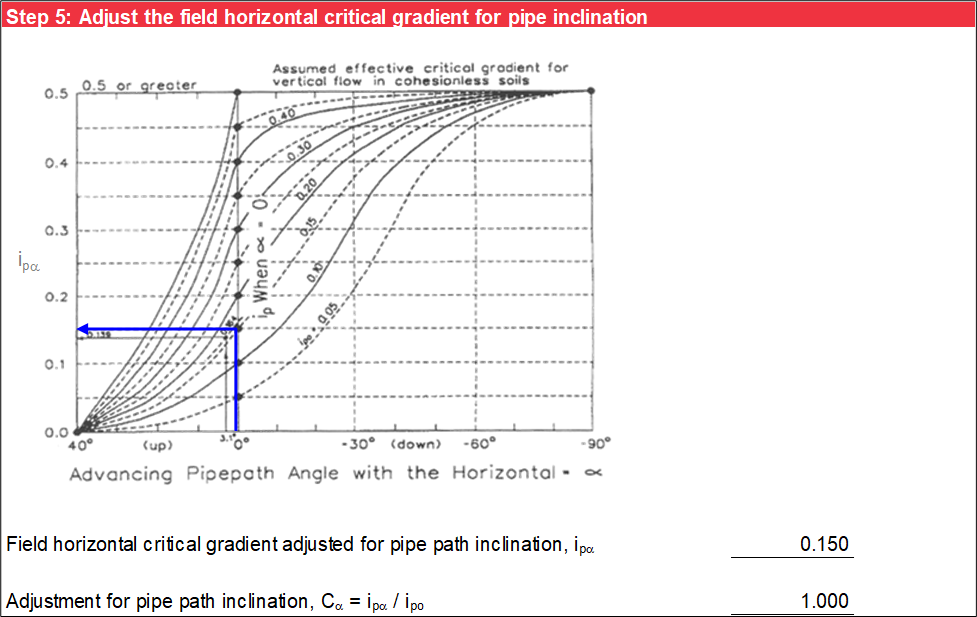
Step 5 determines the adjustment for pipe path inclination. In most cases, the pipe path is horizontal (α = 0 degrees), and Cα= 1. Cells that do not apply have a gray background. If the pipe path inclination is not zero, Schmertmann (2000) [?] provided the field critical gradient adjusted for pipe path inclination (ipα) as a function of α for field horizontal critical gradients (ipo) of 0.05, 0.10, 0.15, 0.20, 0.25, 0.30, 0.35, 0.40, 0.45, and 0.50 or greater, as illustrated in Figure. ipα is obtained from two-way linear interpolation using these ten curves. The back-calculated adjustment for pipe path inclination uses Equation.
Field Critical Gradient for BEP progression
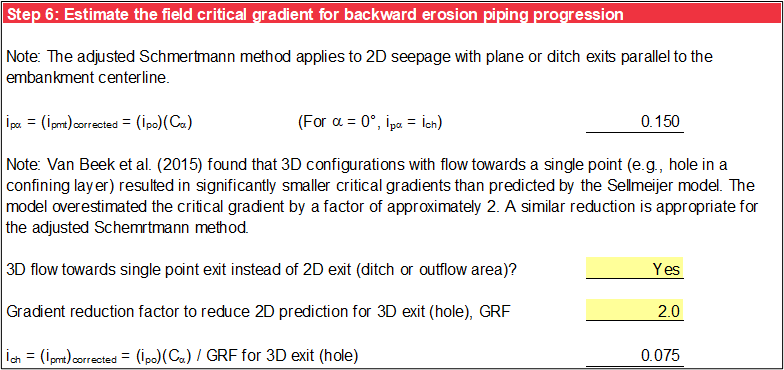
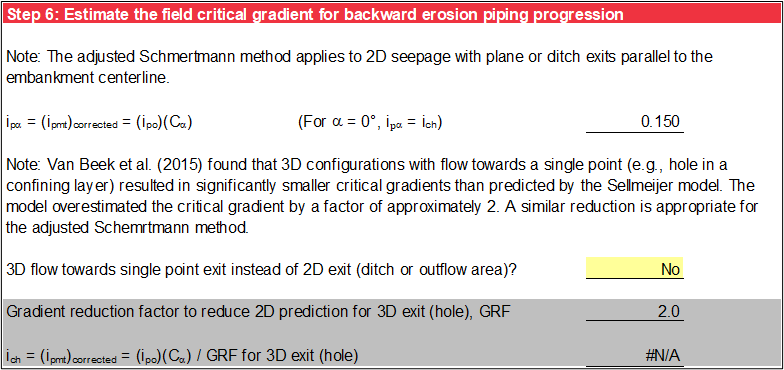
Step 6 adjusts the field horizontal critical gradient for pipe path inclination using the adjustment for pipe path inclination (Cα) from step 4 using Equation.
If the pipe path is horizontal, ipα = ich because Cα = 1.
Schmertmann’s adjusted model applies to 2D seepage with plane or ditch exits parallel to the embankment centerline. Van Beek et al. (2015) [?] found that three-dimensional (3D) configurations with flow toward a single point (such as a hole in a confining layer) resulted in significantly smaller critical gradients than predicted by the Dutch piping model. In both the small and medium-scale experiments, the model overestimated the critical gradient by a factor of approximately two. Although not developed and calibrated for this method, a similar reduction for a 3D exit condition is appropriate. If the field horizontal critical gradient is further adjusted for 3D flow, input a user-specified gradient reduction factor (GRF). Cells that do not apply have a gray background. Figure and Figure illustrate the two scenarios.
Likelihood of Backward Erosion Piping Progression
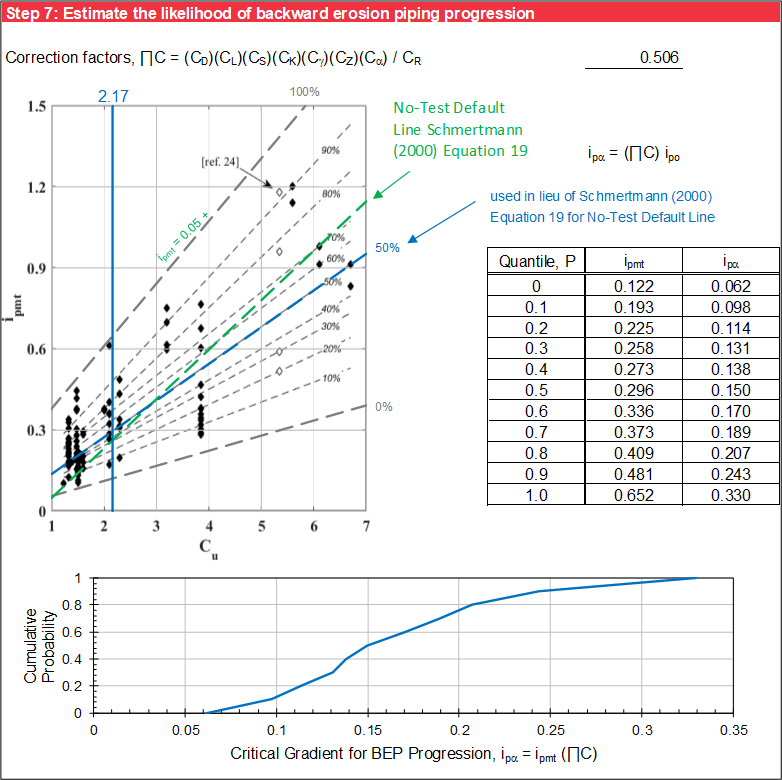
Robbins and Sharp (2016) [?] presented the results of a best-fit quantile regression analysis from the individual laboratory flume tests, which were expanded by Robbins and O'Leary (2020) [?] to include 0 percent and 100 percent probability trend lines based on linear extrapolation of the slopes and intercepts of the quantile regression lines. Step 7 uses this modified chart to develop a cumulative density function to estimate the probability of BEP progression as illustrated in Figure.
The average horizontal gradient in the foundation at the pipe head is calculated by dividing the net hydraulic head by the seepage path length using Equation.
where:
ΔH = net hydraulic head (feet)
HW = headwater level (feet)
TW = tailwater level (feet)
L = direct (not meandered) seepage path length (feet)
The FS against BEP progression is calculated using Equation.
where:
ipα = critical gradient for BEP progression (adjusted for pipe path inclination)
iavf = average horizontal gradient in the foundation at the pipe head
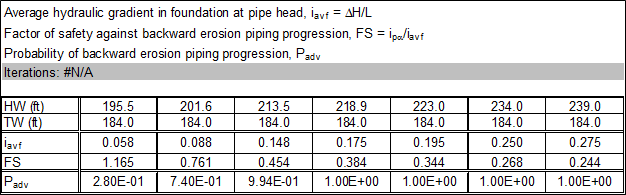
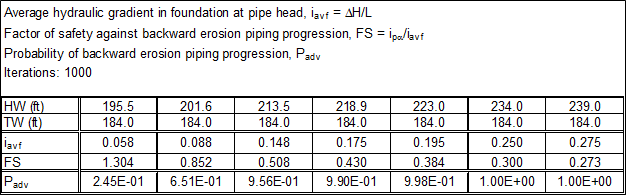
For deterministic analysis, the FS is calculated using the most likely values of the random variables and summarized in a table. Cells that do not apply have a gray background. For probabilistic analysis, the FS is calculated as described for the deterministic analysis but for the mean values of the random variables, and multiple iterations are performed by sampling the distributions in step 2. The probability of BEP progression is equal to the percentage of iterations that resulted in a FS less than 1 [P(FS < 1)]. For probabilistic analysis performed without using @RISK, 1,000 iterations are used. For probabilistic analysis using @RISK, the number of iterations is user-specified, and “@RISK” displays in parentheses after the number of iterations for this scenario. If cycling through iterations using @RISK, the displayed results are no longer mean values; they are the selected iteration’s values. For deterministic and probabilistic analyses, cells with FS less than 1 have an orange background. Figure illustrates the deterministic tabular output, and Figure illustrates the probabilistic tabular output without using @RISK.
Summary Plots
Step 8 generates the summary plots. The first plot is the mean FS against BEP progression (red solid line) and average horizontal gradient at the pipe head (green solid line) as functions of headwater level. If cycling through iterations using @RISK, the displayed results are no longer mean values; they are the selected iteration. FS against BEP progression is plotted on the primary axis, and average horizontal gradient at the pipe head is plotted on the secondary axis. Horizontal reference lines display for the mean field critical gradient for BEP progression (green dashed line) and FS of 1 (red shaded line).
Figure illustrates the deterministic graphical output.
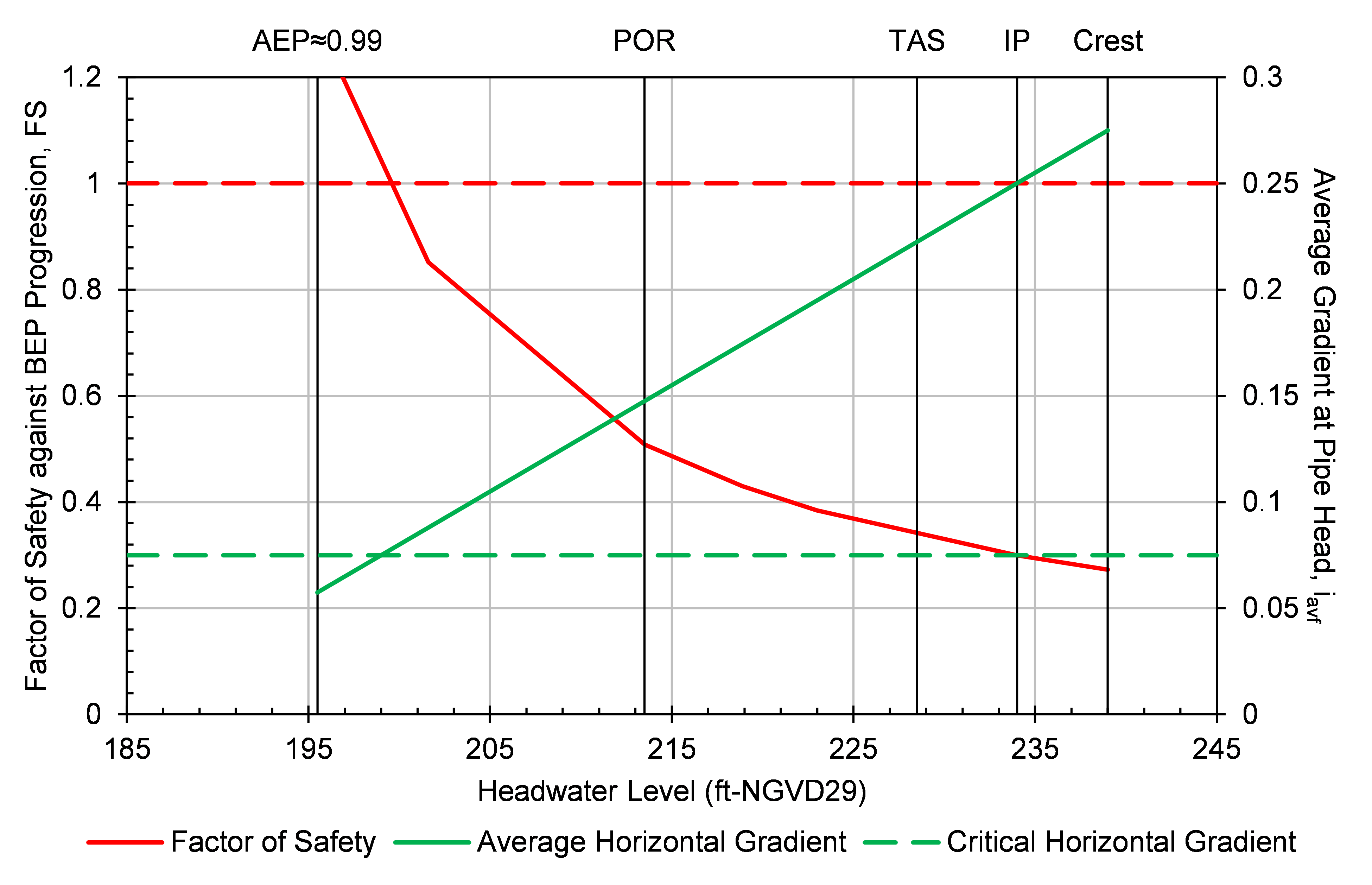
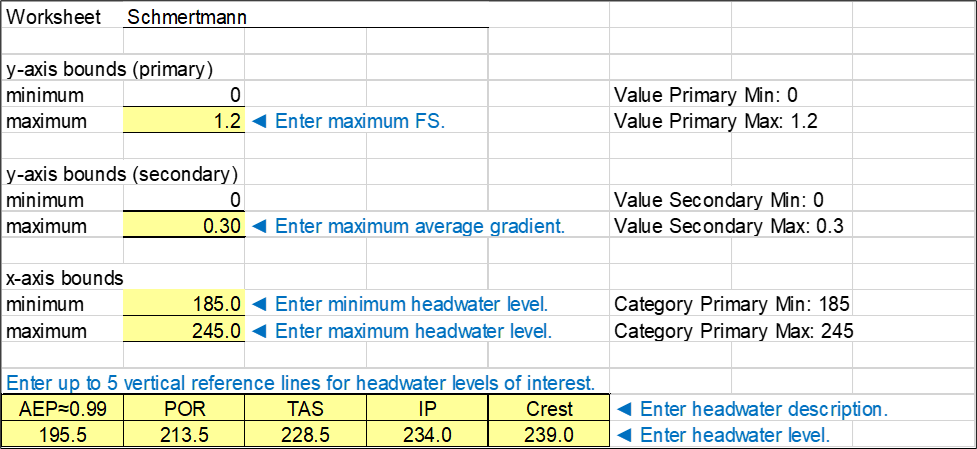
Figure illustrates the plot options this chart. The maximum value for the primary y-axis (FS against BEP progression), maximum value for the secondary y-axis (average horizontal gradient at the pipe head), and minimum and maximum values for the x-axis (headwater level) are user-specified. Users can input up to five vertical reference elevations, and user-specified labels display at the top of the chart.
Because the adjusted Schmertmann method uses the probabilistic chart of Robbins and Sharp (2016) [?], expanded by Robbins and O’Leary (2020) [?], a probability of BEP progression is calculated for both the deterministic and probabilistic methods as illustrated in Figure and Figure, respectively. The mean probability of BEP progression is plotted as a function headwater level. For probabilistic analysis, the 90 percent uncertainty bounds (5th and 95th percentiles) are also plotted as a function headwater level using dashed lines, as shown in Figure.
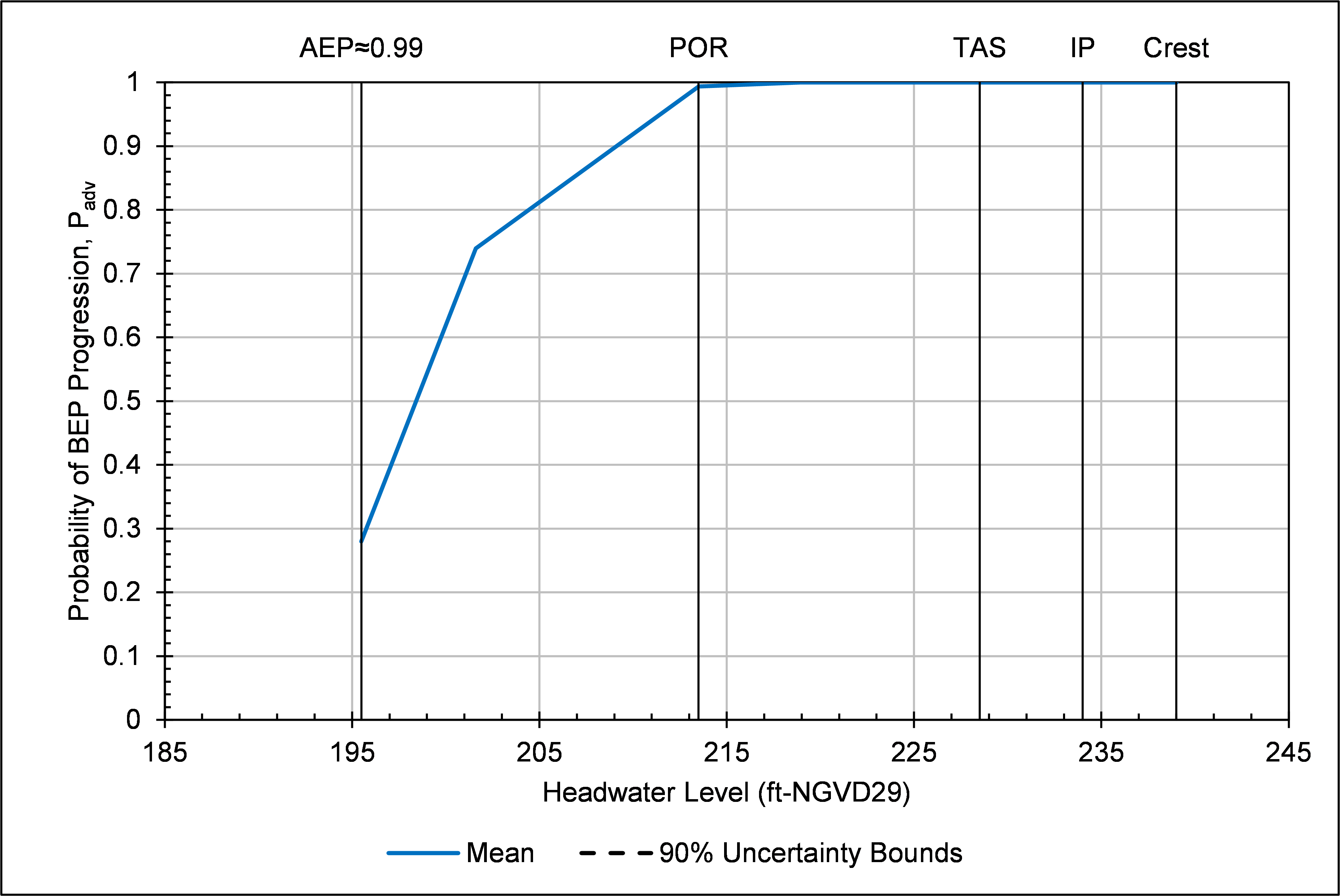
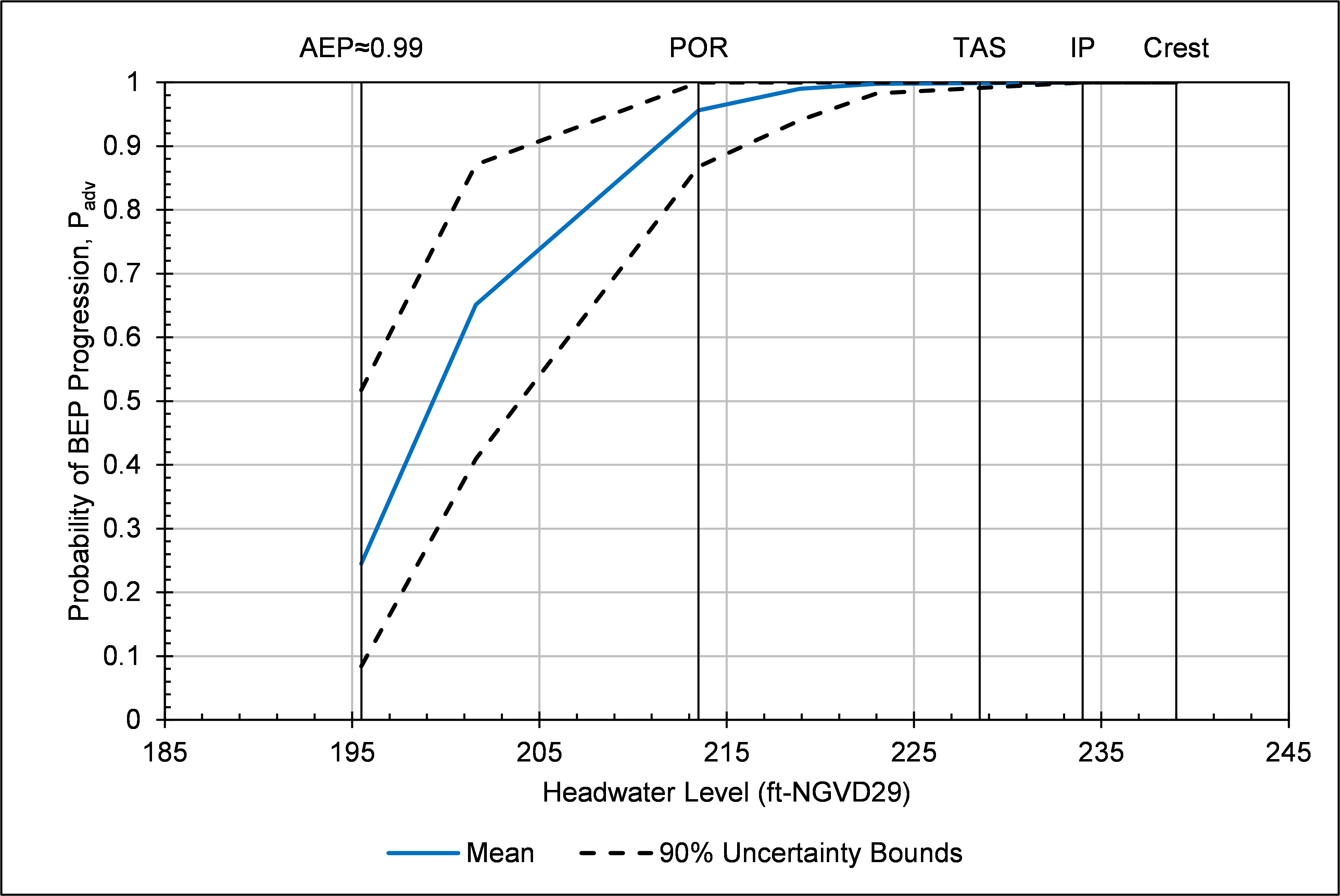
Figure illustrates the plot options for the charts in Figure and Figure. The vertical reference elevations and minimum and maximum values for the x-axis (headwater level) are the same as Figure. Only the maximum value for the y-axis (probability of BEP progression) is user-specified.