

Background
Backward erosion piping (BEP) is the detachment of soil particles that occurs at a free, unfiltered surface in which the process gradually works its way toward the upstream or floodside of the embankment or its foundation until a continuous pipe is formed. Erosion initiates at the downstream side of a dam or the landside of a levee through unfiltered seepage exits that may exist due to penetrations or weaknesses in the overlying blanket, such as ditches, animal burrows (such as rodent or crawfish holes), root holes, former sand boils, cracks, or other thin or weak spots. Once erosion initiates, the pipe may progress horizontally through the foundation in the direction toward the impounded water if hydraulic gradients in the foundation are sufficiently high. The hydraulic gradients and flow must remain high near the upstream or floodside tip of the progressing pipe for particles to continue eroding.
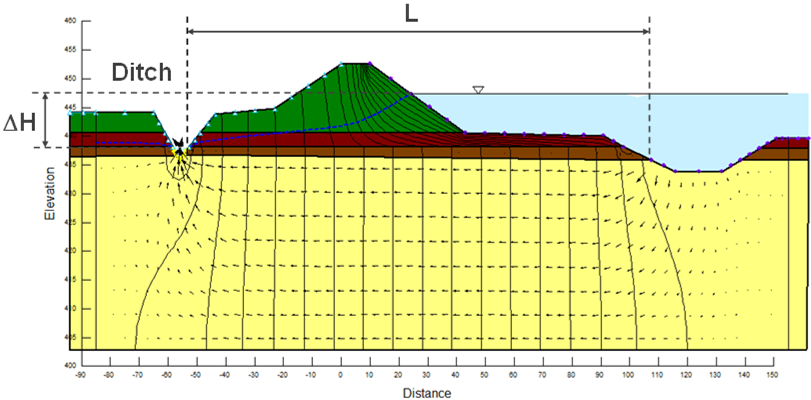
To assess the likelihood of BEP progression (hydraulic condition), the global or average horizontal gradient in the foundation at the pipe head, iavf = ΔH/L, as illustrated in Figure, can be compared to the critical horizontal gradient for BEP progression.
There are several methods for assessing the critical horizontal gradient. Creep ratios are an empirical method based on observations of seepage performance for a range of soil types and are among the oldest methods. The inverse of the creep ratio is the average horizontal gradient if there are no vertical structures. More recently, methods based on horizontal gradient have gained more attention for evaluating the potential for BEP of cohesionless soils, specifically based on laboratory research involving laboratory flume tests to study the hydraulic gradient across a structure required to achieve complete pipe formation.
This toolbox deterministically and probabilistically assesses the likelihood of BEP progression using the adjusted Schmertmann (2000) [?] method and the adjusted calculation rule of Sellmeijer et al. (2011) [?], in addition to the creep ratio methods of Bligh (1910) [?] and Lane (1935) [?].
Applying these methods correctly requires an understanding of the context from which each method was developed. Robbins and van Beek (2015) [?] provide a more detailed review of the background, advantages, and disadvantages of each method and the various laboratory test conditions (such as density, exit configuration, soil characteristics, and scale effects) that significantly impact the findings. For example, the adjusted Schmertmann method and adjusted calculation rule of Sellmeijer et al. can be used only for situations that have a purely two-dimensional (2D) seepage regime (applicable only to situations that have uniform boundary conditions parallel to the embankment centerline, such as an exposed ditch or no confining layer). Some methods may not apply to the materials under consideration. For example, the adjusted calculation rule of Sellmeijer et al. applies only within the range of soils tested. For soils beyond the suggested ranges and differing exit configurations, the methods are not necessarily applicable, and the actual critical horizontal gradients may be quite different from what is estimated.