Gradation
This worksheet performs a particle-size analysis of the base soil. The particle-size analysis informs the effective particle diameter (dH) for the Guidoux et al. (2010) [?] method and the median particle diameter (d50) for the Brauns (1985) [?] method.
Coarsest Base Soil Characterization
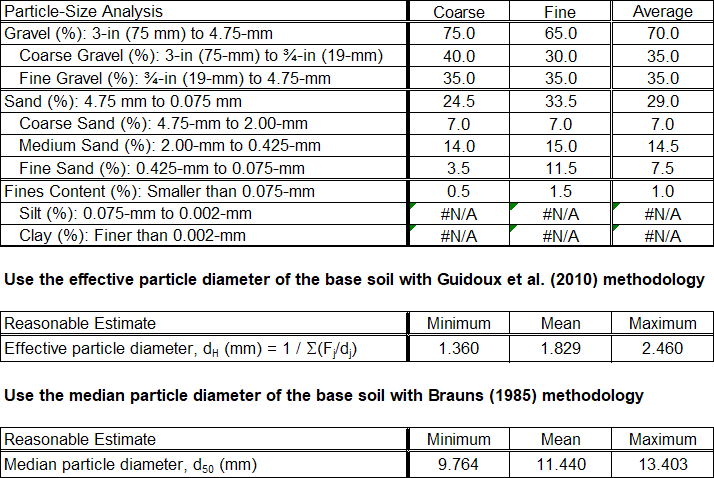
Step 1 inputs the coarsest base soil gradation and calculates the effective particle diameter (dH) and median particle diameter (d50). The input includes sieve size (inches or sieve number), particle size (mm) for hydrometer analysis, and percent finer (by weight).
Use the drop-down list to select the sieve size that defines the gradation of the coarsest base soil. Coarse sieve designations range from 12 inches to 0.25 inch, and standard sieve designations range from No. 3½ to No. 200. The particle size (D) in millimeters is automatically populated if a sieve size is selected. If a hydrometer (sedimentation) analysis was performed on the fine-grained portion of the base soil (i.e., passing the No. 200 sieve), select “Hydrometer” from the drop-down list for sieve size, and input user-specified particle sizes. Particle sizes from sieve or hydrometer analysis must be in descending order.
The user-specified percent finer (by weight) for the coarsest base soil gradation (F) is the percentage of material passing each sieve size or percentage of particles finer than the diameter given by Stokes’ Law for hydrometer analysis. This input must be a decimal number, consisting of a whole number and a fractional part (e.g., 100.0 for 100.0 percent passing, 25.5 for 25.5 percent passing). Cells that do not apply or do not require user-specified input have a gray background. Figure illustrates the gradation input.
For each increment of the base soil gradation curve, the mass fraction (Fj as a decimal), average particle size (dj using geometric mean), and ratio are calculated. The calculations for each increment start in the second row of Figure, since an increment is defined by two consecutive particle sizes in the base soil gradation curve. For the first increment in Figure, the mass fraction of 0.100 is calculated as the difference between the mass passing the 2-inch sieve size and the mass passing the 1.5-inch sieve size (100 percent minus 90 percent), divided by 100 percent. The average particle size of 43.301 mm is calculated as the geometric mean of 50 mm (2-inch sieve) and 37.5 mm (1.5-inch sieve). The calculated ratios for each increment of the base soil gradation curve are summed at the end of the table to use in step 3.
Finest Base Soil Characterization
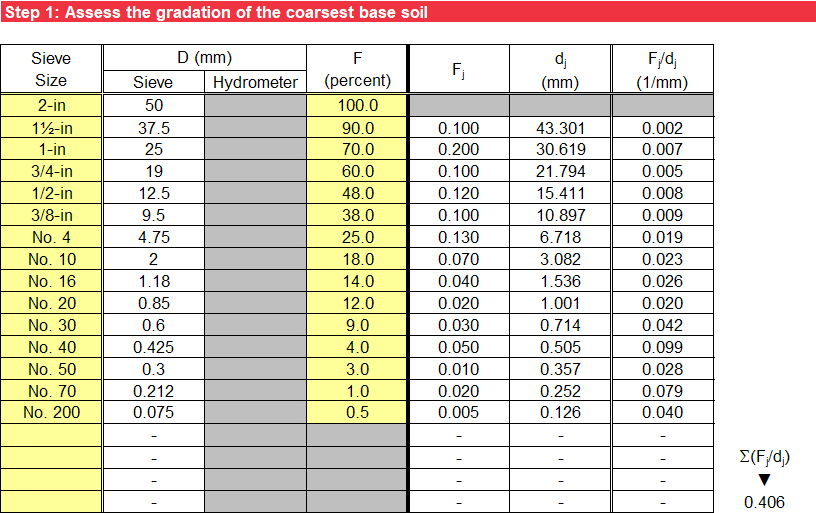
In step 2, the finest base soil gradation characterization is the same as the coarsest base soil gradation as shown in Figure.
Particle Size Analysis
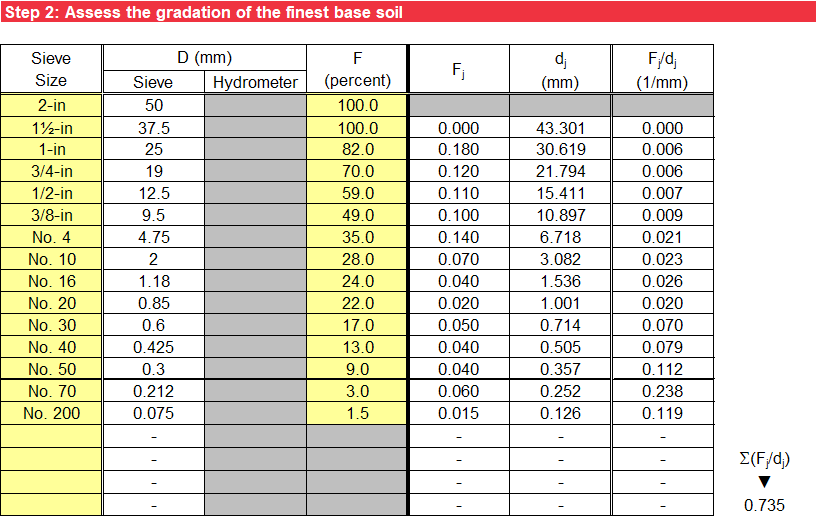
Step 3 plots the user-specified coarsest and finest base soil gradations with particle size on the x-axis and percent passing by weight on the y-axis as shown in Figure. Vertical grid lines correspond to the particle-size boundaries for boulders, cobbles, coarse gravel, fine gravel, coarse sand, medium sand, fine sand, and clay or silt.
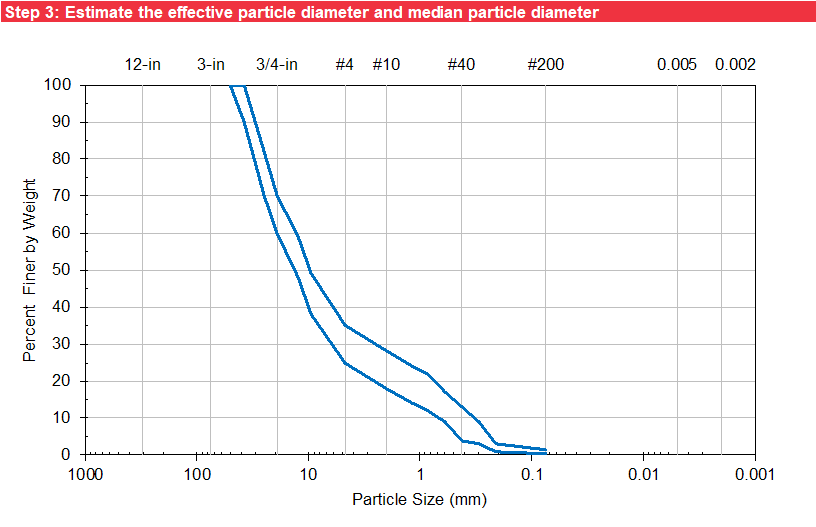
The particle-size analysis for the user-specified gradations from step 1 and step 2 are summarized as shown in Figure. The gravel percentage (including coarse and fine gravel percentages), sand percentage (including coarse, medium, and fine sand percentages), and fines content (FC) (including estimated silt and clay percentages) for the coarsest and finest gradations of the base soil are calculated according to the Unified Soil Classification System (American Society of Testing and Materials [ASTM] D2487). An average percentage is also calculated.
The effective particle diameter of the base soil (dH) is the reciprocal of the sum of the ratios from steps 1 and 2 as shown in Equation.
where:
Fj (-) = mass fraction of the increment j of the base soil gradation curve
dj (mm) = average particle size of the increment j of the base soil gradation curve
The minimum and maximum values correspond to the finest and coarsest base soil gradation, respectively. The mean value corresponds to the geometric mean of the minimum and maximum values.
The median particle diameter of the base soil (d50) is the particle size corresponding to 50 percent finer (by weight). The minimum and maximum values are interpolated using logarithmic scale for particle size and linear scale for percent finer by weight for the finest and coarsest base soil gradations, respectively. The mean value corresponds to the geometric mean of the minimum and maximum values.