

Background
Soil contact erosion is defined as the selective erosion of fine particles from the contact with a coarser layer caused by flow passing through the coarser layer parallel to the contact. It is a scour mechanism like concentrated leak erosion through a crack, but the flow is through a coarse soil layer scouring finer materials in contact with the coarse layer. The field conditions necessary for soil contact erosion are uncommon—the cases that led to lab testing this process apparently were a result of silt levees placed on open-work gravels resulting in sinkholes or subsidence. Generally, soil contact erosion is not likely to lead to breach and is considered a contributing mechanism (e.g., can lead to internal migration and sinkhole development or form a roof/pipe for concentrated leak erosion).
The domain for evaluating initiation of soil contact erosion is defined by a geometric condition and a hydraulic condition. The geometric condition requires that the pores of the coarse soil layer be sufficiently large to allow fine soil particles to pass through, while the hydraulic condition requires that the flow velocity through the coarser layer be sufficient to detach the fine soil particles and transport them. Figure, adapted from Brauns (1985) [?] in Robbins and Griffiths (2018) [?], illustrates the influence of geometry and hydraulic conditions on the critical Froude number for erosion. In this figure, D15F is the particle-size diameter of the filter material (coarse or gravel layer) corresponding to 15 percent passing on the cumulative particle-size distribution curve, and D85B is the particle-size diameter of the base material (fine layer) corresponding to 85 percent passing on the cumulative particle-size distribution curve.
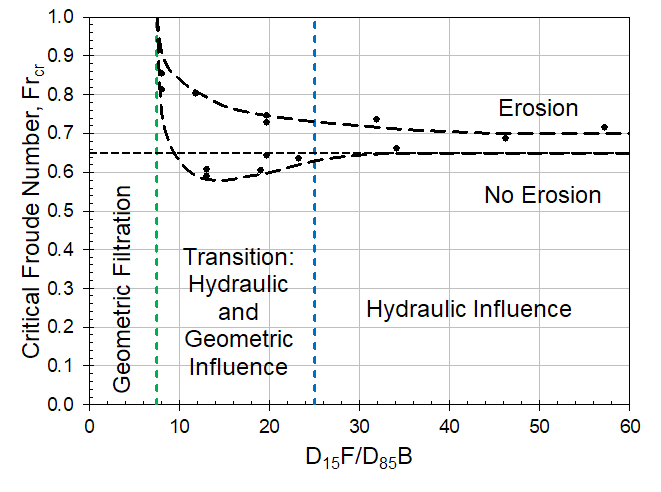
In general, soils with D15F/D85B ratios less than about 7.5 to 8 do not meet the geometric condition and are not susceptible to soil contact erosion. If the geometric condition is met, the critical Darcy velocity of the flow through the filter (coarse layer) at which erosion of the fine base soil is expected must be estimated. A transition zone exists as D15F/D85B approaches the geometric condition in which the critical Darcy velocity depends on both geometric and hydraulic conditions.
Once D15F/D85B becomes greater than about 25 to 30, purely hydraulic conditions control the erosion, and the critical Darcy velocity must be estimated from the method of either Guidoux et al. (2010) [?] for sand, silt, and sand/clay mixtures below gravel or Brauns (1985) [?] for sand below gravel as shown below for porosities of the gravel layer of 0.25 and 0.40. Most of the testing was performed on gravel with a porosity of about 0.40. In Figure, the Brauns (1985) [?] relationship is equivalent to Guidoux et al. (2010) [?] within the range of applicability.
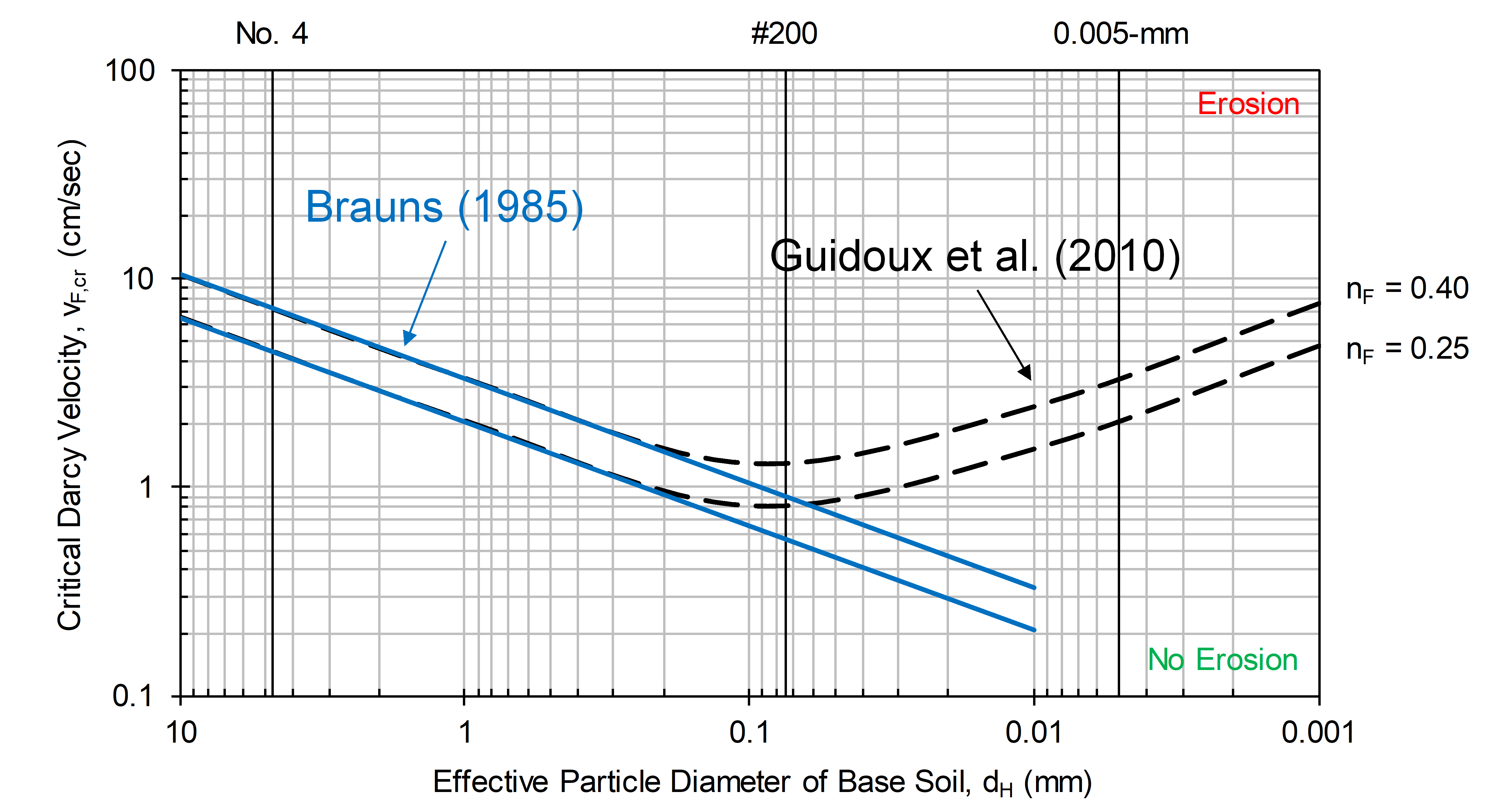
Applying these methods correctly requires understanding the context from which each method was developed, as the laboratory test conditions may vary from field conditions. For example, the Guidoux et al. (2010) [?] and Brauns (1985) [?] methods apply to gravel below fine soil. Experimental data with fine soil above gravel is limited. This phenomenon is complex and cannot be linked to riverine erosion. Influence of confining stress on critical Darcy velocity existed. Although measured critical Darcy velocities were of similar order of magnitude as gravel above fine soil (i.e., between 1 and 10 cm/s), the critical Darcy velocity can be much lower. For silt above gravel where erosion might be expected to initiate when silt particles fall into the gravel, initiation of soil contact erosion depends on the transport of particles, not by detachment. Therefore, neither method applies.