

Background
The effects of local soil conditions on ground motion characteristics must be considered when designing and evaluating structures. Ground motion amplification in soil relative to hard rock is illustrated in Figure. According to Federal Emergency Management Agency publication Earthquake-Resistant Design Concepts: An Introduction , Seismic Provisions for New Buildings (FEMA P-749) (2nd ed.) [?], hard, competent rock efficiently transmits shaking with high-frequency (short-period) energy content but tends to attenuate shaking with low-frequency (long-period) energy content. Deep deposits of soft soil transmit high-frequency motion less efficiently but tend to amplify the low-frequency energy content.
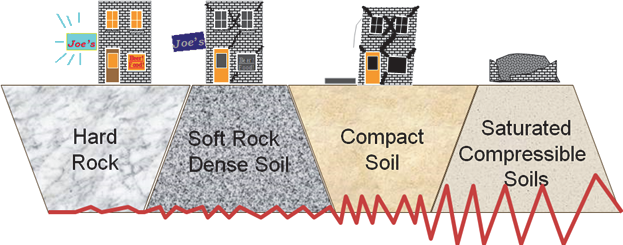
A site response analysis can determine the importance of these effects. However, site class is a simplified method for characterizing the ground motion attenuation and amplifying effects during an earthquake. Site class is defined in terms of the average shear wave velocity in the upper 100 feet of the site profile. Shear waves generated by an earthquake create the strongest horizontal shaking, which is most damaging to structures. Soft soils with lower shear wave velocities generally produce greater amplification than stiff soils with higher shear wave velocities.
The National Earthquake Hazards Reduction Program (NEHRP) Recommended Seismic Provisions defines a suite of site classes to which typical ground motion attenuation and amplification effects are assigned. Site Class A represents a “hard rock” condition, typically found only in the eastern United States. Site Class B represents a “firm rock” condition in the upper 100 feet and indicates limited amplification at the ground surface of predicted bedrock motions. Site Classes C through E represent increasingly looser or softer soil conditions with progressively increasing amplification. Site Class F represents unstable soils requiring site-specific site response analyses.
The site classification procedure is incorporated into seismic design standards and building codes. The RMC Seismic Hazard Curves Toolbox uses the site coefficients in the general procedures in the American Society of Civil Engineers/Structural Engineering Institute’s Minimum Design Loads and Associated Criteria for Buildings and Other Structures (American Society of Civil Engineers [ASCE]/Structural Engineering Institute [SEI] 7-16) [?] to adjust the Site Class B/C hazard curve from the United States Geological Survey (USGS) legacy datasets for the user-specified site class. Since these site coefficients may not be applicable to Site Class F, only Site Classes A through E are evaluated by the RMC Site Classification Toolbox.