

ASCE/SEI 7-16
This worksheet determines the site classification using ASCE/SEI 7-16 [?] when site-specific site response analyses are not required. The site class definitions are based on the average shear wave velocity of the upper 100 feet of the site profile. Measured shear wave velocities should be used for site classification if they are available; however, often they are not available. If measured shear wave velocity data are not available, ASCE/SEI 7-16 [?] provides alternate definitions of site class using the more readily available geotechnical parameters of standard penetration test (SPT) resistance (N or blow count) for cohesionless soils and rock and SPT blow count and undrained shear strength for cohesive soils. Table outlines the six site classes as defined by ASCE/SEI 7-16 [?].
| Site Class | (ft/s) | or (bpf) | (psf) |
|---|---|---|---|
| A. Hard rock | > 5,000 | N/A | N/A |
| B. Rock | 2,500 < ≤ 5,000 | N/A | N/A |
| C. Very dense soil and soft rock | 1,200 < ≤ 2,500 | or > 50 | > 2,000 |
| D. Stiff soil | 600 ≤ ≤ 1,200 | 15 ≤ or ≤ 50 | 1,000 ≤ ≤ 2,000 |
| E. Soft clay | < 600 | or < 15 | < 1,000 |
Any site profile with more than 10 feet of soil with:
| |||
| F. Unstable soils | N/A | N/A | N/A |
Soft Clay Layer
In step 1, the characteristics for Site Class E are evaluated for a total thickness of soft clay greater than 10 feet. A soft clay layer is defined by the following criteria: undrained shear strength (su) less than 500 pounds per square foot (psf) as determined by the American Society for Testing and Materials (ASTM) D2166, Standard Test Method for Unconfined Compressive Strength of Cohesive Soil [?] or ASTM D2850, Standard Test Method for Unconsolidated-Undrained Triaxial Compression Test on Cohesive Soils [?], moisture content (w) greater than or equal to 40 percent as determined by ASTM D2216, Standard Test Methods for Laboratory Determination of Water (Moisture) Content of Soil and Rock by Mass [?], and a plasticity index (PI) greater than 20 as determined by ASTM D4318, Standard Test Methods for Liquid Limit, Plastic Limit, and Plasticity Index of Soils [?].
Each criterion is individually assessed (outside of this toolbox) based on the available site characterization data and judgment, and each criterion that is met is selected using a drop-down list as shown in Figure.

Site Profile Characterization
If all three characteristics of a soft soil layer greater than 10 feet exist in step 1, step 2 is not evaluated, and conditional formatting applies a gray background to step 2. These cells are not used in subsequent calculations even if data is present. If all three characteristics of a soft soil layer greater than 10 feet do not exist in step 1, select the method of analysis to characterize the upper 100 feet of the site profile from the drop-down list.
-
Average shear wave velocity (method 1)
-
Average SPT blow count for cohesionless soils, cohesive soils, and rock (method 2)
-
Average SPT blow count for cohesionless soils and rock and undrained shear strength for cohesive soils (method 3)
The 100-foot site profile is subdivided into a maximum of 14 distinct soil or rock layers based on the site characterization data. Each distinct layer is designated by a number from 1 to n (at the bottom of the site profile). The input includes depth (or elevation) below the ground surface or structure, a description of the layer, and geotechnical parameters based on the selected method of analysis. If site-specific data are not available to a depth of 100 feet, the soil and rock parameters must be estimated based on known geologic conditions and experience to extrapolate the site profile to a depth of 100 feet. The distinct layer thicknesses are computed by subtracting the top and bottom depth (or elevation).
For method 1, the average shear wave velocity in the upper 100 feet of the site profile () is calculated using Equation.
where:
n = number of layers
di = thickness (feet) of any layer
vsi = small-strain shear wave velocity (ft/s) of any layer
The total thickness is calculated using Equation 2.
The sum of the distinct layer thicknesses must be 100 feet, no more and no less. If the sum is not exactly 100 feet, conditional formatting applies an orange background to the cell containing the total thickness of the profile. Figure illustrates Step 2 for method 1.
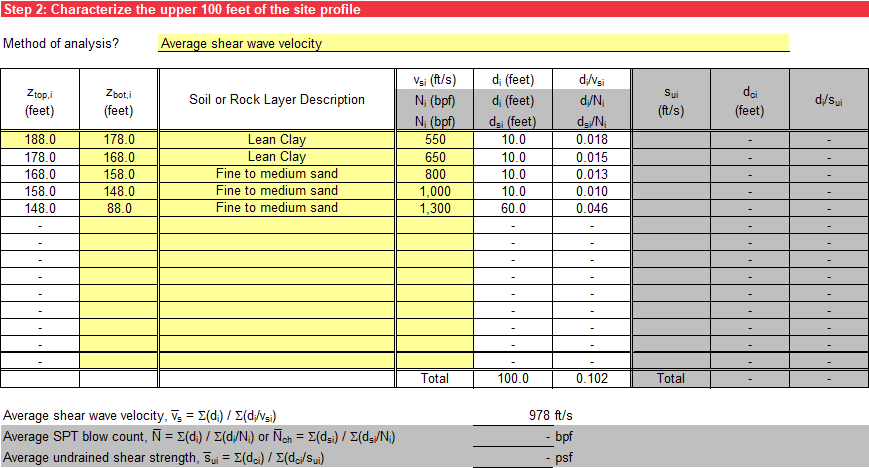
For method 2, the average field SPT resistance () for cohesionless soil, cohesive soil, and rock layers is calculated using Equation.
where:
di = thickness (feet) of any cohesionless soil, cohesive soil, and rock layer
Ni = SPT blow count not to exceed 100 blows per foot (bpf) as directly measured in the field without corrections in accordance with ASTM D1586, Standard Test Method for Standard Penetration Test and Split-Barrel Sampling of Soils
If refusal is met for a rock layer, Ni of 100 bpf can be used. Conditional formatting applies an orange background to Ni values not between 0 and 100 bpf. Figure illustrates Step 2 for method 2.
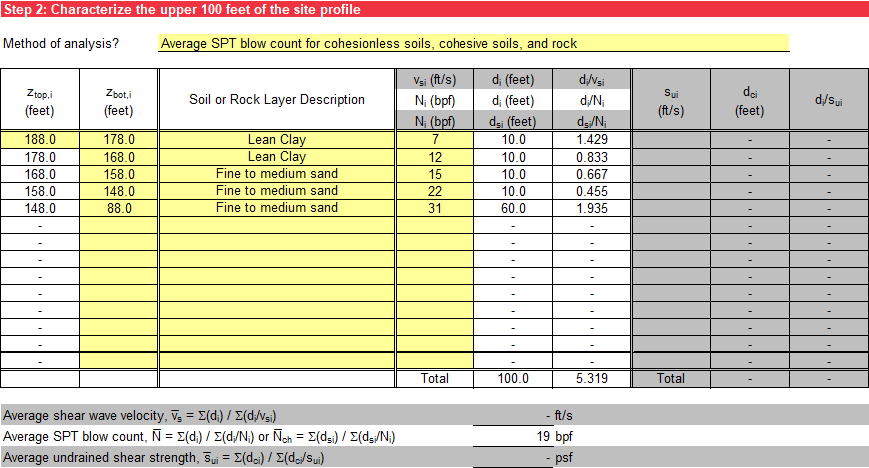
For method 3, the average field SPT blow count for cohesionless soil layers in the upper 100 feet of the site profile () is calculated using Equation.
where:
m = number of cohesionless soil layers
ds = total thickness (feet) of cohesionless soil layers
dsi = thickness (feet) of any cohesionless soil layer
The values of Ni and dsi are only for cohesionless soil layers in the upper 100 feet of the site profile, which are defined in ASCE/SEI 7-16 [?] as having a PI less than 20. The total thickness of cohesionless soil layers (ds) is calculated using Equation.
For method 3, the average undrained shear strength for cohesive soils in the upper 100 feet of the site profile is calculated using Equation.
where:
k = number of cohesive soil layers
dc = total thickness (feet) of cohesive soil layers
dci = thickness (feet) of any cohesive layer
sui = undrained shear strength (psf) not to exceed 5,000 psf
The values of sui and dci are only for cohesive soil layers in the upper 100 feet of the site profile, which are defined in ASCE/SEI 7-16 [?] as having a PI greater than 20. Conditional formatting applies an orange background to sui values not between 0 and 5,000 psf. The total thickness of cohesive soil layers (dc) is calculated using Equation.
For each distinct layer using method 3, either Ni or sui must be input. If a value of Ni only is input, conditional formatting applies a gray background to the corresponding cells for sui that do not require user-specified input and vice versa. If values of both Ni and sui are input for a distinct layer, conditional formatting applies an orange background to both values to indicate one must be deleted. The sum of ds and dc must be 100 feet, no more and no less. If the sum is not exactly 100 feet, conditional formatting applies an orange background to the cells containing the total thickness of cohesionless and cohesive layers. Figure illustrates step 2 for method 3.
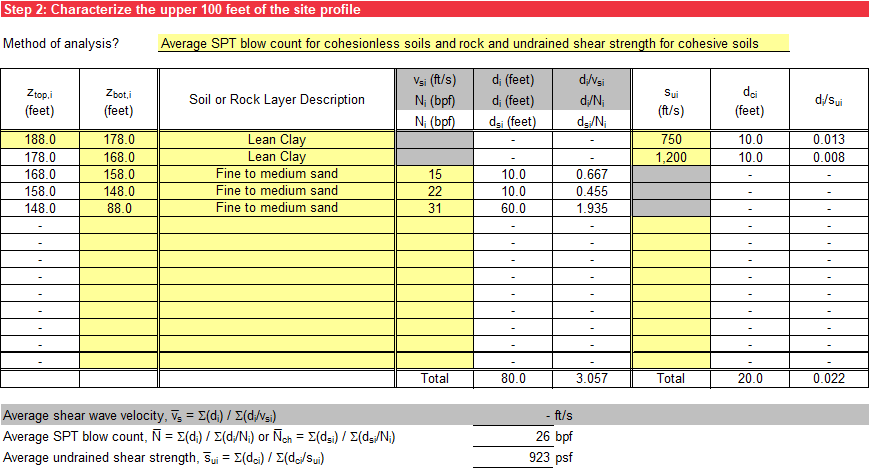
Site Classification
In step 3, the site class is assessed for the selected method of analysis in step 2 as shown in Figure. According to ASCE/SEI 7-16 [?], Site Classes A and B must not be assigned to a site if there are more than 10 feet of soil between the rock surface and the bottom of the structure (or foundation).
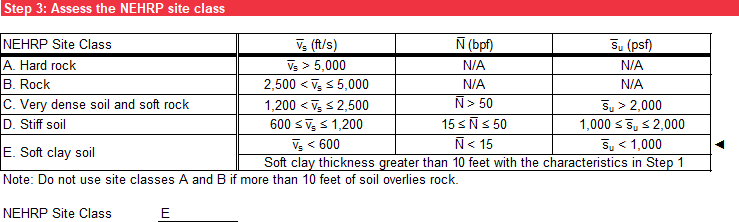
For method 3, the site class is determined using both the average SPT blow count for cohesionless soils and the average undrained shear strength for cohesive soils. If the site classes differ from these two methods, the site class with the softer site class is assigned. For the example data in Figure, the average SPT blow count for cohesionless soils of 26 bpf corresponds to Site Class D, and the average undrained shear strength for cohesive soils of 923 psf corresponds to Site Class E. The site classification is the softer Site Class E.