ASCE/SEI 7-22
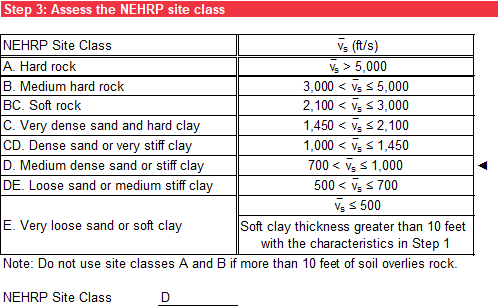
This worksheet determines the site classification using ASCE/SEI 7-22 [?] when site-specific site response analyses are not required. The site class definitions are based on the average shear wave velocity of the upper 100 feet of the site profile. Measured shear wave velocities should be used for site classification if they are available; however, often they are not available. If measured shear wave velocity data are not available, empirical correlations with SPT resistances, cone penetration test (CPT) tip resistance, undrained shear strength, or other geotechnical parameters can be used to obtain an estimated shear wave velocity profile. Table outlines the nine site classes as defined by ASCE/SEI 7-22 [?].
| Site Class | Average Shear Wave Velocity, (ft/s) |
|---|---|
| A. Hard rock | > 5,000 |
| B. Medium hard rock | 3,000 < ≤ 5,000 |
| BC. Soft rock | 2,100 < ≤ 3,000 |
| C. Very dense sand and hard clay | 1,450 < ≤ 2,100 |
| CD. Dense sand or very stiff clay | 1,000 < ≤ 1,450 |
| D. Stiff medium dense sand or stiff clay | 700 < ≤ 1,000 |
| DE. Loose sand or medium stiff clay | 500 < ≤ 700 |
| E. Very loose sand or soft clay | ≤ 500 |
Any site profile with more than 10 feet of soil with:
| |
| F. Unstable soils | N/A |
Soft Clay Layer
This step is the same as described in the Soft Clay Layer section for the ASCE 7-16 worksheet.
Site Profile Characterization
If all three characteristics of a soft soil layer greater than 10 feet exist in step 1, step 2 is not evaluated, and conditional formatting applies a gray background to step 2. These cells are not used in subsequent calculations even if data is present. If all three characteristics of a soft soil layer greater than 10 feet do not exist in step 1, the upper 100 feet of the site profile is characterized using the average shear wave velocity.
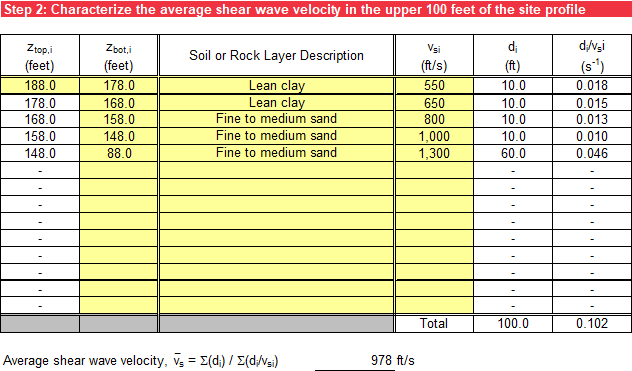
The 100-foot site profile is divided into a maximum of 14 distinct soil or rock layers based on the site characterization data. Each distinct layer is designated by a number from 1 to n (at the bottom of the site profile). The input includes depth (or elevation) below the ground surface or structure, a description of the layer, and measured small-strain shear wave velocity. If site-specific data are not available to a depth of 100 feet, the soil and rock parameters must be estimated based on known geologic conditions and experience to extrapolate the site profile to a depth of 100 feet. The distinct layer thicknesses are computed by subtracting the top and bottom depth (or elevation).
The average shear wave velocity in the upper 100 feet of the soil profile is calculated using Equation.
where:
n = number of layers
di = thickness (feet) of any layer
vsi = small-strain shear wave velocity (ft/s) of any layer
The total thickness is calculated using Equation.
The sum of the distinct layer thicknesses must be 100 feet, no more and no less. If the sum is not exactly 100 feet, conditional formatting applies an orange background to the cell containing the total thickness of the profile. Figure illustrates step 2.
Site Classification
In step 3, the site class is assessed for the average shear wave velocity calculated in step 2 as shown in Figure.