Filter Gradation
This worksheet performs a particle-size analysis of the filter material.
Filter Gradation
The input includes sieve size (inches or sieve number), particle size (mm) for hydrometer analysis, and percent finer (by weight) for representative coarse and fine gradations of the filter material.
Use the drop-down list to select the sieve size that defines the gradation of the filter material. Coarse sieve designations range from 12 inches to 0.25 inch, and standard sieve designations range from No. 3½ to No. 200. The particle size (D) in millimeters is automatically populated if a sieve size is selected. If a hydrometer (sedimentation) analysis was performed on the fine-grained portion of the filter material (i.e., passing the No. 200 sieve), select "Hydrometer" from the drop-down list for sieve size, and input user-specified particle sizes. Particle sizes from sieve or hydrometer analysis must be in descending order.
The user-specified percent finer (by weight) for the filter material gradation (F) is the percentage of material passing each sieve size or percentage of particles finer than the diameter given by Stokes' Law for hydrometer analysis. The input must be a decimal number consisting of a whole number and a fractional part (e.g., 100.0 for 100.0 percent passing, 25.5 for 25.5 percent passing). Cells that do not apply or do not require user-specified input have a gray background. Figure is an example of the gradation input.
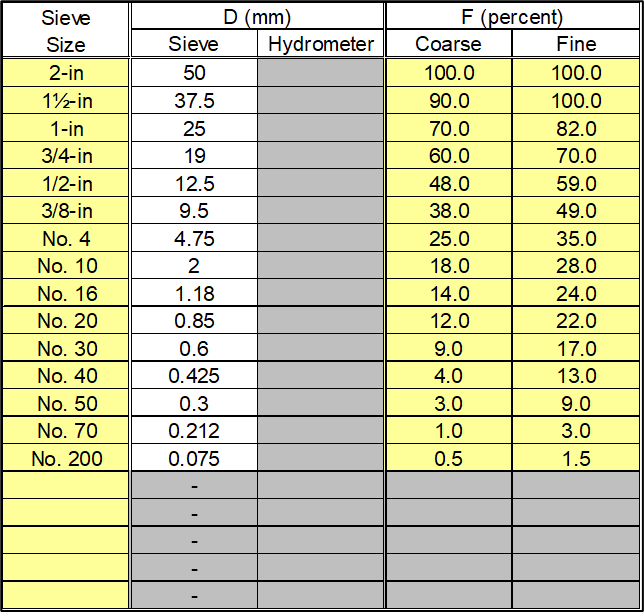
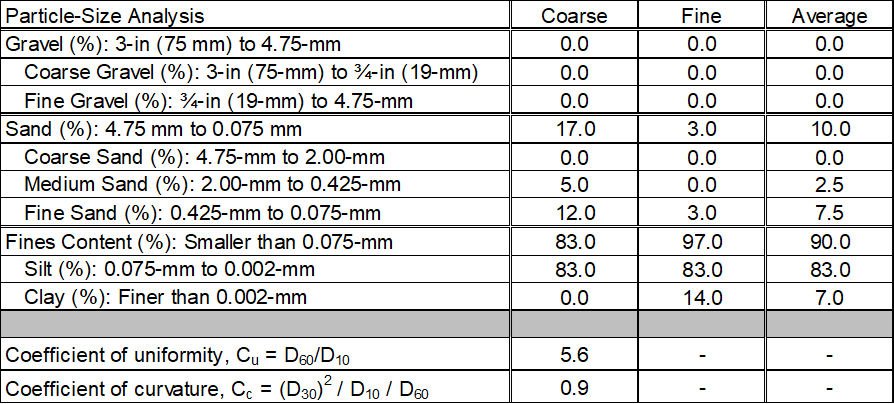
Figure is an example of the summary of the particle-size analysis for the user-specified gradations. The gravel percentage (including coarse and fine gravel percentages), sand percentage (including coarse, medium, and fine sand percentages), fines content (FC) (including estimated silt and clay percentages), coefficient of uniformity (Cu) and coefficient of curvature (Cc) for the coarsest and finest filter material are calculated according to the Unified Soil Classification System, American Society of Testing and Materials [ASTM] D2487 [?]. An average percentage is also calculated.
The coefficient of uniformity (Cu) is calculated as in Equation.
where:
D10 = particle-size diameter corresponding to 10 percent passing on the cumulative particle-size distribution curve
D60 = particle-size diameter corresponding to 60 percent passing on the cumulative particle-size distribution curve
The coefficient of curvature (Cc) is calculated as in Equation.
where:
D30 = particle-size diameter corresponding to 30 percent passing on the cumulative particle-size distribution curve
If a gradation does not specify the particle size corresponding to 10 percent passing, 30 percent passing, or 60 percent passing, Cu and Cc are not calculated.
Filter Gradation After Segregation or Washout
The filter material may be susceptible to segregation or internal instability. Segregation is the tendency of large particles in a given mass of aggregate to gather together when the material is loaded, transported, or otherwise disturbed.
Segregation can cause pockets of coarse zones that may not be filter-compatible with the material being protected. FEMA (2011) [?] provides filter design guidance to limit segregation potential based on the maximum D90F and the minimum D10F. This segregation criterion considers only the design gradation, but the potential for segregation during storing, hauling, dumping, spreading, and compacting must also be considered. This is more subjective and relies on indirect evidence such as construction photographs.
Internal instability describes the loss of soil particles due to seepage. Finer particles in the soil can move within the soil mass under the forces imposed by seepage flow. Gap-graded or broadly graded soils are examples of internally unstable soils. The RMC Internal Instability Toolbox assesses the susceptibility of the filter material to internal instability. Soils that are susceptible to internal instability are also susceptible to segregation.
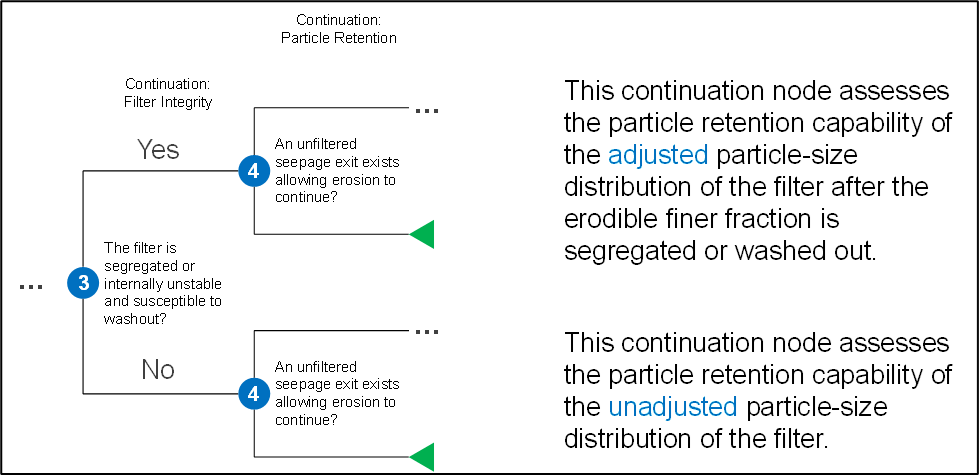
Segregation and internal instability result in a coarser filter. Figure illustrates an event tree node that can be added to explicitly consider the likelihood of the filter being segregated or internally unstable during a risk assessment. The particle retention evaluation must consider two gradations of the filter material. Perform the first evaluation using the original or stable gradation and perform the second evaluation using the adjusted gradation after segregation or washout of the erodible finer fraction.