Constricted Exit
Constricted, or non-erodible, exits consist of open joints, defects, or cracks in conduits, drains, walls, or rock. For erosion to continue, the opening size must be sufficient for the adjacent base soil particles to pass through it. This worksheet assesses the joint/defect opening size that allows erosion to continue.
Base Soil Characterization
Step 1 characterizes the base material. The range of D95B of the base soil adjacent to the open joint, defect, or crack is obtained from the Base Gradation worksheet, where the finest and coarsest D95B of the adjacent base soil after regrading (if applicable) are interpolated using a logarithmic scale for particle size and linear scale for percent passing. Figure is an example of step 1.

Open Joint, Defect, or Crack Characterization
Step 2 characterizes the open joint, defect, or crack, and the joint/defect opening size (JOS) is input. The user-specified JOS and range of D95B of the adjacent base soil are portrayed on a cumulative particle-size plot to visually compare their relative sizes, as shown in Figure. The y-axis (percent passing by weight) is truncated at 90 percent passing since only the particle-size diameter corresponding to 95 percent passing is used in the evaluation. The size of the open joint, defect, or crack is depicted with a vertical back line at the JOS and horizontal lines that extend infinitely smaller since a logarithmic scale is used. The range of D95B displays as a red horizontal line.
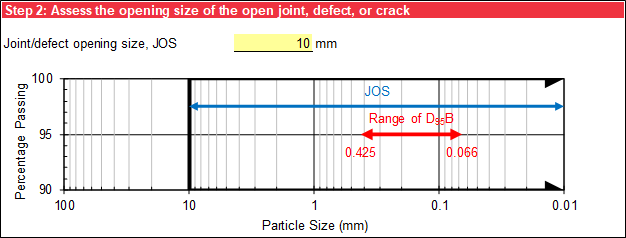
The plot options for this chart are illustrated in Figure. The minimum and maximum values for the x-axis (particle size) are user-specified.

Likelihood of Continuation
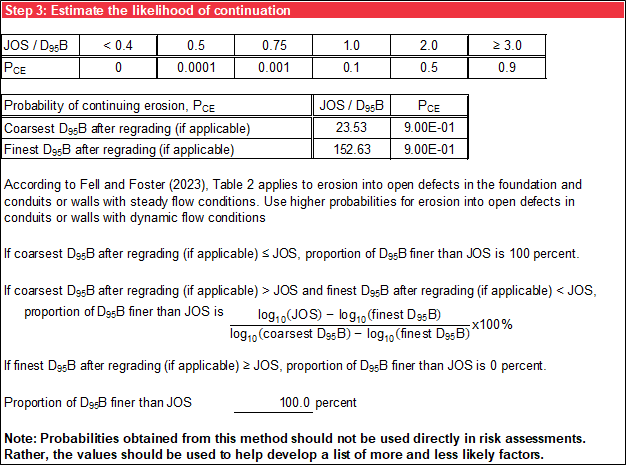
Step 3 estimates the probability of continuing erosion (PCE) using the procedure of Fell and Foster (2023) [?]. The JOS that allows continuing erosion of the adjacent base soil (JOSCE) is between D95B and 3D95B. Sherard et al. (1984) [?] concluded that uniform filters act similar to laboratory sieves with an opening sieve size approximately equal to . The D95B criterion assumes the Foster and Fell (2001) [?] continuing erosion criterion (see section 8.4) applies to erosion into an open joint, defect, or crack, and the crack width is equivalent to the filter opening size of the voids between the particles in a filter. The 3D95B criterion is based on the JOS for cement grout to penetrate and flow along the opening of joints in rock.
The probabilities shown in Table considered these limits. In the table, PCE is a function the ratio of the JOS to the finest D95B of the adjacent base soil after regrading (if applicable). If is less than 0.4, zero is displayed. If is greater than or equal to 0.4 and less than 0.5, "<0.0001" is displayed. Intermediate values between 0.5 and 3.0 are interpolated using a z-variate scale for probability and a linear scale for the ratio .
| JOS / D95B | < 0.4 | 0.5 | 0.75 | 1.0 | 2.0 | ≥ 3.0 |
|---|---|---|---|---|---|---|
| PCE | 0 | 0.0001 | 0.001 | 0.1 | 0.5 | 0.9 |
According to Fell and Foster (2023) [?], these probabilities apply to erosion into open defects in the foundation and conduits or walls with steady flow conditions. Use higher probabilities for erosion into open defects in conduits or walls with dynamic flow conditions.
If the coarsest D95B of the adjacent base soil after regrading is less than or equal to the JOS (coarsest D95B ≤ JOS), the proportion of the D95B finer than the JOS is 100 percent. If the finest D95B of the adjacent base soil after regrading is greater than or equal to the JOS (finest D95B ≥ JOS), the proportion of the D95B finer than the JOS is 0 percent. If the coarsest D95B of the adjacent base soil after regrading (if applicable) is greater than the JOS and the finest D95B after regrading (if applicable) is less than the JOS, the proportion of the D95B finer than the JOS is calculated as in Equation. Figure is an example of step 3.