

Overview of RMC-RFA Methodology
Basic Framework
There are two primary components of randomness in reservoir stage exceedance probabilities: natural variability and knowledge uncertainty. Natural variability is best described as the effect of randomness and is a function of the system (Vose, 2008) [?]. It is not reducible through either study or further measurement. For example, a flow-frequency curve describes the natural variability in flow. Knowledge uncertainty is the lack of knowledge about parameters that characterize the system being modeled. Knowledge uncertainty can be reduced through further measurement or study. For example, the confidence intervals, or uncertainty bounds, around a flow-frequency curve describe the knowledge uncertainty in the statistical flow-frequency curve parameters.
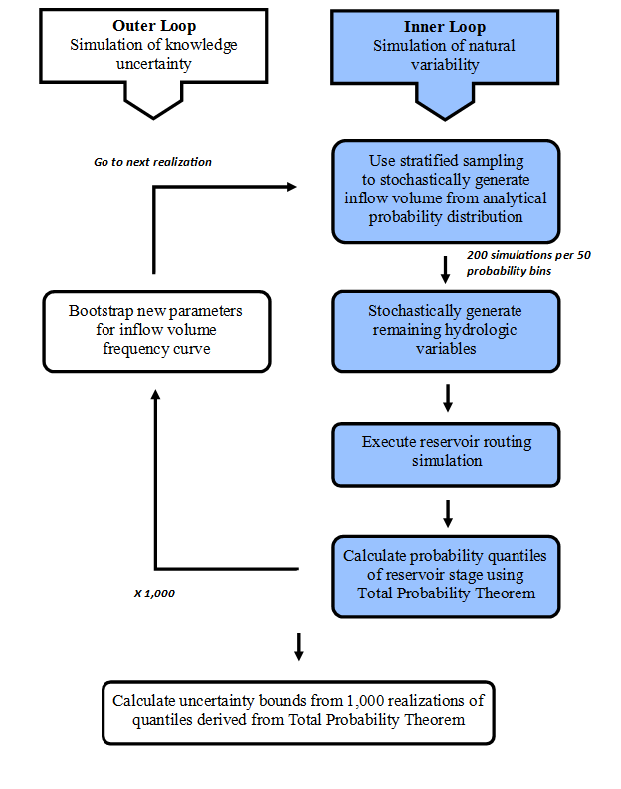
RMC-RFA produces a reservoir stage-frequency curve with uncertainty bounds by utilizing a deterministic flood routing model while treating the inflow volume, the inflow flood hydrograph shape, the seasonal occurrence of the flood event, and the antecedent reservoir stage as uncertain variables rather than fixed values. In order to quantify both the natural variability and knowledge uncertainty in reservoir stage-frequency estimates, RMC-RFA employs a two looped, nested Monte Carlo methodology. The natural variability of the reservoir stage is simulated in the inner loop defined as a realization, which comprises many thousands of simulated flood events, while the knowledge uncertainty in the inflow volume frequency distribution is simulated in the outer loop, which comprises many realizations. The basic construct of the simulation procedure employed by RMC-RFA is illustrated in Figure.
Stratified Sampling Approach
Standard Monte Carlo sampling procedures are computationally inefficient. The bulk of the computation burden is expended on sampling flood events in the range of exceedance probabilities that are not typically important in risk assessments. For example, in a Monte Carlo simulation with 10,000 events, there are only 1,000 events that provide any information about flood events with an annual exceedance probability less than 1 in 10.
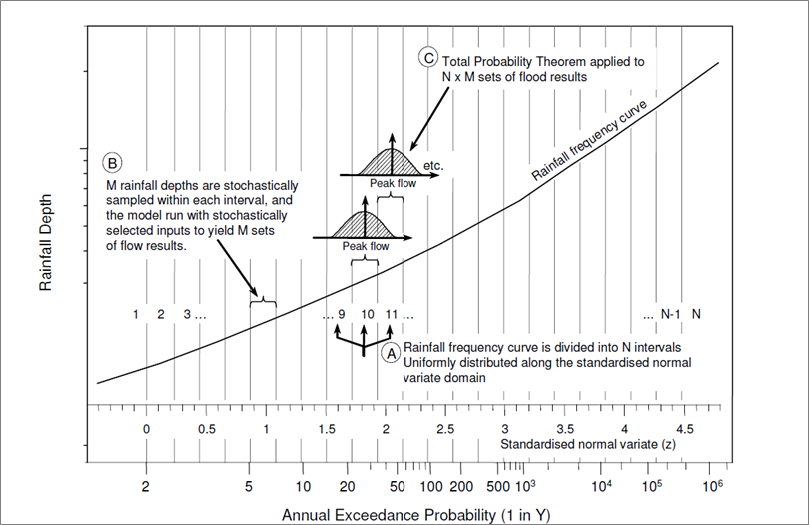
Consequently, to ensure computational effort is focused on extreme flood events, RMC-RFA uses a stratified sampling approach based on procedures outlined in Nathan and Weinmann (2013) [?] and Nathan et al. (2016) [?]. The procedure involve first dividing the inflow volume-frequency curve into 50 bins uniformly spaced over the Extreme Value Type I (EVI) probability domain. Within each bin, 200 inflow volumes are stochastically sampled. For each sampled inflow volume, a reservoir routing simulation is executed using a set of model parameters (as described in the table below) that are sampled using standard Monte Carlo procedures. This process performed for each of the 200 sampled inflow volumes within each of the 50 bins, for a total of 10,000 reservoir routing simulations. The routing results from the 10,000 simulations are combined using the Total Probability Theorem to produce a reservoir stage-frequency curve. A conceptual schematic of the stratified sampling approach can be seen in Figure.
With only 10,000 simulations, accurate reservoir stage-frequency results can be attained within the exceedance probability range of 0.99 to ~10-8 using the stratified sampling approach. Conversely, with only 10,000 simulations, standard Monte Carlo sampling procedures will only offer accurate results within the range of 0.99 to ~10-4.
| Input Parameter | Dependency | Statistical Distribution | Sampling Approach |
|---|---|---|---|
| Inflow Volume | Independent | Analytical | Stratified |
| Inflow Hydrograph Shape | Independent | Empirical | Monte Carlo |
| Flood Season | Independent | Empirical | Monte Carlo |
| Reservoir Starting Shape | Flood Season | Empirical | Monte Carlo |
The Parametric Bootstrap
A significant portion of the knowledge uncertainty in the reservoir stage-frequency curve is due to sampling error, which is caused by observing the sample instead of the population. The sampling error is the difference between the sample statistic used to estimate the population parameter, such as the mean or variance, and the actual but unknown value of the parameter. Sampling error is a function of the record length of observed reservoir inflow, stage, and discharge data. As the record length increases, the sampling error decreases; thus, the knowledge uncertainty decreases.
The uncertainty due to sampling error can be estimated using the bootstrap, which was originally introduced in 1979 as a computer-based method for estimating standard errors by Dr. Bradley Efron in his paper "Bootstrap methods: Another look at the jackknife" (Efron, 1979) [?]. Typical applications of the bootstrap method use the empirical cumulative distribution function as the approximating distribution for the observed data. However, RMC-RFA uses the parametric bootstrap, which is a variation of the general bootstrap, in which the approximating distribution for the observed dataset is an analytical probability distribution. The bootstrap procedure in RMC-RFA involves the following steps:
- Randomly sample N inflow volumes from a user-defined volume-frequency curve (N is equal to the effective record length of the annual maxima inflow volume data).
- Estimate the statistical parameters of interest (such as mean, standard deviation, and skew) from the bootstrapped sample of size N.
- Using the new statistical parameters, fit a new inflow volume-frequency curve.
- Repeat steps 1 through 3 for a sufficiently large number of realizations in order to derive uncertainty bounds.
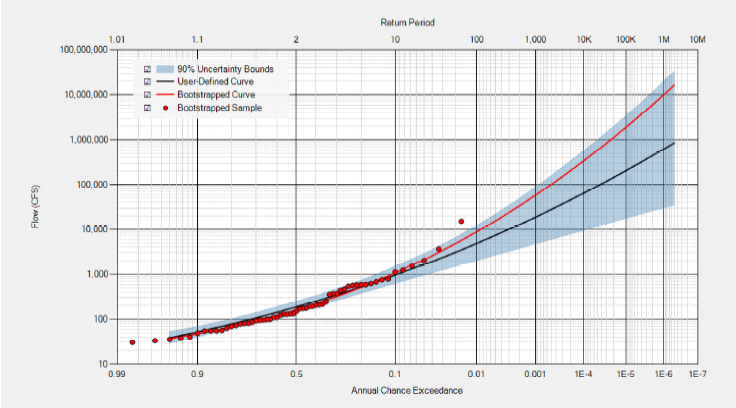
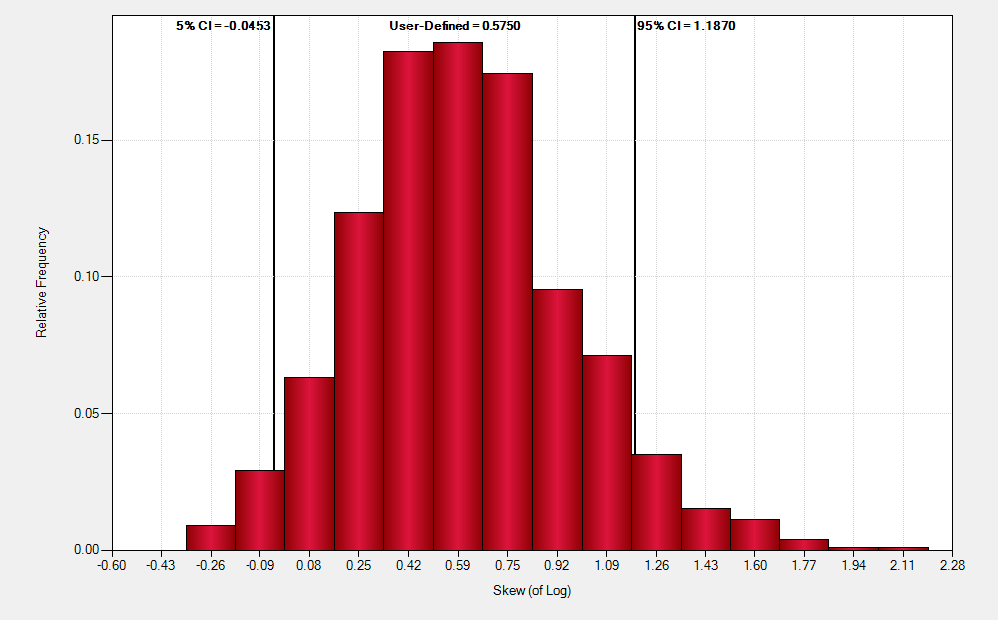
An illustration of steps 1 through 3 is shown in Figure. A histogram representing the uncertainty in skew (of log) developed from 1,000 bootstrap realizations is shown in Figure. For greater details on the parametric bootstrap, see Efron’s "An Introduction to the Bootstrap" (Efron and Tibshirani, 1998) [?].
Limitations
Every stochastic simulation system has limitations due to the choices made in the design and development of the software. Stochastic simulation with RMC-RFA permits the exploration of an extensive variety of possible flood scenarios for reservoirs as compared to more traditional deterministic approaches. However, users should understand the limitations associated with the stochastic simulation methods employed by RMC-RFA.
Knowledge Uncertainty
In RMC-RFA, knowledge uncertainty in the form of sampling error is estimated using the parametric bootstrap. However, there are other sources of knowledge uncertainty that are not accounted for in RMC-RFA, such as measurement error, model uncertainty, reservoir operation uncertainty, and others. In addition, in the current version of the software, only the knowledge uncertainty in the inflow volume-frequency distribution is estimated. Future versions of the software will account for knowledge uncertainty in flood seasonality and stage duration relationships.
Empirical Distributions
In the current version of RMC-RFA, the statistical properties of the inflow hydrograph shapes, the flood seasonality, and the reservoir starting stage are described with empirical distributions. Empirical probabilities rely on observed data, which is often scarce. Therefore, there are limitations when estimating probabilities very close to one or zero. Empirical distributions would require very large observed data sets to have accuracy in these probability ranges. To overcome this limitation, RMC-RFA allows users to manually enter quantile estimates for these inputs to allow more flexibility.
Reservoir Routing
The current version of RMC-RFA utilizes the Modified Puls method for routing, and only requires a stage-storage-discharge relationship. Therefore, RMC-RFA cannot simulate complex reservoir operations, such as those that require seasonal guide curves, complex rules, or downstream constraints on releases. Consequently, RMC-RFA should only be used as a screening level tool for those reservoirs requiring complex operations. However, for most dams in the USACE portfolio, RMC-RFA will provide valid results stage-frequency estimates above the spillway invert to beyond the top of dam elevation. In this elevation range, many reservoirs have uncontrolled spillway flow, which can be modeled accurately using only a stage-storage-discharge relationship. Future versions of the software will provide more flexibility in simulating complex operations.
Simulation Convergence
The current version of RMC-RFA does not allow the user to simulate until convergence. As such, there are sampling errors associated with the stochastic simulation. The precision in the simulated uncertainty bounds, expected, and median frequency curves is based on the number of bootstrap realizations, the number of stratification bins, and the number of simulated events per bin. RMC-RFA allows the user to simulate up to 10,000 realizations, which should be sufficient in most cases. However, currently the user cannot set the number of stratification bins or simulated events per bin. Future versions of the software will allow the user to set convergence criteria.