Overtopping Evaluation Process using WinDAM C
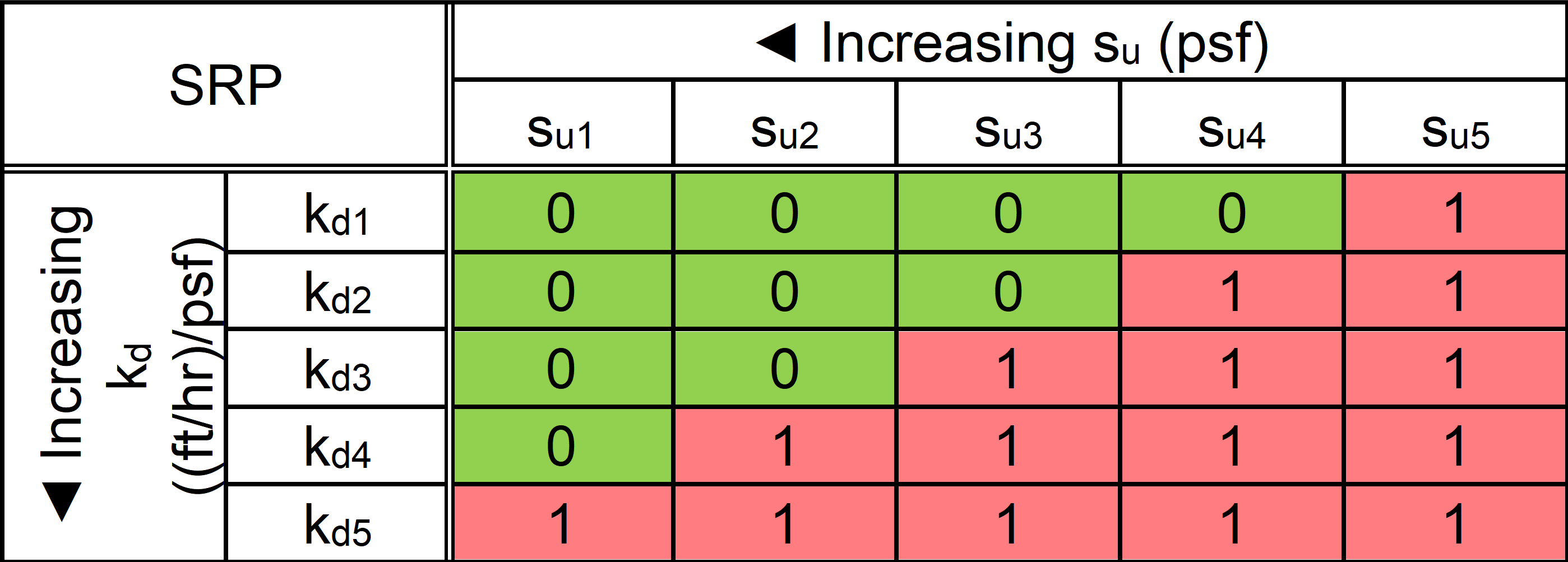
To inform the evaluation of embankment overtopping performance (i.e., likelihood of failure given the loading), a table (or matrix) of conditional probability of failure (i.e., system response probability, SRP) as a function of erodibility coefficient (kd) and undrained shear strength (su) is constructed using WinDAM C. For efficiency, critical shear stress (τc) is typically conservatively assumed to be zero, and the other input parameters are modeled as discrete variables.
If the selected combination of kd and su result in a breach initiation time greater than zero in WinDAM C (i.e., headcut breaches upstream crest regardless of breach size), a value of 1 is entered in the table. Otherwise, a value of 0 for no failure/breach is entered in the table. Users typically quickly get a feel for where failure occurs to focus their efforts and efficiently populate the matrix.
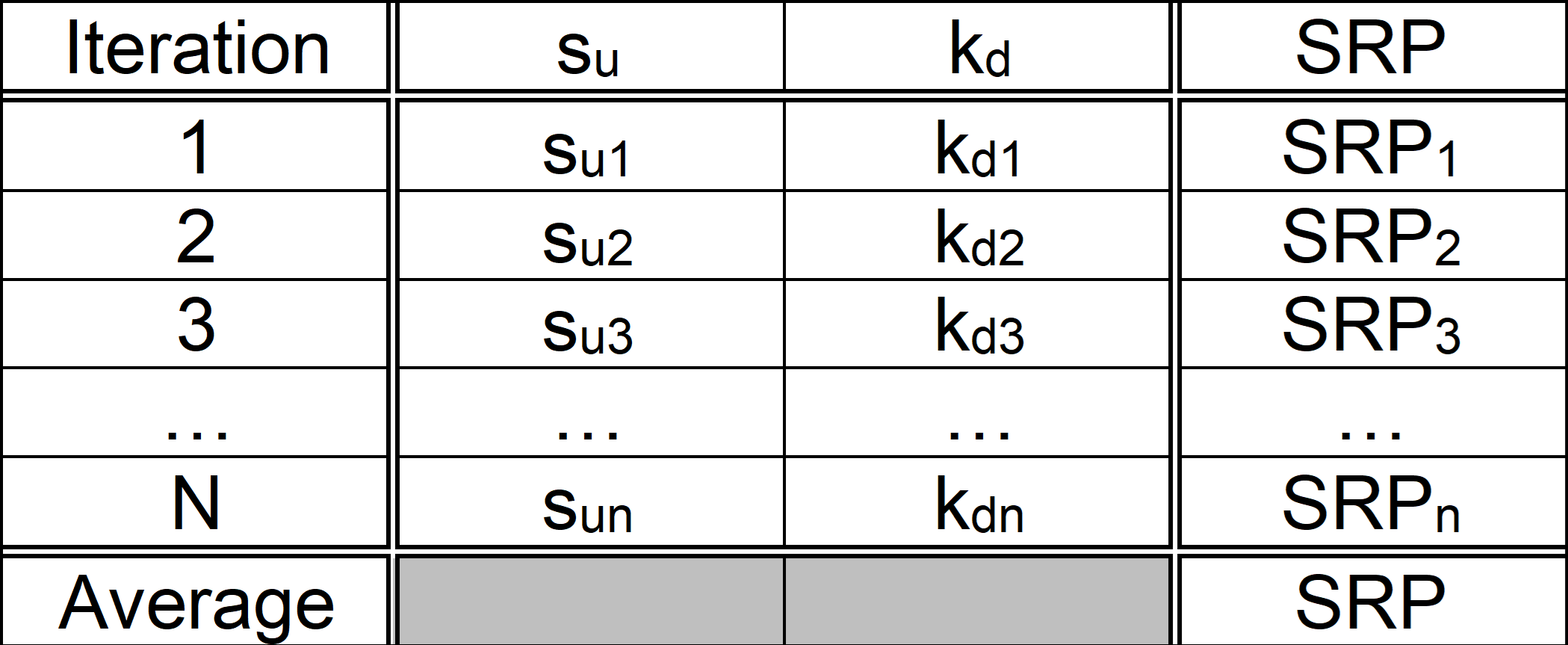
The process is repeated for a series of hydrographs that are scaled so that the peak stage corresponds to the peak overtopping depths of interest (e.g., 0.5, 1, 1.5, 2, 3 ft, etc.) to fully assess the system response. The end-product of this phase of the evaluation is a series of system response matrices corresponding to the peak overtopping depths of interest. A generic example is shown in Figure.
The toolbox performs a probabilistic analysis using 1,000 iterations. Values of kd and su are randomly sampled based on a user-specified triangular distribution. The toolbox assumes kd and su have a -1.0 correlation (perfectly negative). This will be conservative.
Although not required to perform a probabilistic analysis, Palisade @RISK software (standalone version or as part of the Palisade DecisionTools Suite) can customize the probabilistic analysis. If a probabilistic analysis is selected using @RISK to customize the probabilistic analysis, the minimum, most likely, and maximum values are input, and an @RISK formula for a triangular distribution is used as a default. However, a valid @RISK distribution can be input in lieu of this default formula. The correlation matrix named "Corr" must be added to the end of the user-specified input distributions for kd and su using the @RISK RiskCorrmat property function. Use RiskCorrmat(Corr,1) for kd and RiskCorrmat(Corr,2) for su.
A user-defined function (UDF) performs two-way linear interpolation to obtain the SRP for each iteration (kd-su pair). The iteration results are tabulated, and the average SRP value is calculated as shown in Figure. This process is repeated for each peak overtopping depth.